Part 2 of 3
Name of code: P1694(19) - Bus Communication with Engine ModuleWhen monitored: Continuously with key on.
Set condition: If no bus messages are received from the Powertrain Control Module (PCM) for 10 seconds.
Theory of operation: The TCM communicates with the PCM using the communication bus. It relies on certain information to function properly. The TCM continuously monitors the bus to check for messages broadcast from the PCM.
Transmission Effects: Delayed 3-4 shifts. No EMCC and early 3-4 shifts for a few minutes after engine is started. Generally poor shift quality.
Possible causes:
- Open or shorted bus circuit
- TCM
- PCM
Name of code: P0706(28) - Check Shifter Signal
When Monitored: Continuously with the key on.
Set Condition: Any occurrences of an invalid PRNDL code which lasts for more than 0.028 second.
Theory of Operation: The C1 through C5 (TRS T1, TRS T2, TRS T3, TRS T41, and TRS T42) sense circuits communicate the shift lever position to the TCM. Each circuit is terminated at the transmission with a switch. Each switch can be either open or closed, depending on the shift lever position. The TCM can decode this information and determine the shift lever position. Each shift lever position has it own unique combination of closed and open switches. This is called a PRNDL code. There are 5 switches, therefore: there are many possible combinations of open and closed switches (codes). There are 12 valid codes, two for neutral, one for each other gear position (5), and five temporary (transition zone) codes. The remainder of the codes should never occur, these are called invalid codes.
Transmission Effects and possible causes:
(This code alone will not illuminate the MIL)
- Excessive metal debris in the transmission oil pan
- Worn Code Plate. Check for heavy wearing by TRS switch contacts
- Intermittent C1 through C5 (T1, T2, T3, T41 or T42) circuits. Check for corrosion, terminal push-outs or spread terminals at 60-way TCM connector and/or 23-way transmission connector.
- TRS connector not plugged in, or unplugged with the key on.
- TRS C1 through C5 (T1, T2, T3, T41, or T42) circuit(s) are either open, shorted to ground, or shorted to 12 volts.
- TRS
- TCM
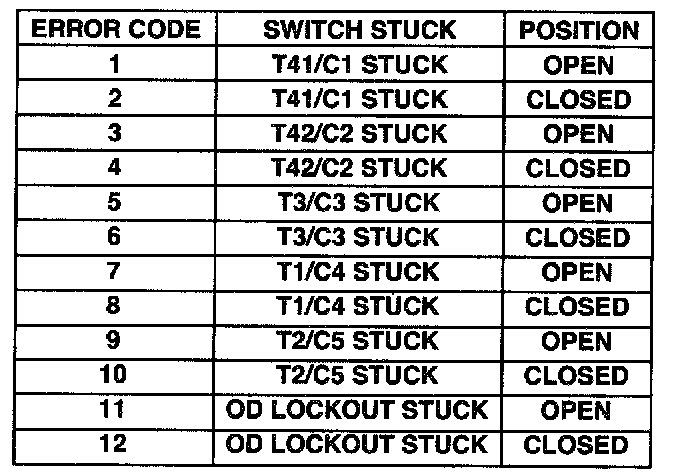
SHIFT LEVER ERROR CODES REPORTED BY THE DRBIII (R)
NOTE: If you are using the transmission simulator and do not push the OD off button in the vehicle when performing a Shift Lever position test, you will receive a code 11 OD lockout stuck open.
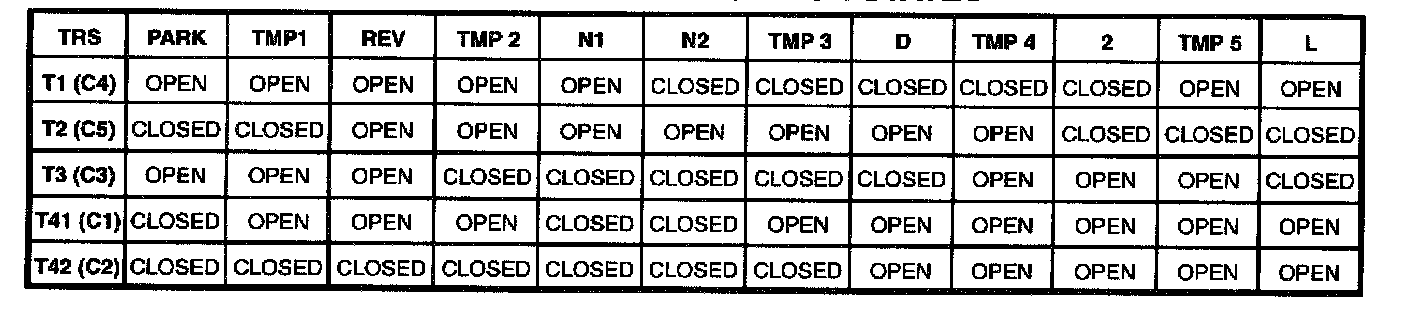
45RFE/545RFE TRS SWITCH STATES
Name of code: P0120(29) - Throttle Position Signal
When monitored: Whenever the engine is running.
Set condition: This code is set if the throttle angle goes out of range or changes erratically i.e. faster than the throttle body motion should occur.
Theory of operation: The Transmission Control Module (TCM) receives the throttle position signal from the Throttle Position Sensor (TPS). The TPS has a 5-volt pull up supplied from the Powertrain Control Module (PCM). The signal is checked for out-of-range as well as intermittent (excessive signal changes).
Transmission Effects: The MIL will illuminate, the transmission system will not go into limp-in mode. The TCM will use a "calculated throttle angle" supplied by the PCM over the communication bus. If the communication bus is unavailable, the TCM will use a default throttle angle of 24( degrees for the key start in which the code was set. The TCM will try to use the TPS signal again on the next key start. The vehicle may experience extremely erratic transmission shifting just prior to setting the code. If the intermittent does not last long enough to set the code, the customer will say that the transmission violently hunts between gears.
Possible causes:
- Open or shorted TPS signal and/or ground circuits
- TCM connector problems
- Failed TPS or TPS connector (Check PCM DTC's)
- PCM
- TCM
Name of code: P0944(35) - Loss Of Prime
When monitored: If the transmission is slipping in any forward gear and all the pressure switches are indicating no pressure, a loss of prime test is run.
Set condition: If the transmission begins to slip in any forward gear, and all pressure switches are open, a loss of prime test begins. All available elements are momentarily turned on by the Transmission Control Module (TCM) to see if pump prime exists. The code is set if none of the pressure switches respond. The TCM will continue to run the loss of prime test until pump pressure returns. Note: Loss of Prime test is not run when transmission temperature is "Super Cold".
Theory of operation: The loss of prime test is used to prevent transmission defaults, which can be caused by a lack of pump prime.
Transmission Effects: Vehicle will not move or transmission slips. Normal operation will continue if pump prime returns.
Possible causes:
- Low transmission fluid level
- Transmission fluid filter improperly installed (Seal installed onto filter neck instead of into pump bore, seal not fully seated against pump bore housing, filter neck not engaged into pump, bolts loose or O-ring missing or damaged)
- Transmission fluid filter clogged, damaged or cracked
- Transmission has massive hydraulic leak (valve body pipe plugs missing, etc.)
- Transmission oil pump
- Transmission oil pump drive is sheared or damaged
- PRNDL indicates a valid OD code in the hydraulic reverse position
Name of code: P1790(36) - Fault Immediatel After Shift
When monitored: When a speed ratio error DTC (50 through 55) is stored.
Set condition: This code is set if the associated speed ratio code is stored within 1.3 seconds after a shift.
Theory of operation: This code will only be stored along with a 50 series code. If this code is set, it indicates a probable hydraulic (line pressure) or mechanical problem exists. When this code is set, diagnosing the transmission should be based on the associated speed ratio code and mechanical causes should be considered first.
Transmission Effects: None
Possible causes:
- Mechanical causes as listed under associated speed ratio code.
- Inadequate line pressure
- Cut or damaged clutch piston seals
Name of code: P1775(37) - Solenoid Switch Valve Latched in TCC Position
When monitored: During an attempted shift into 1st gear.
Set condition: This code is set if 6 unsuccessful attempts are made to get into Ist gear, with transmission temp above 27°C (80°F), in one given key start.
Theory of operation: The solenoid switch valve (SSV) controls the direction of the transmission fluid when the LR solenoid is energized. The SSV will be in the downshifted position in 1st gear, thus directing the fluid to the L-R clutch circuit. In 2nd, 3rd, and 4th, it will be in the upshifted position and directs the fluid into the torque converter clutch (TCC).
When shifting into Ist gear, a special hydraulic sequence is performed to ensure SSV movement into the downshifted position. The L-R pressure switch is monitored to confirm SSV movement. If movement is not confirmed (the L-R pressure switch does not close), EMCC is inhibited until SSV operation is confirmed.
Transmission Effects: Transmission will have 1st gear, and no EMCC operation. The MIL will illuminate after 5 minutes of
no EMCC operation.Possible causes:
- Valve body - Solenoid Switch Valve stuck in TCC position
- L-R solenoid armature or plunger broken (should also set DTC P0841 (81) and often sets P0740 (38)
- Solenoid malfunction - may also set code P0841(81)
- L-R Pressure Switch Sense circuit shorted to battery
- High idle speed
- PRNDL indicates a valid OD code in the hydraulic reverse position