Transfer Case: Description and Operation
TRANSFER CASE - NV245DESCRIPTION
NV245 Transfer Case:
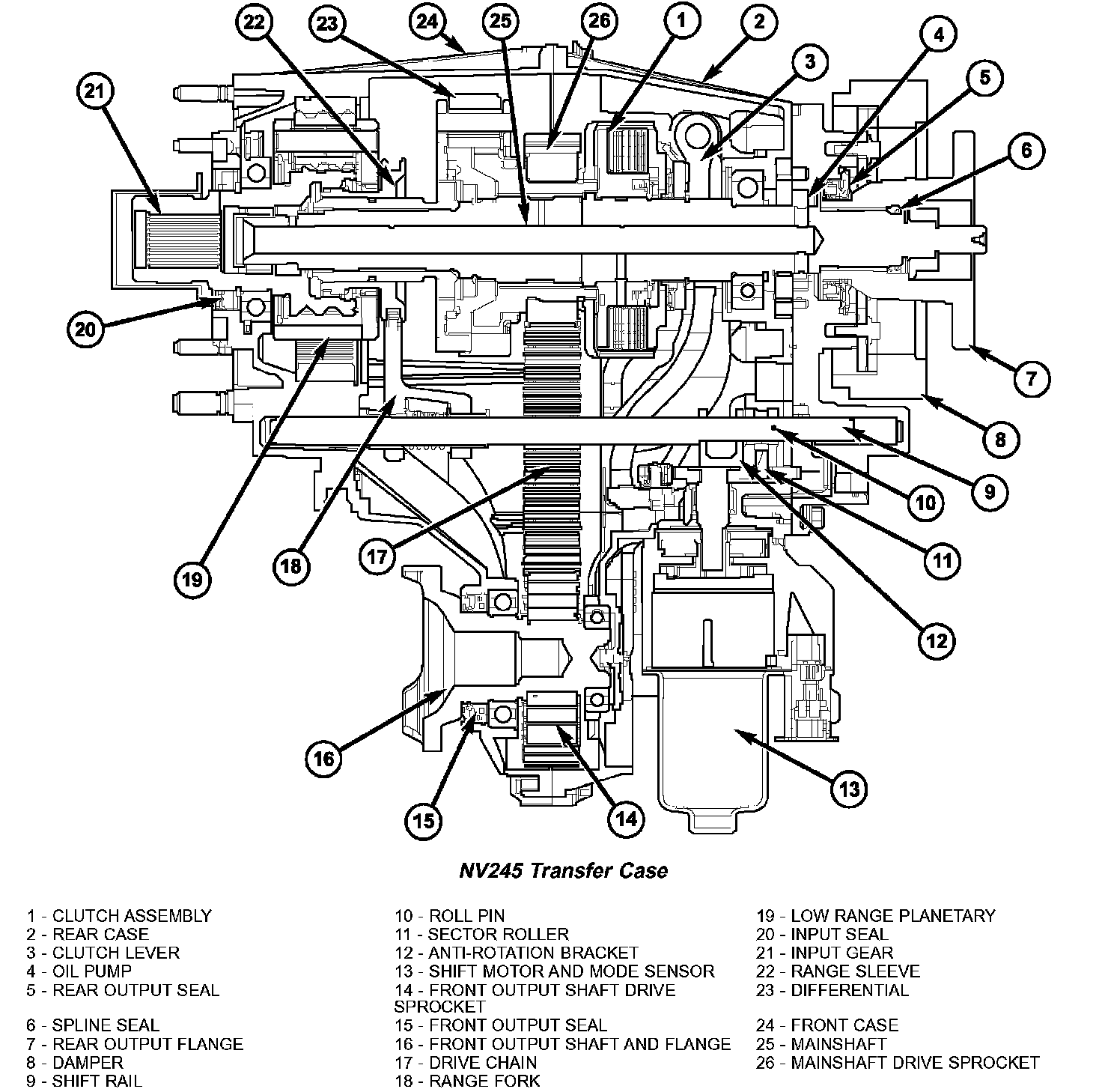
The NV245 transfer case provides Full-Time Active Four-Wheel Drive for optimum traction in a wide range of conditions and is used in Quadra-Trac II and Quadra-Drive II systems. The transfer case center differential distributes torque 48 percent to the front axle and 52 percent to the rear axle along with an electronically controlled clutch pack that is coupled to the center differential for torque biasing. The NV245 electronics provide an active system because it can anticipate and prevent slip. The transfer case can redistribute 100 percent of torque to the front or rear axle, depending on need. For added traction when traversing steep grades, rough terrain or extremely slippery/poor traction surfaces at low speeds, the transfer case can be switched into 4WD Low, which multiplies engine torque 2.72 times and locks the clutch pack for maximum traction at all times. The Neutral mode allows the vehicle to be flat towed behind another vehicle.
Electric shifting is accomplished with a T-handle transfer case lever in the shifter assembly to provide simplified operation and positive engagement of 4 Low. A pushpin button is provided to shifting the transfer case into NEUTRAL.
OPERATION
ACTIVE TRANSFER CASE CONTROLS
Controls for the NV245 transfer case active clutch (torque biasing device) are located in the Final Drive Control Module (FDCM) and communicated on the CAN C bus. The FDCM monitors wheel speeds at the front and rear axles to detect wheel slippage. A complete vehicle dynamics model calculates slip at each tire for given vehicle operating conditions. The clutch pack in the transfer case is engaged to minimize the speed difference between the front and rear axle, resulting in torque transfer to the axle with higher traction. The electronically controlled wet clutch pack uses an electric motor to actuate a sector plate. The sector plate actuates a clutch lever that applies normal force to the multi-disc wet clutch pack bridging the differential. The clutch discs are alternately splined to the front and rear driveshafts. When normal force is applied to this clutch pack, torque is transferred to equalize speed differences between front and rear axles.
TRANSFER CASE MODES
The transfer case operates in active full-time four-wheel drive (4 High Full-Time) unless the driver chooses 4-wheel drive Low or Neutral. A chrome T-handle momentary contact lever in the shifter assembly labeled 4WD Low allows the driver to select 4WD Low when a set of conditions is met. A separate Neutral push-button switch located beside the 4WD Low T-Handle is used by the operator to enter Neutral when a set of conditions is met. An indicator located in the instrument cluster indicates when 4WD Low is active. There is an indicator next to the Neutral button to indicate Neutral position as well as a message in the EVIC in the cluster that states "AWD SYSTEM IN NEUTRAL."
ELECTRIC SHIFT MECHANISM
All of the switching functions use resistive multiplexing to tell the Final Drive Control Module (FDCM) which mode to select. The FDCM operates an electric motor that shifts the transfer case. The FDCM obtains additional data necessary for operation and to provide diagnostic outputs via the CAN network. The electric shift mechanism helps protect the transfer case against internal damage by preventing a shift to 4WD Low range unless the vehicle speed is below 3 mph (5 km/h) and the transmission is in Neutral. To shift the transfer case into Neutral for towing the vehicle, the pushpin button next to the range shifter must be depressed with a pen and a set of shift conditions must be met.
Through communication with various modules over the CAN network, the FDCM knows vehicle speed, automatic transmission position, engine run status, ignition status and brake switch position, some or all of which are required to determine whether shifts between 4WD Low, 4WD High or Neutral will be allowed. Diagnostic outputs include fault codes and the ability to "read" switch position and position sensor output. A warning message in the EVIC in the cluster indicates if a malfunction occurs in the electric shift system. A motor and encoder (position sensor) replace a lever on the shaft that shifts the transfer case. When a shift is called for, the motor turns the shaft until the sensor indicates that the correct angular position has been reached. To prevent the transfer case from making unintended shifts, the switch must be in position for 0.25 seconds before a shift will take place. A shift can take up to 1-2 seconds from the time that the switch is moved for full travel. If the shift is not completed in the appropriate time, the module will repeat the action up to five times. Misalignment of the gears in the transfer case may block a shift, in which case the sensor will detect this; the motor will then reverse and try again to complete the shift. Blockage can occur if the vehicle is stationary when the shift is initiated, but if the vehicle is moving as recommended when the shift is initiated, blockage is unlikely. If the shift is not completed after five attempts, the cluster indicator will flash and the driver will have to return the switch to its former position and repeat the operation.