Monitors, Trips, Drive Cycles and Readiness Codes
Drive Mode Test Procedure Flow Chart:
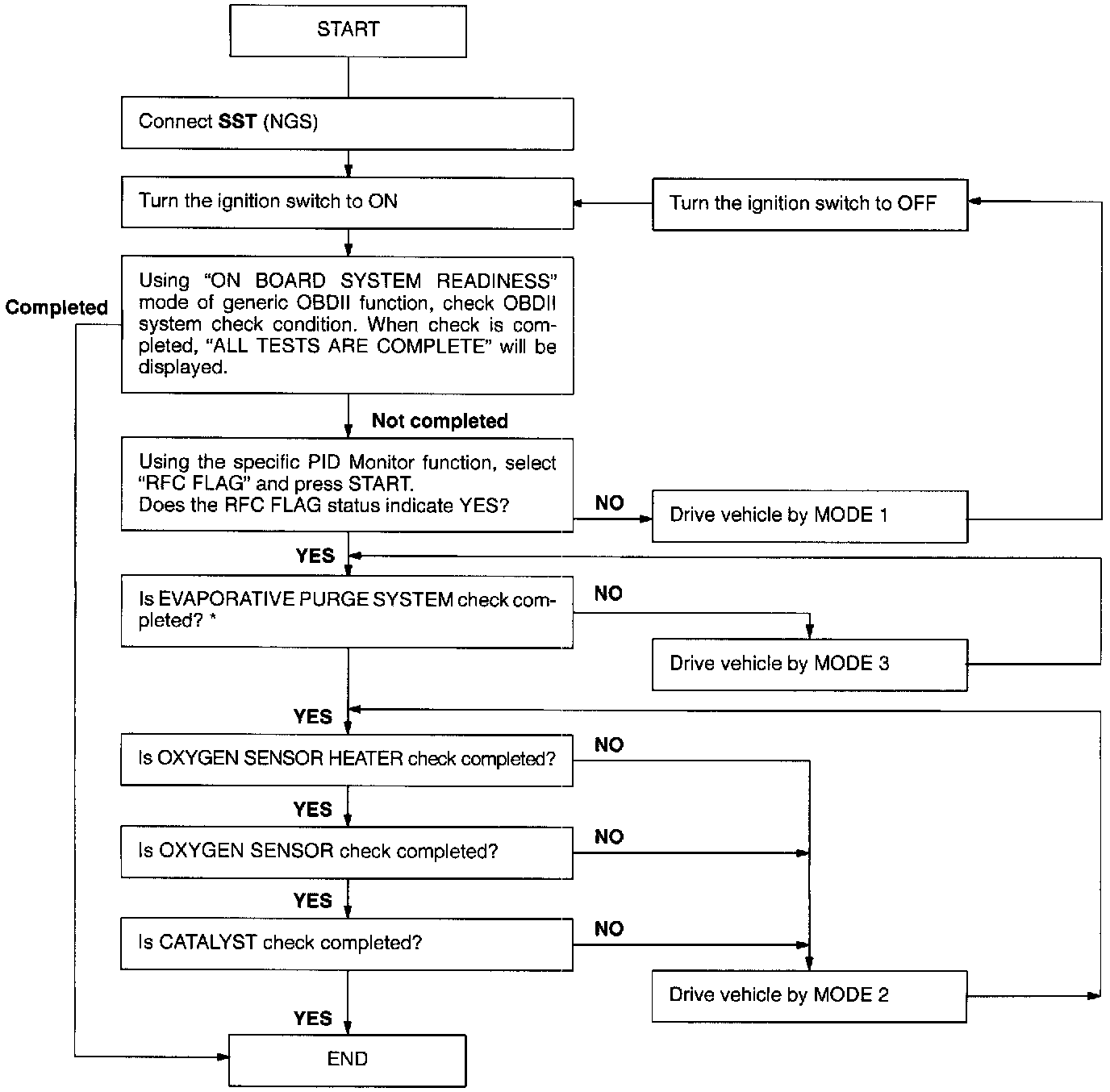
NOTE:
- Disconnecting the battery will reset the memory. Do not disconnect the battery during and after this procedure.
- Vehicle speed and engine speed detected by the PCM may differ from that indicated by the speedometer and the tachometer. Check the vehicle speed and engine speed during driving mode by using the Special Service Tools (SST)s New Generation Star (NGS) tester.
- If the OBD II system check is not completed while the drive cycle procedure is carried out, the following cause is guessed.
1. The OBD II system detects the malfunction.
2. The drive cycle procedure is not completed correctly.
AFTER REPAIR PROCEDURE
1. After repairs, connect the NGS to the data link connector 2.
2. Select "CLEAR DIAGNOSTIC CODES" function and erase diagnostic trouble codes from the NGS memory.
3. Carry out OBD II drive cycle procedure twice.
4. Start the engine.
5. Perform diagnostic trouble code inspection again and verify that no diagnostic trouble codes are displayed.
* Verify that all of the following conditions are satisfied
- Engine coolant temperature is 0 - 35°C (32 - 95°F)
- Intake air temperature is 10 - 6O°C (50 - 140°F)
- Barometric pressure is 72.0 kPa (21.3in.Hg) or higher
- Fuel gauge needle point within 15 - 85%
If any of there conditions is not satisfied, you can not perform Drive Mode 3. Therefore, you must go to the following steps first.
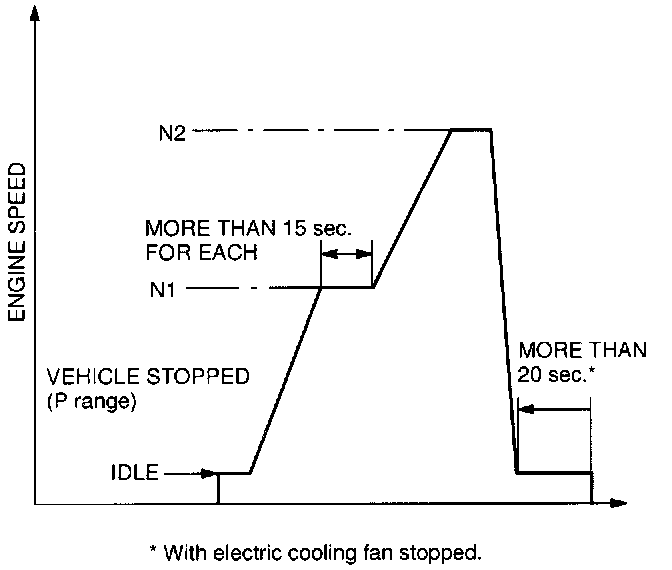
MODE 1
1. Start the engine and warm it up completely.
2. Verify that all electrical loads (headlight, blower motor and rear window defroster) and A/C loads are off.
3. Verify that the initial ignition timing and the initial idle speed are within the specification.
4. If not as specified, adjust the ignition timing and idle speed.
5. Verify-that terminals TEN and GND of the data link connector are not connected.
6. Carry out no-load racing at the specified speed for each model. Race the engine for more 15 seconds at each time. Refer to the following engine speed table for engine speed.
Engine speed table
N1 (rpm) 2000 - 3000
N2 (rpm) 4000 - 5000
7. Idle the engine for more than 20 seconds with the electric cooling fan stopped.
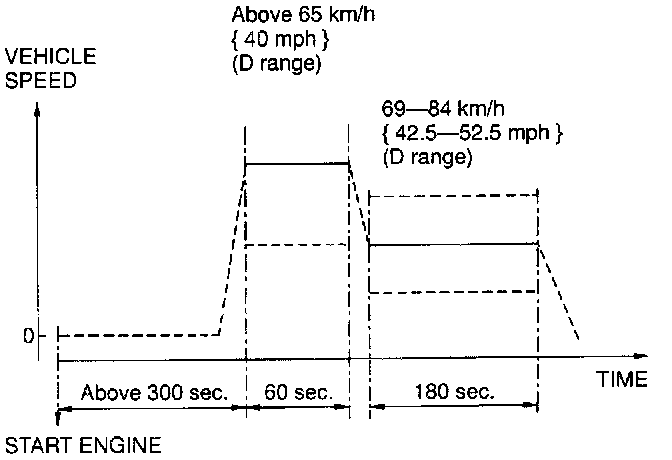
MODE 2
1. Start the engine and warm it up completely.
2. Verify that all electrical loads (headlight, blower motor and rear window defroster) and A/C load are off.
3. Drive the vehicle at the constant speed of above 65 km/h (40 mph) for 60 seconds after the above 300 seconds from engine start. (D range)
4. Drive the vehicle at the constant speed 69 - 84 km/h (42.5 - 52.5 mph) for 180 seconds. (D range)
NOTE: Driving mode before the constant speed driving is not specified.
MODE 3
1. Verify that all following conditions are satisfied.
- Engine coolant temperature is 0 - 35°C (32 - 95°F).
- Intake air temperature is 10 - 60°C (50 - 140°F).
- Barometric pressure is 72.0 kPa (21.3 in.Hg) or higher.
- Fuel gauge needle points within 15 - 85 %.
2. Start the engine and race it at 3,500 rpm for 200 seconds to warm it up completely.
3. Within 240 seconds after engine start, start the vehicle and accelerate to 65 - 95 km/h (40 - 60 mph) in approximately 20 seconds.
4. Drive the vehicle at the constant speed of 65 - 96 km/h (40 - 60 mph) till 360 seconds after engine start.