Service Port HVAC: Service and Repair
Evacuating and Charging Valve, Low and High Pressure Side
Special tools, testers and auxiliary items required
• Robinair A/C Service Unit (ROB 134APF) or newer model
• Torque Wrench (V.A.G 1783) (2 to 10 Nm)
• 1/4" Ratchet Insert (VAS 6234)
• Socket for A/C Valves (T10364)
There is a danger of ice-up.
Refrigerant leaks out if refrigerant circuit is not discharged.
Refrigerant must be extracted before opening the refrigerant circuit. If the refrigerant circuit is not opened within 10 minutes after extracting it, pressure may build up in the circuit again. The refrigerant must be extracted again.
Removing
• Extract the refrigerant using the (ROB 134APF) (or succeeding model).
• Environmentally hazardous draining of refrigerant is an offense punishable by law.
• See notes, refer to => [ Repairing Vehicles Equipped with A/C and Handling Refrigerants ] Repairing Vehicles Equipped with A/C and Handling Refrigerants.
- Extract the refrigerant with the (ROB 134APF) (or newer models) from the refrigerant circuit.
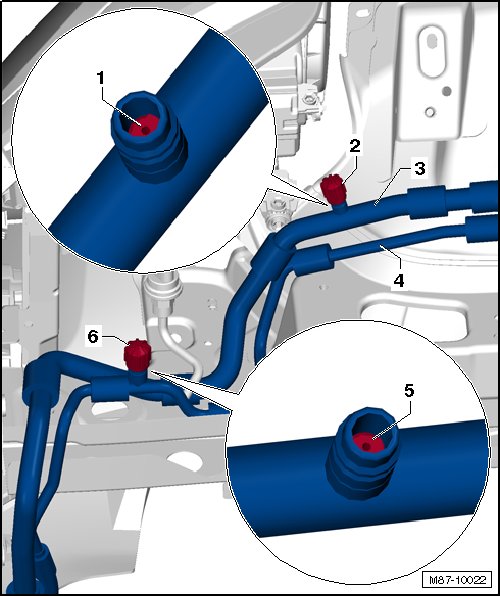
- Remove the evacuating and charging valve caps - 2 - and - 6 - for low pressure and high pressure sides.
- Remove the evacuating and charging valve on the low pressure side - 1 - with the (T10364/3) from the refrigerant line - 3 -.
- Remove the evacuating and charging valve on the high pressure side - 5 - with the (T10364/4) from the refrigerant line - 4 -.
Installing
Install in reverse order of removal.
• Check the evacuating and charging valve for leaks after filling the A/C System with refrigerant. Spray the connections, for example, with a soapy water and remove any remaining bubbles.