On Board Diagnostic (OBD), Function
The automatic transmission is controlled electronically and hydraulically.
The Transmission Control Module (TCM) -J217- is supplied with information from components which affect the gearshifts. It analyses this information to operate the relevant solenoid valves in the valve body. The solenoid valves direct the oil pressure produced by the ATF pump to the relevant clutches or brakes to be closed.
Malfunction Recognition Of Transmission Control Module
The term "On Board Diagnostic" relates to this electrical/ electronic control.
The Transmission Control Module -J217- features a Diagnostic Trouble Code (DTC) memory to enable the cause of the malfunction to be rapidly located in the event of an electrical/electronic component failing or if there is an open circuit in the wiring. Malfunctions are detected by electrical signals and stored in the DTC memory.
The Transmission Control Module -J217- diagnoses and stores certain types of malfunctions under various conditions. Refer to Diagnostic Trouble Code table.
If malfunctions occur in the sensors or components which are monitored, these are stored in the DTC memory with an indication of the type and the location of the malfunction.
If a malfunction exists, it is first stored as a static malfunction. If the malfunction ceases to exist, it is classified initially as a sporadic malfunction (SP).
Malfunctions which are stored as sporadic malfunctions in the DTC memory, are displayed as sporadic malfunctions when reading the DTC memory with VAG 1551 (VAG 1552). In this case, "SP" appears on the right of the DTC memory display. If the printer is switched on, the sporadic malfunction is printed out after reading the DTC memory.
Malfunctions which are stored as sporadic malfunctions in the DTC memory, are automatically erased after 40 engine cold starts (followed by transmission warming-up).
The possibilities of On Board Diagnostic can only be fully utilized with the Scan Tool VAG 1551 (or VAG 1552) in operating mode 1 "Rapid data transfer".
- Functions which the Scan Tool is able to detect, Refer to List of available functions.
The possibilities of the On Board Diagnostic (OBD) can be used with a Generic Scan Tool (GST) or with Scan Tool VAG 1551 (or VAG 1552) under address code 33. Functions of OBD, refer to Diagnostic Trouble Code (DTC) table.
Fail-Safe Functions Of The Transmission Control Module
If individual or several components or sensors fail, the Transmission Control Module -J217- activates corresponding substitute functions or backup programs. This ensures that the automatic transmission operates without any damage and the respective effect is noticeable on the operation and quality of the gearshifts.
If critical malfunctions occur and the Transmission Control Module -J217- is active, the gear engaged at that moment is maintained initially. The Transmission Control Module -J217- activates the "Fail-safe mode with active control module" as soon as the driving situation permits it while ensuring transmission security and road safety.
Fail-safe mode with active control module
- Transmission shifts out of all forward gears into hydraulic 4th gear. Torque converter clutch is open. All solenoid valves are de-energized.
- Maximum shift pressure applied to the power-transmitting elements.
- Reverse gear can be engaged. Selector lever lock is inactive (in "P, and "N").
- All the segments of the gear display light up completely.
If the Transmission Control Module -J217- fails (e.g. power failure or failure of wiring connection), the transmission immediately continues to operate in "Fail-safe mode with non-active control module".
Fail-safe mode with non-active control module
- Transmission shifts out of all forward gears into hydraulic 4th gear. Torque converter clutch is open. All solenoid valves are de-energized.
- Maximum shift pressure applied to the power-transmitting elements.
- Reverse gear can be engaged. Selector lever lock is inactive (in "P" and "N").
- All the segments of the gear display are dark.
- The Transmission Control Module-J217- is completely inoperative and it is not possible to initiate On Board Diagnostic (OBD).
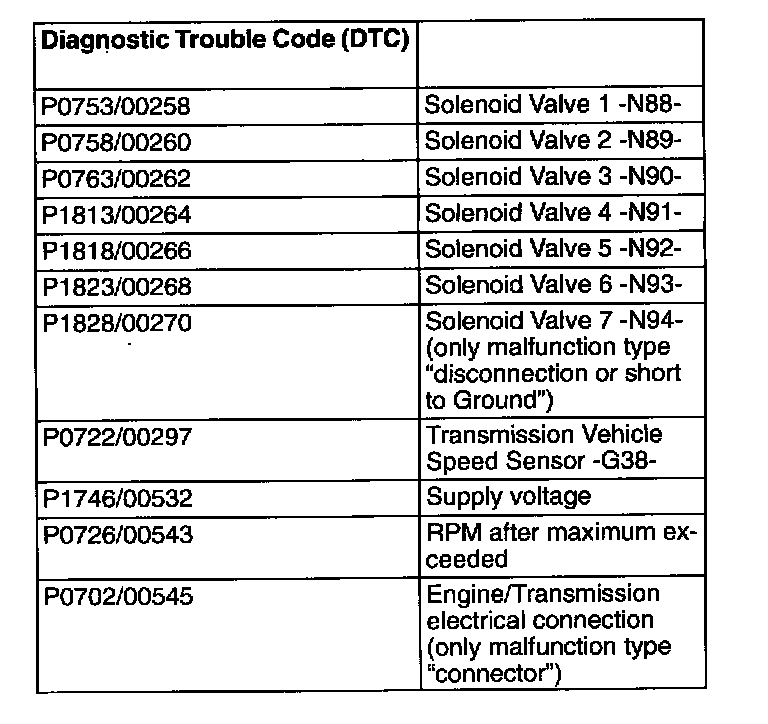
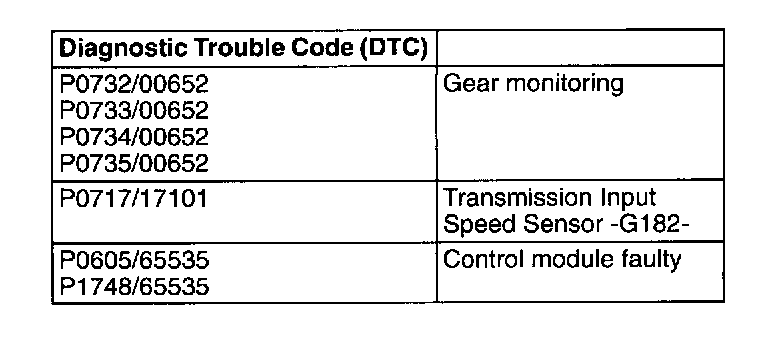
Malfunctions Which Lead to Fail-Safe Mode
Meaning of "Malfunction Indicator Light" (MIL)
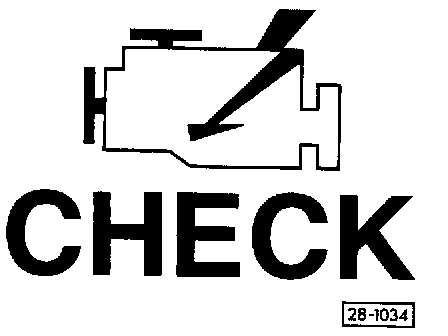
If exhaust influencing malfunctions are diagnosed from the control module, it will be indicated with the MIL switching on.
Extremely critical malfunctions are indicated immediately by the MIL.
Less critical malfunctions are indicated if they occur during two sequential "trips".
Functional check of MIL
- Switch ignition on
- MIL must light up
- Start engine
- MIL must not be lit
If the MIL stays lit after the engine has been started, read the Diagnostic Trouble Code (DTC) memory.
Recognizing A "Trip"
- After the ignition has been switched on all exhaust relevant diagnosis functions for malfunction recognition must be checked one time.
- A started trip is considered complete after a maximum drive of 20 minutes.
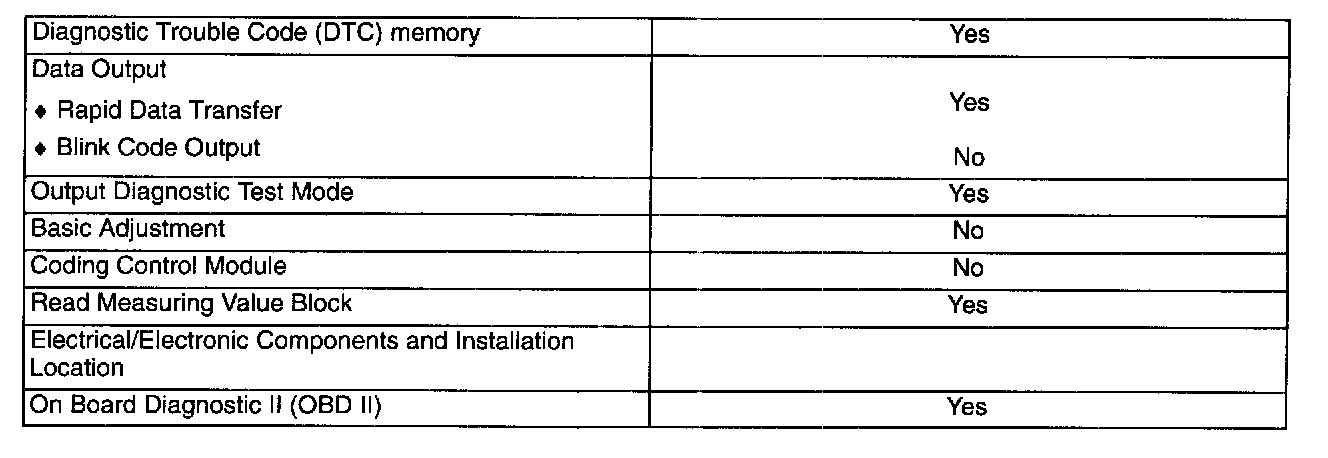
Technical Data For OBD