Evaporative Emissions System: Testing and Inspection
Chart C-3:
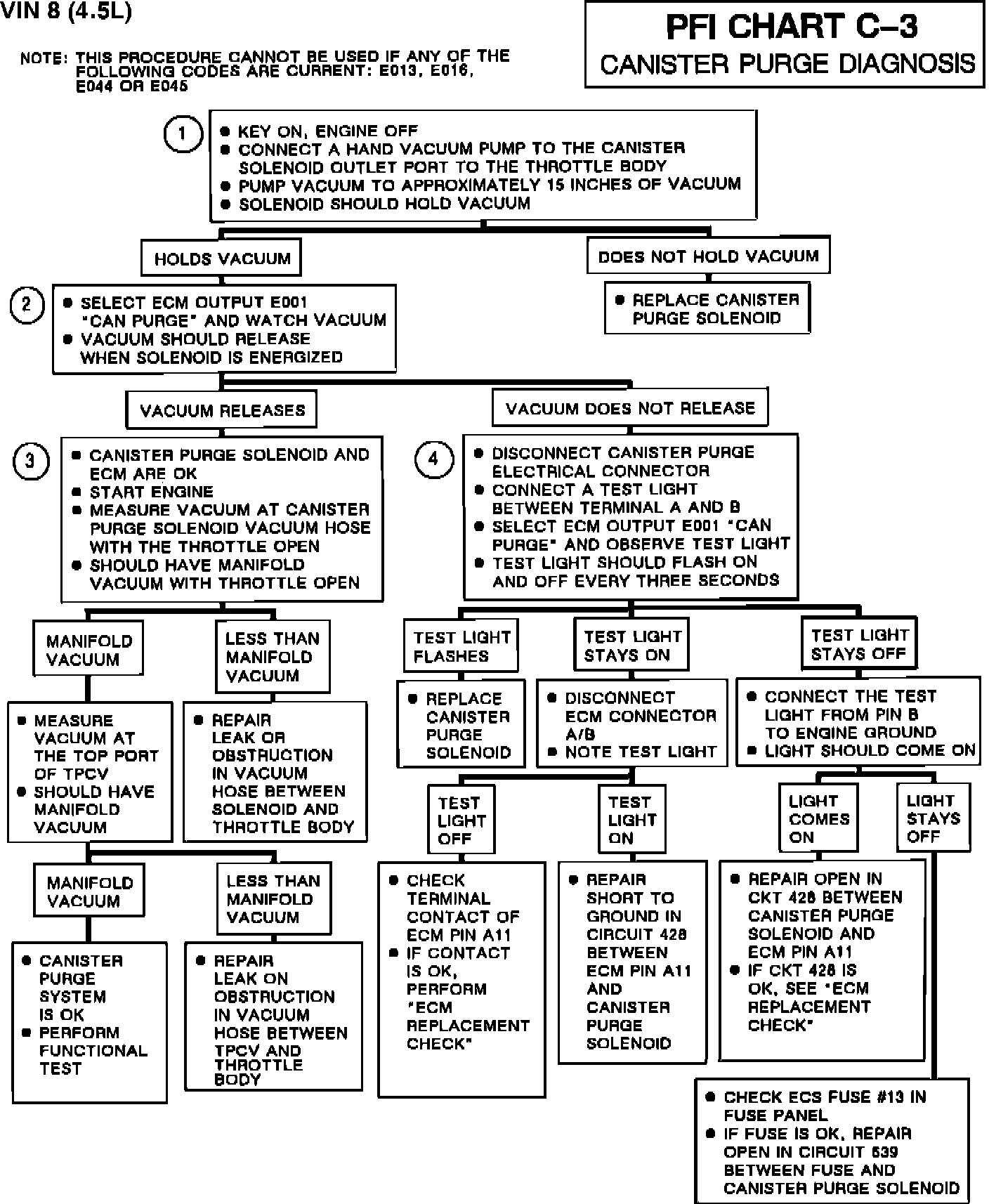
Canister Purge Wiring Diagram:
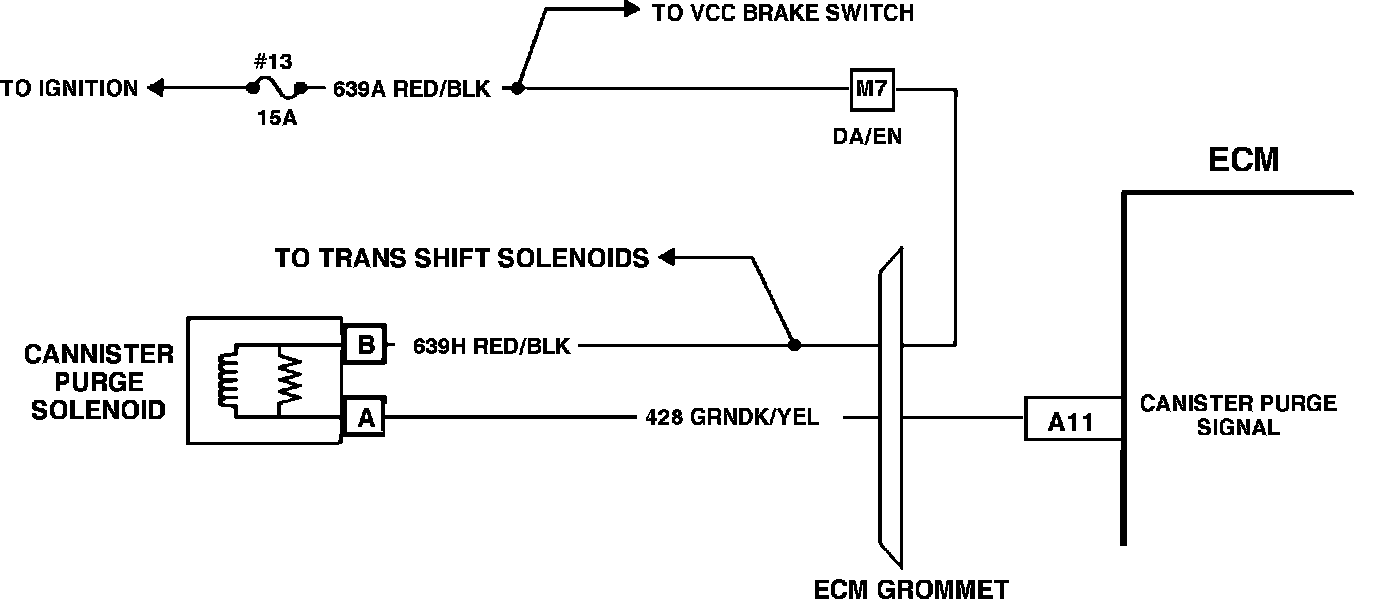
CANISTER PURGE CONTROL DIAGNOSIS
CIRCUIT DESCRIPTION:
The canister purge solenoid receives 12 volts from the 15 amp ECS fuse on the fuse block through circuit 639. The ECM powers the canister purge solenoid by grounding pin A11 (428). When the solenoid is powered, the canister is allowed to purge.
TEST DESCRIPTION: The numbers below refer to circled numbers on the diagnostic chart.
1. Checking for the canister purge solenoid's ability to hold vacuum. If the solenoid can not hold vacuum, it should be replaced.
2. Vacuum should release when the solenoid is cycled "ON" in output cycling. See ON-BOARD DIAGNOSTICS under TESTING PROCEDURES.
3. This checks for proper vacuum signals from the throttle body.
4. This checks for proper electrical signals to the canister purge solenoid.
NOTE: Once the test sequence is completed, clear codes and verify operation.
FUNCTIONAL TEST OF THE CHARCOAL CANISTER
NOTE: This test assumes that the C-3 CHART has been performed.
TEST DESCRIPTION:
1. Disconnect the hose leading from the Tank Pressure Control Valve (TPCV) to the lower port of the canister. Attach a hose to the fuel tank port of the TPCV and attempt to blow air through it. Very little or no air should flow through the TPCV.
2. Use a hand held vacuum pump and apply 15" Hg or 51 kPa of vacuum to the TPCV upper tube (manifold vacuum port). If the diaphragm does not hold vacuum for at least 20 seconds, then the diaphragm is leaking and the TPCV needs to be replaced.
3. If the diaphragm holds vacuum, then try to blow air through the hose connected to the lower tube while vacuum is still being applied. An increased air flow should be observed. If not, then replace the TPCV.
4. Attach a hose to the lower port of the canister and attempt to blow air through it. Air should pass through the canister. If not, then replace the canister.
5. Disconnect the canister purge solenoid electrical connector, attach a hose to the upper port of the canister, and attempt to blow air through it. Air should NOT pass through the canister. If air passes, replace the purge solenoid.
6. Measure the resistance of the purge solenoid. See ELECTRICAL AND ELECTRONIC SPECIFICATIONS for resistance values.
7. Reconnect all purge hoses and the solenoid electrical connector.