Rear
REAR ROTOR CHECKING PROCEDUREDial Indicating Disc For Runout:
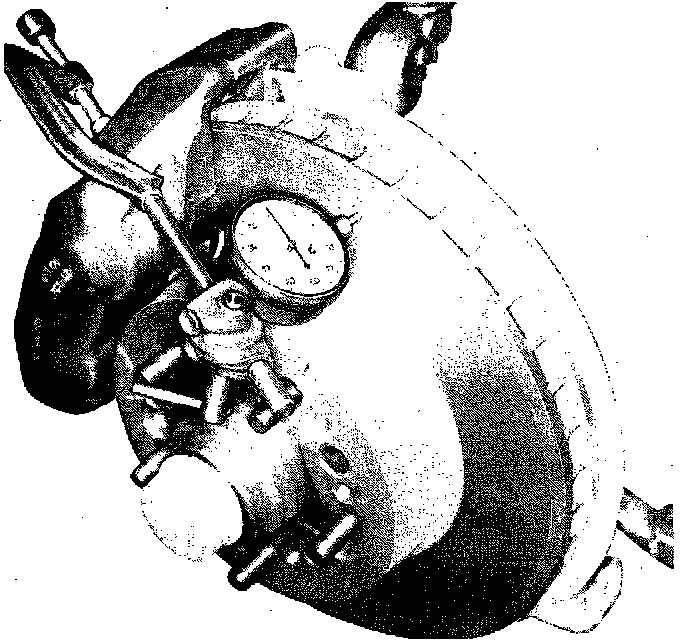
Check the rear wheel bearing end play. Then dial indicate the disc face.
If lateral runout of the disc exceeds the bearing end play by 0.005" (0.13 mm), the disc should be repaired.
Parallelism
1. Parallelism is the measurement of the thickness of the rotor at four or more points around the circumference of the rotor. All measurements must be made at the same distance in from the edge of the rotor.
2. A rotor that varies over 0.0005" (0.013 mm) causes pedal vibration, as well as front end vibration during brake applications. A rotor that does not meet these specifications may be refinished to specifications if precision equipment is available.
Tolerance and Surface Finish
In manufacturing the brake rotor, tolerances of the rubbing surfaces for flatness, for parallelism and for lateral runout are held very closely. The maintenance of these close controls on the shape of the rubbing surfaces is necessary to prevent brake roughness.
In addition to these tolerances, the surface finish must be held to a specified range. The control of the rubbing surface finish is necessary to avoid pulls and erratic performance and to extend lining life.
Light scoring of the rotor surfaces not exceeding 0.015" (0.38 mm) in depth, which may result from normal use, is not detrimental to brake operation.
Machining
Since accurate control of the rotor tolerances is necessary for proper performance of the disc brakes, machining of the rotor should be done only with precision equipment.
NOTICE: All brake rotors have a minimum thickness dimension cast into them. This dimension is the minimum wear dimension and not a refinish dimension. Do not use a brake rotor that will not meet the specifications, as shown below, after refinishing. Replace with new brake rotor.