Brake Caliper/Knuckle Maintenance
InspectionInspection Procedure

Important: The brake pads must have freedom of movement within the brake caliper bracket. If movement is restricted by debris or rust, the brake pads may remain against the rotor after the brake pedal is released. This condition may contribute to the following:
^ Accelerated brake pad wear
^ Brake pulsation
^ Rotor damage
1. Use a suction gun in order to remove and discard 1/3 of the brake fluid from the master cylinder.
2. Raise and suitably support the vehicle. Refer to Vehicle Lifting.
3. Remove the tire and wheel. Refer to Tire and Wheel Removal and Installation.
4. Install a C-clamp over the top of the brake caliper and against the back of the outboard brake pad.
5. Tighten the C-clamp in order to push the brake caliper piston into the brake caliper bore as far as possible.
6. Remove the C-clamp from the brake caliper.
Important: The brake pad should move easily within the brake caliper bracket.
7. Check the outer brake pad for freedom of movement relative to the brake caliper bracket.
Important: The brake caliper should move easily within the brake caliper bracket.
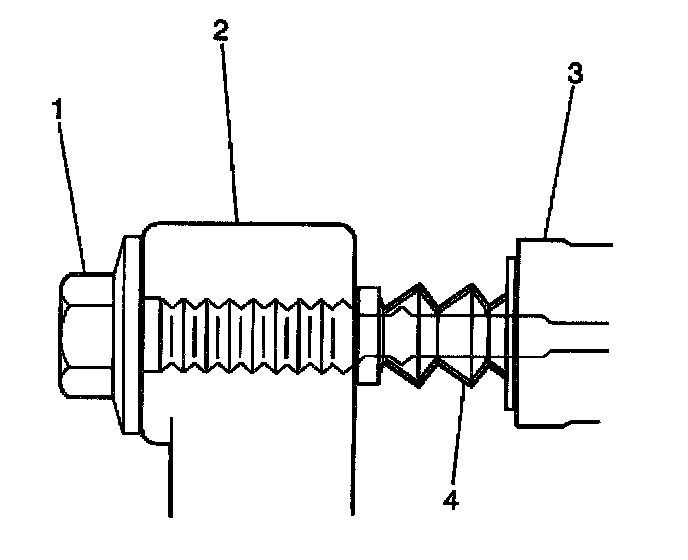
8. Use your hands in order to push the brake caliper inboard as far as possible. If the brake caliper does not move easily, perform the following steps.
^ Inspect and replace any worn or damaged brake caliper bolts (1).
^ inspect and replace any worn or damaged brake caliper bolt boots (4).
^ For information on the front brake caliper bolt hardware, refer to Brake Caliper Bracket Replacement - Front.
^ For information on the rear brake caliper bolt hardware, refer to Brake Caliper Bracket Replacement - Rear (Export).
Important: The brake pad should move easily within the brake caliper bracket.
9. Check the inner brake pad for freedom of movement relative to the brake caliper bracket.
^ If brake pad movement is restricted for either brake pad, proceed to the Cleaning Procedure.
^ If brake pad movement is not restricted for either brake pad, proceed to the Installation Procedure
Cleaning Procedure

1. Remove the brake pads (5) from the brake caliper bracket.
^ For front brake pad replacement, refer to Brake Pads Replacement - Front.
^ For rear brake pad replacement, refer to Brake Caliper Bracket Replacement - Rear (Export).
2. Remove the brake pad retainers (4) from the brake caliper bracket.
3. Use a wire brush in order to clean away any rust and debris from the brake caliper bracket where the brake pads/brake pad retainers contact the brake caliper bracket.
4. Use a wire brush in order to clean away any rust and debris from the brake pads where the brake pads contact the brake pad retainers/brake caliper bracket.
5. Clean away any rust and debris from the brake pad retainers.
6. Install the brake pad retainers to the brake caliper bracket.
7. Apply a thin coat of silicone grease (GM P/N 18010909 or equivalent) to the brake pad retainers/brake caliper bracket where the brake pads come in contact with the brake pad retainers/brake caliper bracket.
8. Perform the Inspection Procedure for the opposite side brake caliper/bracket.
Installation Procedure
1. Install the tire and wheel. Tire and Wheel Removal and Installation.
2. Perform the Inspection Procedure for the opposite side brake caliper/bracket.
3. Lower the vehicle.
4. Fill the master cylinder to the proper level with new clean brake fluid. Refer to Master Cylinder Reservoir Filling.
Caution: Do not move the vehicle until a firm brake pedal is obtained Failure to obtain a firm pedal before moving vehicle may result in personal injury.
5. Pump the brake pedal (3/4 of a full stroke) as many times as necessary to obtain a firm brake pedal.