Brake Pads Replacement - Front
Removal Procedure
Use GM replacement brake lining material (or equivalent) for all GM vehicles in order to maintain the balance between front and rear brake performance. GM replacement brake parts have been carefully selected in order to provide the proper brake balance for stopping and control over a full range of operation conditions. Installation of front or rear brake lining material not recommended for this vehicle may change the intended brake balance.
1. Use a suction gun in order to remove and discard 1/3 of the brake fluid from the master cylinder.
2. Raise and support the vehicle. Refer to Vehicle Lifting.
3. Remove the tire and wheel. Refer to Tire and Wheel Removal and Installation.
4. Install two wheel nuts in order to secure the rotor.
5. Install a C-clamp (2) over the top of the brake caliper and against the back of the outboard brake pad.
6. Tighten the C-clamp (2) until the brake caliper piston pushes into the brake caliper bore enough to slide the brake caliper (1) off of the rotor.
7. Remove the C-clamp (2) from the brake caliper.
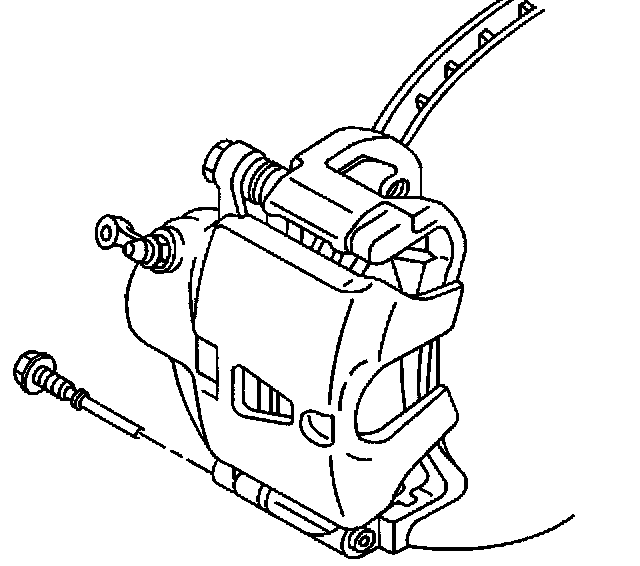
8. Remove the lower brake caliper bolt.

9. Rotate the brake caliper (2) upward in order to access the brake pads.
10. Remove the brake pads (5) from the brake caliper bracket (3).
11. Remove the brake pad retainers (4) from the brake caliper bracket (3).
Important: Insert a block of wood or the old brake pad brake between the C-clamp and the brake caliper piston in order to prevent damage to the brake caliper piston and the brake caliper piston boot.
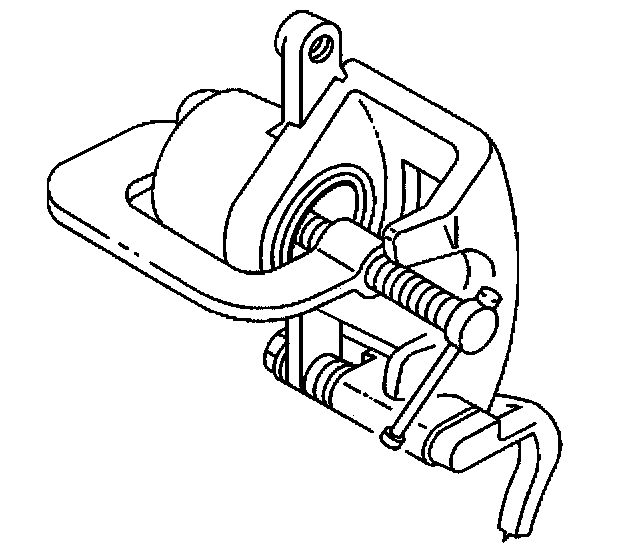
12. Install a C-clamp over the brake caliper and against the block of wood or the old brake pad.
13. Tighten the C-clamp until the brake caliper piston pushes completely into the brake caliper bore.
14. Remove the C-clamp from the brake caliper.
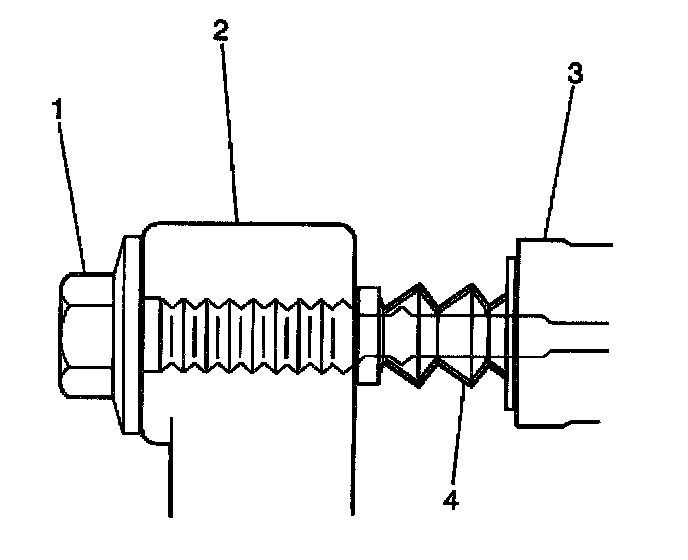
15. Inspect the brake caliper bolt boots (4) for the following conditions:
^ Cuts
^ Tears
^ Deterioration
Replace the brake caliper bolt boots if damage exists. Refer to Brake Caliper Bracket Replacement - Front.

16. Inspect the brake caliper piston boot (1) for the following conditions:
^ Cuts
^ Tears
^ Deterioration
Replace the brake caliper piston boot if damage exists. Refer to Brake Caliper Overhaul - Front.
17. Inspect the brake caliper bolts for corrosion or damage. If corrosion is found, use new parts, including bushings, when installing the brake caliper. Do not attempt to polish away corrosion.
Installation Procedure
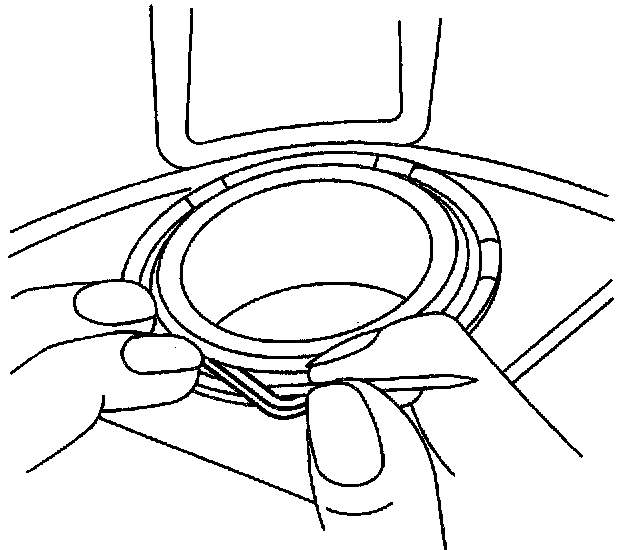
Important: Use denatured alcohol to clean the outside surface of caliper boot before installing new brake pads.
1. If you are installing new brake pads, use a C-clamp in order to compress the piston to the bottom of the caliper bore. Use the old brake pad, a metal plate or a wooden block across the face of the piston in order to protect the piston and the caliper boot.
Important: Use a small flat-bladed tool and lift the inner edge caliper boot next to the piston to release any trapped air.
2. Ensure that the piston boot is below the level of the piston face.
3. Install the two brake pad retainers (4) to the caliper bracket (3).
Important: Ensure that the wear sensor is positioned at the leading edge (upward) of the outer pad during forward wheel rotation.
4. Install the brake pads (5) over the brake pad retainers (4) and onto the caliper bracket (3).
5. Lubricate the bolt (1) and the bolt boot using silicone grease.
Notice: Use care to avoid damaging pin boot when rotating caliper.
6. Swing the caliper (2) down onto the pads (5).
Notice: Refer to Fastener Notice in Service Precautions.
7. Install the lower caliper bolt.
^ Tighten the caliper bolt to 85 Nm (63 ft. lbs.).
8. Remove the two wheel nuts securing the rotor to the hub and bearing.
9. Install the tire and wheel. Tire and Wheel Removal and Installation.
10. Lower the vehicle.
11. Fill the master cylinder to the proper level with new clean brake fluid. Refer to Master Cylinder Reservoir Filling.
Caution: Do not move the vehicle until a firm brake pedal is obtained Failure to obtain a firm pedal before moving vehicle may result in personal injury.
12. Pump the brake pedal (3/4 of a full stroke) as many times as necessary to obtain a firm brake pedal.
13. Burnish the pads and the rotors. Refer to Burnishing Pads and Rotors.