Cruise Control Module
The cruise control module (2) is located to the right of the instrument panel compartment. The main function of the cruise control module is to monitor and act upon input signals from the cruise control switch and the Vehicle Speed Sensor (VSS).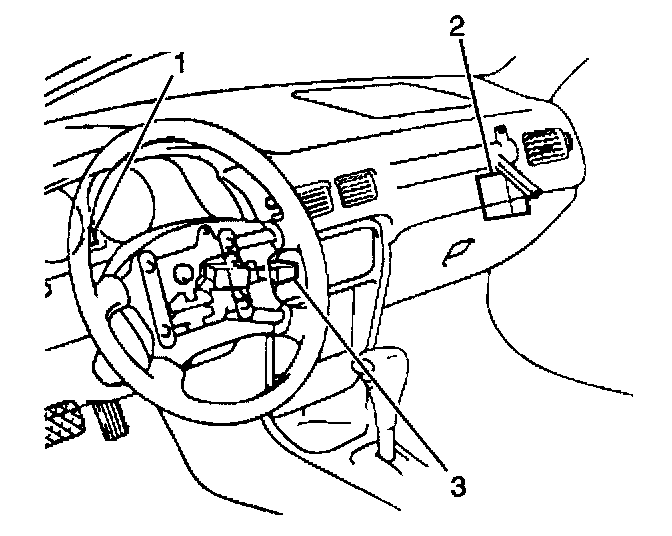
There are four different categories of input signals received by the cruise control module. These four categories are ON/OFF, speed control, throttle position and cancel. The ON/OFF input signal to the cruise control module is provided by the cruise control switch and simply activates and de-activates the cruise control system. The speed control input signals to the cruise module are provided by the cruise control switch and the VSS. Speed control input signals are provided by the cruise control switch are the RES/ACC (Resume/Accelerate) signal and the SET/COAST signal. These signals are also used to initiate the tap-up and tap-down functions. The cruise control module uses these signals, in addition to the vehicle speed signal from the VSS, to determine and maintain or alter vehicle speed in accordance with the driver's commands. The throttle position signals to the cruise control module are provided by the servo and the idle switch inside the Throttle Position (TP) sensor. These signals, as their names suggest, allow the cruise control module to constantly monitor throttle position during cruise control system operation. The cancel input signals to the cruise control module are provided by the cruise control switch CANCEL signal, the stoplamp switch, the PNP switch, or the cruise control release switch. These input signals inform the cruise control module that cruise control operation should be immediately suspended.
Output signals from the cruise control module are all sent to the cruise control servo and will vary depending upon the type of input signals received. If, for example, the cruise control module senses that vehicle speed has dropped below the desired cruise speed, an output signal will be sent to the OPEN side of the DC servo motor within the cruise control servo. This action will cause the motor to turn the worm gear, open the throttle, and increase vehicle speed until the desired cruise speed is activated. If the cruise control module should sense that vehicle speed is above the desired cruise speed, an output signal is sent to the CLOSE side of the DC servo motor within the cruise control servo. This action will cause the motor to turn in the opposite direction, close the throttle, and decrease vehicle speed until the desired cruise speed is achieved. Finally, should a cancel input signal be received, the cruise control module de-energizes the magnetic clutch within the servo. This action disengages the DC servo motor from the worm gear, causing the throttle to go to the idle position and effectively canceling cruise control operation.
The cruise control module also has a self-diagnostic capability. In conjunction with the cruise control switch, it can be used to run an abbreviated self-test which covers all cruise control switch positions, the stoplamp switch, the PNP switch, the cruise control release switch, and the VSS. In addition to the abbreviated self-test, grounding the Tc terminal in the Data Link Connector (DLC) allows the cruise control module to flash Diagnostic Trouble Codes (DTCs) on the CRUISE indicator. By reading the DTCs and following the diagnostic tables, any electrical problem in the cruise control system can be identified and repaired.
RES/ACC Switch
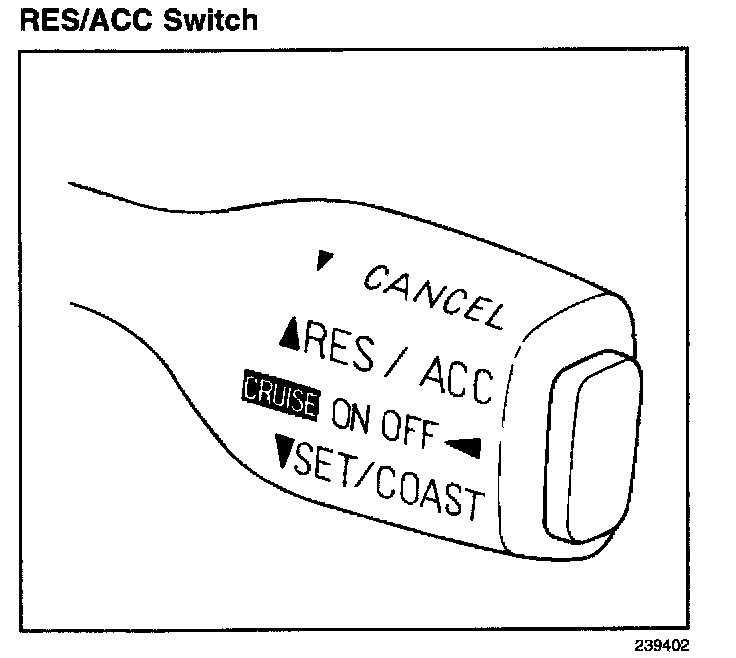
The RES/ACC (Resume/Accelerate) switch returns cruise control system operation to the last speed setting after a cancel input signal is received by the cruise control module (such as vehicle braking). This switch is activated when the cruise control switch is momentarily moved upward. Do not hold the cruise control switch in this position. Release it immediately. If the cruise control switch is held in the RES/ACC position for more than one second, the system goes into the accelerate mode. If acceleration during cruise control system operation is desired, move the cruise control switch upward into the RES/ACC position and hold it there until the vehicle reaches the desired speed. When the cruise control switch is released, the cruise control system will maintain the new cruise speed. In order to use the accelerate mode, the cruise on-off switch button must have been pressed, the CRUISE indicator must be lit, and the vehicle speed must be over 40 km/h (25 mph).
SET/COAST Switch
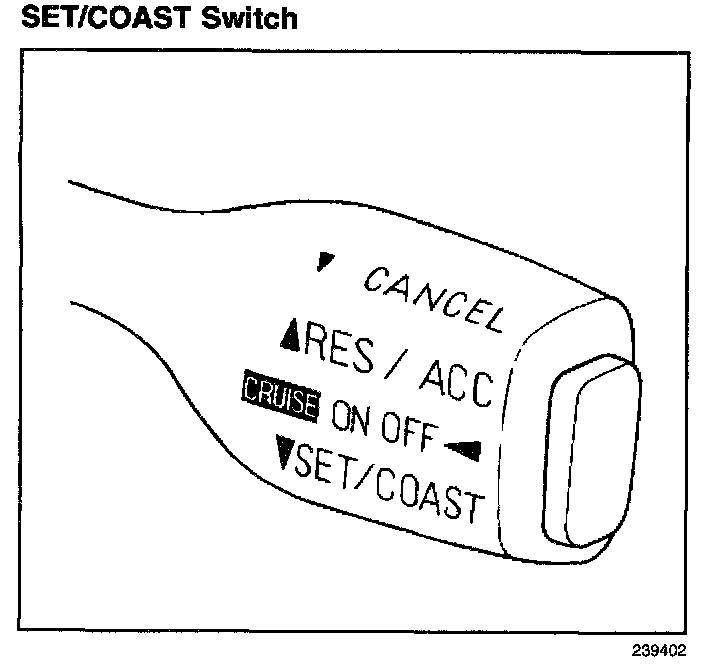
The SET/COAST switch is activated when the cruise control switch is moved downward into the SET/COAST position. When the cruise control switch is moved downward into the SET/COAST position and released, the cruise speed will be set at the speed at which the vehicle was traveling when the switch was activated. In order for this switch to operate, however, the cruise on-off switch button must have been pressed, the CRUISE indicator must be lit, and the vehicle speed must be over 40 km/h (25 mph).
The SET/COAST switch can also be used to decrease the cruise speed. By moving the cruise control switch downward into the SET/COAST position and holding it there, the cruise control system will disengage and allow the throttle to return to the idle position. When the new, lower cruise speed has been reached, the cruise control switch is released from the SET/COAST position. Once released, the cruise control system will re-engage and maintain the new desired cruise speed.
The SET/COAST switch can also be used to tap-down vehicle speed. In order to do this, the cruise control system must be engaged and operating. Tapping-down is performed by quickly moving the cruise control switch down into the SET/COAST position and releasing it (or tapping the switch into the SET/COAST position). Do not hold the cruise control switch in the SET/Coast position, or the cruise control system will enter the coast mode. Tap-down is a function in which cruise speed can be decreased by 1.6 km/h (1 mph) increments) (one tap = 1.6 km/h [1 mph] decrease).
The accelerator may be pressed at any time to override cruise control system operation. Release of the accelerator will return the vehicle to the previously set cruise speed.