Part 2 of 3
Name of Code: P0706(28) - Check Shifter SignalWhen Monitored: Continuously with the key on.
Set Condition: 3 occurrences in one key start of an invalid PRNDL code which lasts for more than 0. 1 second.
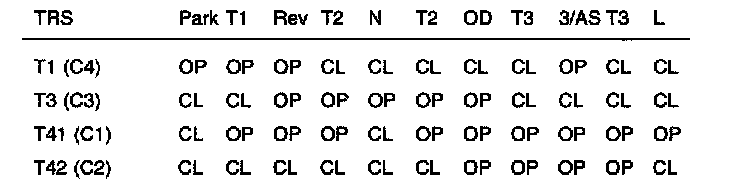
Theory of operation: The T1, T3, T41, and T42 (C1, C2, C3, C4) sense circuits communicate the shift lever position to the TCM. Each circuit is terminated at the transmission with a switch. Each switch can be either open or closed, depending on the shift lever position. The TCM can decode this information and determine the shift lever position. Each shift lever position has a certain combination of switches which will be open and closed, this is called a PRNDL code. There are 4 switches, therefore: there are many possible combinations of open and closed switches (codes). However, there are only 9 valid codes (8 for Autostick), one for each gear position and three recognized between gear codes.
The remainder of the codes should never occur, these are called invalid codes. The following chart shows the normal switch states for each shift lever position.
Transmission Effects and Possible Causes:
Scenario 1) - All PRNDL lights stay illuminated indefinitely in Park following a Key start.
- Wrong Part Number TCM for application
- TRS connector not plugged in
- T1, T3, T41, or T42 (C1, C2, C3, C4) circuits are either open, shorted to ground, or shorted to 12 volts.
- bus failure (Open or shorted resulting in no communication to BCM or Cluster)
- TRS
- TCM
- BCM
Scenario 2) - "P" is indicated following a key start but all PRNDL lights illuminate in "N" following a shift from "R" to "N". If PRNDL lights illuminate in "N" and shifter is moved directly into "3" or "L" position without pausing in "OD", then the "OD" position shift schedule and electronic display will indicate "OD" until the shifter is shifted into the "OD" position and held for at least 3 seconds.
- Worn Manual Lever (Rooster Comb). Check for heavy wearing by TRS switch contacts
- Intermittent T1, T3, T41 or T42 (C1, C2, C3, C4 circuits. Check for corrosion, terminal push-outs or spread terminals at 60-way and/or TRS switch 10-way connector
- TRS
- TCM
- BCM
Scenario 3) - If the invalid code happened while operating in the "3" or "L" position, then the "3" or "L" shift schedule and electronic display will be frozen (regardless of whether "OD"', "3" or "L" is selected) until the shifter is moved to the "N" position (all PRNDL lights will illuminate) and then back to the "OD" position and held there for at least 3 seconds in order to resume the normal "OD" shift schedule and electronic display.
- Intermittent T1, T3, T41 or T42 (C I, C2, C3, C4) circuits. Check for corrosion, terminal push-outs or spread terminals at TCM 60-way and/or TRS 10-way connector
- TRS
- TCM
- BCM
These same Symptoms may occur without the fault code P0705(28) getting set. It is possible that the invalid code that was sensed by the TCM only occurred once or twice during the given ignition key start and/or did not last for longer than 0. 1 second.
Name of Code: P-0120(29) - Throttle Position Sensor Signal Circuit
When Monitored: Whenever the engine is running.
Set Condition: This code is set if the throttle angle goes out of range or if throttle angle changes abruptly (ie: faster than the throttle body motion could occur)
Theory of operation: The Transmission Control Module (TCM) receives the throttle position signal from the Throttle Position Sensor (TPS) through a wire spliced into the TPS Signal and Sensor Ground circuits to the PCM. The TPS has a 5-volt pull up supplied from the Powertrain Control Module (PCM). The signal is checked for out-of range as well as intermittent operation (excessive signal changes).
Transmission Effects: Extremely erratic transmission shifting with an intermittent TPS signal just prior to setting the code. If the intermittent operation does not last long enough to set the code, the customer will say that the transmission violently hunts between gears. The TCM will use a calculated throttle angle supplied by the PCM over the bus. If the bus is unavailable, the TCM will use a default throttle angle of 24 degrees for the key start in which the code was set. The TCM will try to use the TPS signal again on the next key start.
POSSIBLE CAUSES: :
- Open or shorted TPS signal and/or ground circuits
- TCM connector problems
- TPS or TPS connector (Check PCM DTC)
- PCM
- TCM
Name of Code:
P-1787(31) - OD Hydraulic Pressure Test Failure
P-1788(32) - 2-4 Hydraulic Pressure Test Failure
P-1789(33) - OD/2-4 Hydraulic Pressure Test Failure
When Monitored: In 1st, 2nd, or 3rd gear with engine speed above 1000 RPM shortly after a shift and every minute thereafter.
Set Condition: Immediately after a shift into 1st, 2nd, or 3rd gear, with engine speed above 1000 RPM, the TCM momentarily turns on element pressure to the 2-4 and/or OD clutch circuits to identify that the appropriate pressure switch closes. If the pressure switch does not close it is tested again. If the switch does not close the second time, the appropriate code is set.
Theory of operation: The Transmission Control Module (TCM) tests the OD and 2-4 pressure switches when they are off (OD and 2-4 are tested in 1st gear, OD in 2nd gear, and 2-4 in 3rd gear). The test verifies that the switches are operational. The TCM verifies that the switch closes when the corresponding element is applied. If a switch fails to close, it is retested, If it fails the second test, the code is set.
Transmission Effects: The MIL illuminates and the transmission system defaults to Relay Open limp-in mode.
POSSIBLE CAUSES:
- Pressure switch sense circuit shorted to battery between TCM and solenoid pack.
- Low line pressure
- Solenoid Pack
Name of Code: P-1791(35) - Loss Of Prime
When Monitored: If the transmission is slipping in any forward gear and the pressure switches are not indicating pressure, a loss of prime test is run.
Set Condition: If the transmission begins to slip in any forward gear, and the pressure switch or switches that should be closed for a given gear are open, a loss of prime test begins. All available elements (in 1st gear L-R, 2-4 and OD, in 2nd, 3rd, and 4th gear 2-4 and OD) are turned on by the Transmission Control Module (TCM) to see if pump prime exists. The code is set if none of the pressure switches respond. The TCM will continue to run the loss of prime test until pump pressure returns.
Theory of operation: The loss of prime test is used to prevent transmission defaults which can be caused by a lack of pump prime.
Transmission Effects: Vehicle will not move or transmission slips. Normal operation will continue if pump prime returns.
POSSIBLE CAUSES:
- Low transmission fluid level
- PRNDL indicates a valid OD code in the hydraulic reverse position
- Transmission fluid filter clogged or damaged
- Transmission fluid filter improperly installed (Bolts loose or O-ring missing)
- Oil pump - If a customer has a problem when the transmission is cold whereby he shifts to reverse, gets reverse, and then shifts to OD and does not get OD (gets a neutral condition), and then can not get reverse or OD for between 3 - 20 seconds, replace the oil pump. High side clearance in the oil pump will set a code 35. The pump will prime upon start-up, but as the torque converter purges air (drain down) the air will leak across the inner rotor into the pump suction port and cause a loss of prime right after the shift into OD. After 3 - 20 seconds, pump prime will return and normal operation will continue. The pump should be replaced only after all other POSSIBLE CAUSES: above have been checked and verified.
Name of Code: P-1790(36) - Fault Immediately After Shift
When Monitored: After a speed ratio error is stored.
Set Condition: This code is set if the associated speed ratio code is stored within 1.3 seconds after a shift.
Theory of operation: This code will only be stored along with a 50 series code, If this code is set, it indicates the problem is mechanical in nature. When this code exists, diagnosing the transmission should be based on the associated speed ratio code and primarily mechanical causes should be considered. Transmission Effects: None
POSSIBLE CAUSES:
- Mechanical causes as listed under associated speed ratio code.
Name of Code: P-1775(37) - Solenoid Switch Valve Latched in TCC Position
When Monitored: During an attempted shift into 1st gear.
Set Condition: This code is set if three unsuccessful attempts are made to get into 1st gear in one given key start.
Theory of operation: The solenoid switch valve (SSV) controls the direction of the transmission fluid when the LR/TCC solenoid is energized. The SSV will be in the downshifted position in 1st gear, thus directing the fluid to the L-R clutch circuit. In 2nd, 3rd, and 4th, it will be in the upshifted position and directs the fluid into the torque converter clutch (TCC).
When shifting into 1st gear, a special hydraulic sequence is performed to ensure SSV movement into the downshifted position. The L-R pressure switch is monitored to confirm SSV movement. If movement is not confirmed (the L-R pressure switch does not close), 2nd gear is substituted for 1st.
Transmission Effects: Transmission will have no 1st gear (2nd gear will be substituted), and no EMCC operation.
POSSIBLE CAUSES:
- PRNDL indicates a valid OD code in the hydraulic reverse position
- Valve body - Solenoid valve stuck in TCC position
- High idle speed
- Solenoid malfunction - L-R pressure switch will not close
- L-R Pressure Switch Sense circuit shorted to battery
Name of Code: P-0740(38) - Torque Converter Clutch Control Circuit
When Monitored: During Electronically Modulated Converter Clutch (EMCC)
Set condition:
(a) The transmission must be in EMCC, with the input speed greater than 1750 RPM. The TCC/L-R solenoid must achieve its maximum duty cycle and still not be able to pull the engine speed within 60 RPM of input speed.
(b) If the transmission is in FEMCC and the engine can slip the TCC by more than 100 RPM (Engine speed - Input speed) for 10 seconds.
The code will be set if one of these event happens three times at a throttle angle less than 30 degrees. Theory of operation: When in 2nd, 3rd, or 4th gear, the torque converter clutch (TCC) can be locked when certain conditions are met. The TCC piston is electronically modulated by increasing the duty cycle of the L-R/TCC solenoid until the torque converter slip difference (difference between engine and turbine speed) is within 60 RPM. Then the L-R/TCC solenoid is fully energized (FEMCC / 100% duty cycle). Torque converter slip is monitored in FEMCC to ensure adequate clutch capacity.
Transmission Effects: EMCC will still be available after code is set. MIL will illuminate after 5 minutes of accumulated slip in FEMCC. The trans will attempt normal operation (no limp-in) even after the MIL is illuminated.
POSSIBLE CAUSES:
- Worn pump bushing and/or failed torque converter - both should be replaced during a rebuild with code P-0740(38) present
- Solenoid pack.
Name of Code:
P-0750(41) - L-R Solenoid Circuit
P-0755(42) - 2-4 Solenoid Circuit
P-0760(43) - OD Solenoid Circuit
P-0765(44) - UD Solenoid Circuit
When Monitored: Ignition key is turned from off position to run position and/or ignition key is turned from crank position to run position, then every 10 seconds thereafter, or when a speed ratio or pressure switch error fault is detected.
Set Condition: All four solenoids are tested for continuity continuously immediately upon start up and during vehicle operation. For solenoids that are currently energized, power is momentarily interrupted, then reenergized. For solenoids that are not currently energized, the solenoid is momentarily energized, then deenergized. Under both situations, if an inductive spike is not sensed by the Transmission Control Module (TCM) during the continuity check, it is retested twice. If it fails the test the third time, the appropriate code is set.
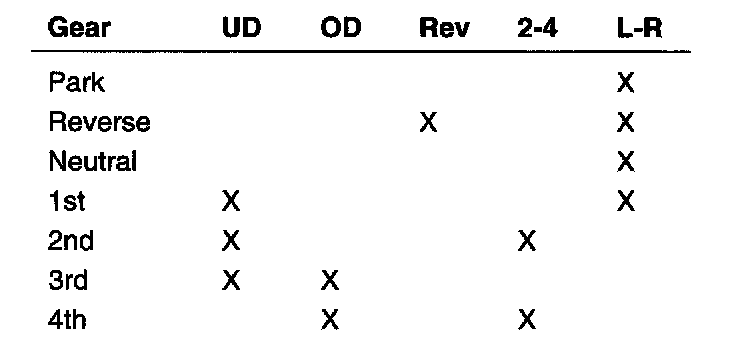
Theory of operation: Four solenoids are used to control the friction elements (clutches). The continuity of the solenoids circuits are periodically tested. Each solenoid is turned on or off depending on its current state. An inductive spike should be detected by the TCM during this test. If no spike is detected, the circuit is tested again to verify the failure. In addition to the periodic testing, the solenoid circuits are tested if a speed ratio or' pressure switch error occurs. In this case, one failure will result in the appropriate code being set. Transmission Effects: The MIL will illuminate and the transmission goes into neutral if code is set above 35 Km/h (22 MPH), limp-in mode when vehicle speed is below 35 Km/h (22 MPH).
POSSIBLE CAUSES:
- Open or shorted solenoid circuit(s) between TCM and solenoid pack.
- Open ground circuit.
- TCM connector problems.
- Solenoid pack connector problem.
- Solenoid Pack.
- TCM
Name of Code: P-1776(47) - Solenoid Switch Valve (SSV) Latched in L-R Position
When Monitored: Continuously when doing partial or full EMCC (PEMCC or FEMCC)
Set Condition: If the transmission senses the L-R pressure switch closing while performing PEMCC or FEMCC. This code will be set after two unsuccessful attempts to perform PEMCC or FEMCC.
Theory of operation: The solenoid switch valve (SSV) controls the direction of the transmission fluid when the LR/TCC solenoid is energized. SSV will be in the downshifted position in 1st gear, thus directing the fluid to the L-R clutch circuits. In 2nd, 3rd, and 4th, the SSV will be in the upshifted position and directs the fluid into the torque converter clutch (TCC).
When doing PEMCC or FEMCC, the L-R pressure switch should indicate no pressure if the SSV is in the TCC position. If the L-R pressure switch indicates pressure while in PEMCC or FEMCC, EMCC operation is aborted and inhibited to avoid inadvertent application of the L-R clutch. Partial EMCC will be attempted if the L-R pressure switch does not indicate pressure. A second detection of L-R pressure results in setting the code.
Transmission Effects: At speeds above 45 MPH, EMCC is inhibited. Once speed falls below 45 MPH, the transmission will go into relay open limp-in mode and the MIL will illuminate.
POSSIBLE CAUSES:
- Valve body - Solenoid valve stuck in L-R position
- Intermittent short to ground or open circuit in L-R Pressure Switch Sense circuit (with code 24 only)
- Solenoid pack (with code P-1784(24) only)
- TCM (with code P-1784(24) only)
Name of Code: P-1793(48) - Torque Reduction (TRD) Link Communication Error
When Monitored: Whenever the engine is running
Set Condition: This code is set when the TCM sends multiple torque reduction messages to the PCM and the TCM does not receive a response from the PCM.
Theory of operation: During high torque shifts the TCM will send a message requesting that the PCM reduce engine power until the shift is completed. This message is sent from the TCM to the Powertrain Control Module across the Torque Management Request Sense Circuit. The PCM will acknowledge the TCM's request by sending a message across the bus within a specific amount of time. The TRD Link communication is also tested periodically for operation whenever the engine is running and the vehicle is not moving with zero degrees throttle.
Transmission Effects: Maximum throttle angle used by TCM will be 54 degrees. As a result a customer may complain about loss of performance or of short shifting when driving aggressively.
POSSIBLE CAUSES:
- Sticky Throttle Position Sensor (TPS)
- Wiring or Connector problems in the Torque Management Request Sense Circuit
- PCM
- TCM