Part 1
RESTRAINTSDESCRIPTION
The occupant restraints for this model include both active and passive types. Active restraints are those which require the vehicle occupants to take some action to employ, such as fastening a seat belt; while passive restraints require no action by the vehicle occupants to be employed.
ACTIVE RESTRAINTS
The active restraints include:
Front Seat Belts - Both front seating positions are equipped with three-point seat belt systems employing a lower B-pillar mounted inertia latch type retractor, height-adjustable upper B-pillar mounted turning loops, a fixed lower seat belt anchor secured to the lower B-pillar, and a traveling end-release buckle secured to the inboard side of the seat cushion frame. The driver side front seat belt retractor (and passenger retractor if equipped with OCS) includes an integral seat belt switch that detects whether the driver side front seat belt has been fastened.
Rear Seat Belts - Both outboard rear second and third seating positions are equipped with three point seat belt systems. The outboard seating position belts employ a lower C or D-pillar mounted inertia latch-type retractor, a fixed position upper C or D-pillar mounted turning loop, and a fixed lower seat belt anchor secured to the inboard side of the seat cushion frame.
Child Restraint Anchors - Also equipped in this vehicle are two, fixed-position, child seat upper tether anchors located on the lower seat cushion, in the rear of the lower seat cushion. There is one anchor integral to the back of the third row seat back panel, one on each seat back panel. Two lower second row anchors are also provided for each rear outboard seating position. The lower anchors are integral to the seat cushion frame and are accessed from the front of the second row seat where the seat back meets the seat cushion.
PASSIVE RESTRAINTS
The passive restraints available for this model include the following:
- Dual Front Airbags - Multistage driver. front passenger, and driver knee blocker airbags are available for this model. This airbag system is a passive, inflatable, Supplemental Restraint System (SRS) and vehicles with this equipment can be readily identified by the SRS - AIRBAG logo molded into the driver airbag trim cover in the center of the steering wheel and also into the passenger airbag door on the instrument panel above the glove box. Vehicles with the airbag system can also be identified by the airbag indicator, which will illuminate in the instrument cluster for about seven seconds as a bulb test each time the ignition switch is turned to the ON position. A pyrotechnic-type seat belt tensioner is integral to the driver and passenger front seat belt retractor of all models equipped with dual front airbags.
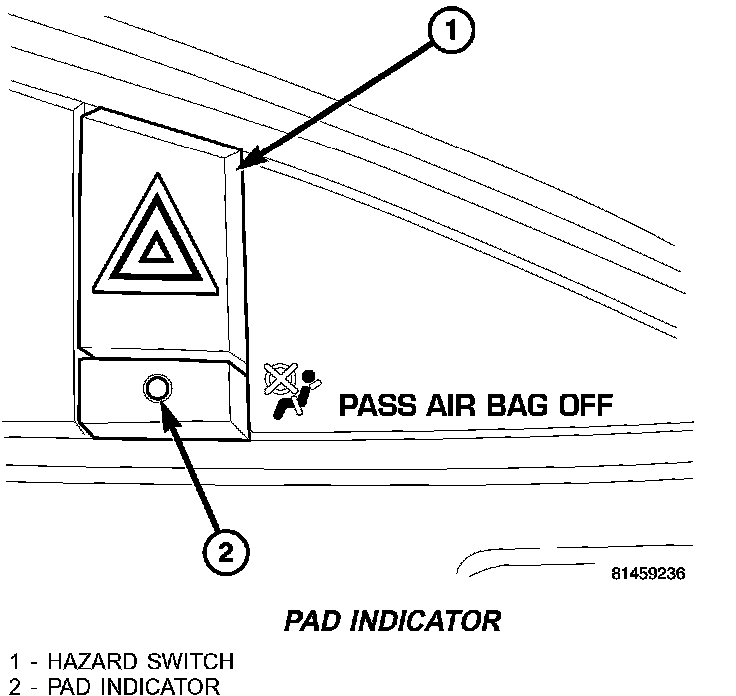
- Occupant Classification System - These vehicles also include an Occupant Classification System (OCS) with components that are located on or in the passenger front seat cushion. These components include an Occupant Classification Module (OCM) and a seat weight bladder and pressure sensor assembly. In addition, this system includes a belt tension sensor integral to the lower anchor of the passenger side front seat belt. Vehicles equipped with the OCS can be readily identified by a Passenger Airbag Disabled (PAD) indicator located in the instrument panel switch pod, below the hazard switch, above the center stack a/c outlets.
PAD Indicator:
SRS Logo:
- Curtain Airbags - Curtain airbags are available for this model when it is also equipped with dual front airbags. This airbag system is a passive, inflatable, Supplemental Restraint System (SRS) and vehicles with this equipment can be readily identified by a molded identification trim button with the SRS - AIRBAG logo located on the headliner above each B-pillar.
This vehicle is equipped with a Frontal Impact Airbag System, which utilizes the driver/passenger airbags, driver knee blocker airbag, and seat belt tensioners. This system is designed to protect occupants in the event of a front impact collision. These airbags and seat belt tensioners are all serviceable parts. If these pyrotechnics are deployed or defective, they must be replaced, as well as the Occupant Restraint Controller (ORC) must be diagnosed following procedures outlined in the diagnostic information.
The Driver and Passenger Airbag System was designed to reduce the likelihood of injury or death in frontal collisions. Each separate system is supplemental or Passive to the primary restraint device, which are the seat belts.
- Airbag Indicator - The airbag indicator is integral to the Instrument Cluster, which is located on the instrument panel in front of the driver.
- Belt Tension Sensor - Vehicles equipped with the Occupant Classification System (OCS) include a belt tension sensor. This sensor is integral to the passenger side front seat belt lower anchor which is secured to the lower B-pillar, out board and rear of the front passenger seat, concealed beneath an access cover on the seat belt assembly.
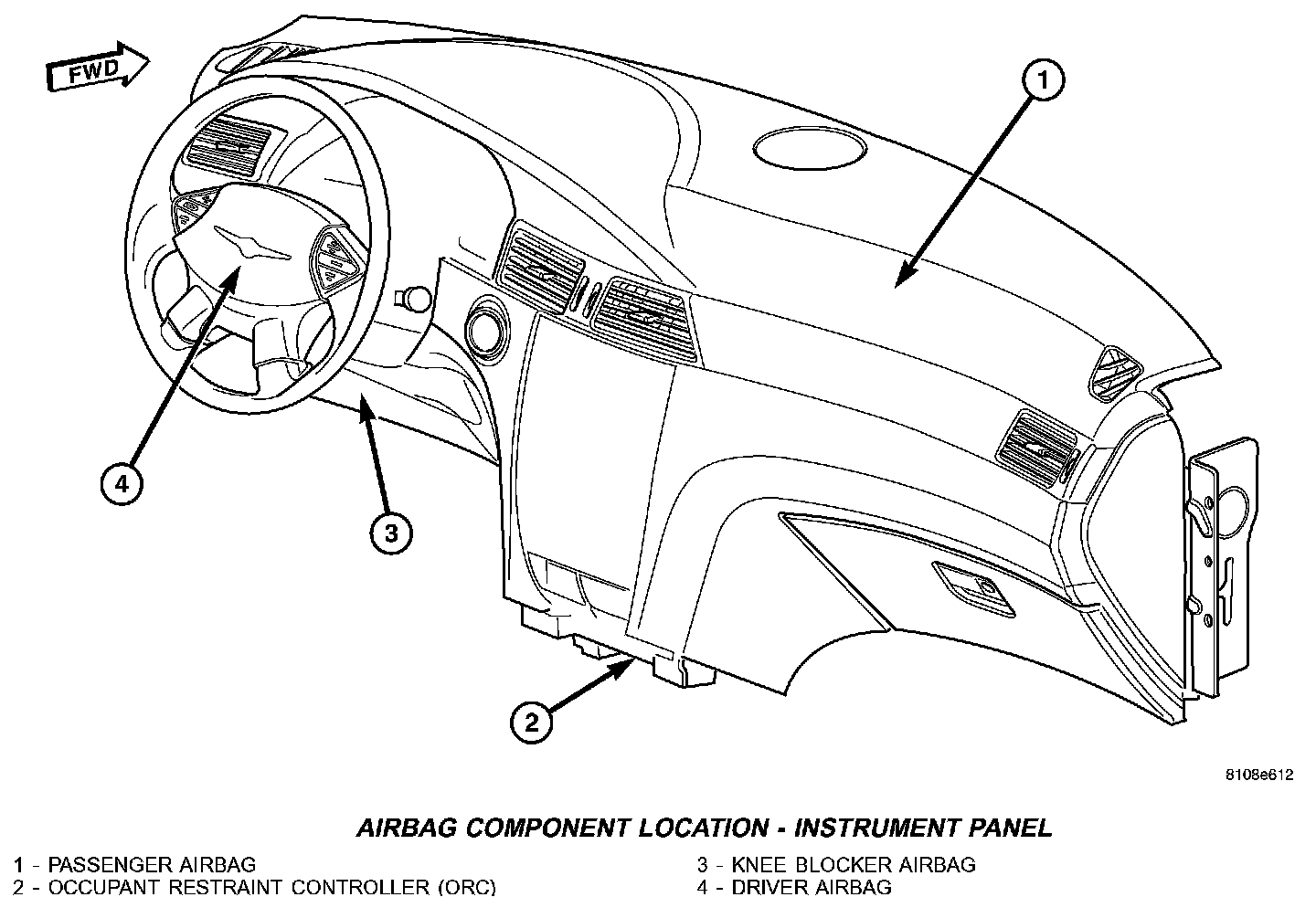
Airbag Component Location - Instrument Panel:
- Clockspring - The clockspring is located near the top of the steering column, directly beneath the steering wheel.
- Curtain Airbag - A side curtain airbag is located on each inside roof side rail above the headliner, and extends from the A-pillar to just beyond the D-pillar.
- Driver Airbag - The driver airbag is located in the center of the steering wheel, beneath the driver airbag trim cover.
Front Impact Sensor - Two front impact sensors are used on vehicles equipped with dual front airbags, one left side and one right side. The sensors are located on the rail tips, rearward of the bumper attachments.
Knee Blocker Airbag - The driver knee blocker airbag is secured to the instrument panel behind the steering column opening cover.
Occupant Classification Module - Vehicles equipped with the Occupant Classification System (OCS) include an Occupant Classification Module (OCM) which is secured to a stamped steel mounting bracket on the underside of the passenger side front seat cushion frame.
Occupant Restraint Controller - The Occupant Restraint Controller (ORC) is also sometimes referred to as the Airbag Control Module (ACM). The ORC is located on a mount on the floor transmission tunnel just underneath the instrument panel center stack.
Passenger Airbag - The passenger airbag is located on the instrument panel, beneath the instrument panel top pad and above the glove box on the passenger side of the vehicle.
- Passenger Airbag Disabled (PAD) Indicator - Vehicles equipped with the Occupant Classification System (OCS) include a passenger airbag disabled (PAD) indicator which is located in the instrument panel switch pod, next to the cluster.
- Passenger Knee Blocker - The passenger knee blocker is a structural reinforcement that is integral to and concealed within the glove box door.
- Seat Belt Tensioner - A seat belt tensioner is integral to both front seat belt retractors. The seat belt retractors are secured to the lower B-pillars.
- Seat Weight Bladder and Pressure Sensor Assembly - Vehicles equipped with the Occupant Classification System (OCS) include a seat weight bladder that is sandwiched between an insulator pad on the top of the passenger side front seat pan and the seat cushion foam padding. A short hose connects the bladder to a pressure sensor which is secured to the Occupant Classification Module (OCM) mounting bracket on the underside of the passenger side front seat cushion frame. These components are not replaceable separately from the seat cushion foam. When replaced as an assembly, the complete service kit (seat cushion, bladder,/sensor, OCM, and new wiring harness) MUST be used.
- Side Impact Sensors - Six side impact sensors are used on vehicles equipped with the curtain airbags, three left side and three right side. The first row side impact sensor is located in the B-pillar, just above the front seat belt retractor. The second row side impact sensor is located in the sliding side door track opening, just in front of the C-pillar. The third row side impact sensor is located behind the quarter trim panel, above the rear tire wheel well, between the C and D-pillars.
The ORC, the OCM, and the cluster each contain a microprocessor and programming that allow them to communicate with each other using the Programmable Communications Interface (PCI) data bus network. This method of communication is used by the ORC for control of the airbag indicators.
OPERATION
The primary passenger restraints in this are the seat belts and child restraint anchors. Seat belts and child restraint anchors are referred to as an Active Restraint because the vehicle occupants are required to physically fasten and properly adjust these restraints in order to benefit from them.
ACTIVE RESTRAINTS
The primary passenger restraints in this or any other vehicle are the seat belts and child restraint anchors. Seat belts and child restraint anchors are referred to as an active restraint because the vehicle occupants are required to physically fasten and properly adjust these restraints in order to benefit from them. See the owner's manual in the vehicle glove box for more information on the features, use and operation of all of the active restraints.
LAP / SHOULDER BELTS
All the seats are equipped with Lap/Shoulder Belts.
The belt webbing retractor is designed to lock during very sudden stops or collisions. This feature allows the shoulder part of the belt to move freely with you under normal conditions. But in a collision, the belt will lock and reduce the risk of your striking the inside of the vehicle or being thrown out.
1. Enter the vehicle and close the door. Sit back and adjust the seat.
2. The seat belt latch plate is near the seat back of the front seats and next to your arm in the rear seats. Grasp the latch plate and pull out the belt. Slide the latch plate up the webbing as far as necessary to allow the belt to go around your lap.
3. When the belt is long enough to fit, insert the latch plate into the buckle until you hear a click.
4. Position the lap belt across your thighs, below your abdomen. To remove slack in the lap belt portion, pull up on the shoulder belt. To loosen the lap belt if it is too tight, tilt the latch plate and pull on the lap belt. A snug belt reduces the risk of sliding under the belt in a collision.
5. Position the shoulder belt on your chest so that it is comfortable and not resting on your neck. The retractor will withdraw any slack in the belt.
6. To release the belt, push the red button on the buckle. The belt will automatically retract to its stowed position. If necessary, slide the latch plate down the webbing to allow the belt to retract fully.
FRONT SEAT BELT HEIGHT ADJUSTER
In the front seats, the shoulder belt anchorage can be adjusted upward or downward to help position the belt away from your neck. Press the button to release the anchorage, and then move it up or down to the position that serves you best.
As a guide, if you are shorter than average, you will prefer a lower position, and if you are taller than average, you'll prefer a higher position. When you release the anchorage, try to move it up or down to make sure that it is locked in position.
SEAT BELT TENSIONERS
The seat belts for both front seating positions are equipped with tensioning devices that are designed to remove slack from the seat belt in the event of a collision. These devices improve the performance of the seat belt by assuring that the belt is tight about the occupant early in a collision. Tensioners are designed to work for all size occupants.
These devices are not a substitute for proper seat belt placement by the occupant. The seat belt still must be worn snugly and positioned properly.
The tensioners are triggered by the Occupant Restraint Controller (ORC). Like the front airbags, the tensioners are single use items. After a collision that is severe enough to deploy the airbags and tensioners, both must be replaced.