Disassembly
Before starting disassembly, remove accessories and any emission control equipment which is not directly attached to the engine.1. Remove flywheel.
2. Remove exhaust manifolds. With LH exhaust manifold removed, note the location of the oil level indicator tube bracket.
3. Remove positive crankcase ventilation valve.
4. Disconnect ignition wires from the spark plugs.
NOTE: When removing an ignition wire from a spark plug, use Spark Plug Wire Remover. Grasp and twist the boot back and forth on the spark plug insulator to free the boot. Use the tool to pull the boot from the spark plug. Do not pull on the ignition wire directly or it may become separated from the connector inside the boot.
5. Remove EGR valve and EGR valve gasket, if so required.
6. Remove the throttle body.
7. Remove crankshaft pulley and the damper. Use Crankshaft Damper Remover and Vibration Damper Remover Adapter to remove damper.
8. Remove hold-down clamp and the camshaft position sensor and camshaft position sensor and camshaft position sensor housing.
9. Remove valve covers.
10. Before attempting to remove the lower intake manifold, break the seal between the intake manifold and the cylinder block. Wedge a large pry bar between the intake manifold and the cylinder block. Pry downward on the pry bar using the lug on the water pump as a leverage point.
CAUTION: Use care to prevent damage to machined surfaces or engine oil and coolant leakage may occur.
11. Remove rocker arms and push rods.
Note the location of each rocker arm, push rod and rocker arm seat. When engine is assembled each component must be installed in its original position.
12. Remove spark plugs.
13. Remove intake manifold and intake manifold gasket. Discard intake manifold gasket.
14. Remove cylinder heads. Discard cylinder head retaining bolts.
15. Remove and discard head gaskets.
16. Remove valve tappets.
NOTE:
- The location of each valve tappet should be identified. When the engine is assembled each valve tappet should be installed in its original position.
- If the valve tappets are stuck in the bores due to excessive varnish or gum deposits, it may be necessary to use a magnet or claw-type tool to aid removal. When using a remover tool rotate the valve tappet back and forth to loosen it from the gum or varnish that may have formed on the valve tappet.
17. Remove oil bypass filter.
18. Remove oil pan and oil pan gasket. Discard oil pan gasket.
19. Remove oil pump.
20. Remove water pump and engine front cover as an assembly. Remove and discard engine front cover gasket.
NOTE: If necessary, the water pump can be removed from the engine front cover. Discard water pump housing gasket after removal.
21. Remove camshaft sprocket retaining bolt.
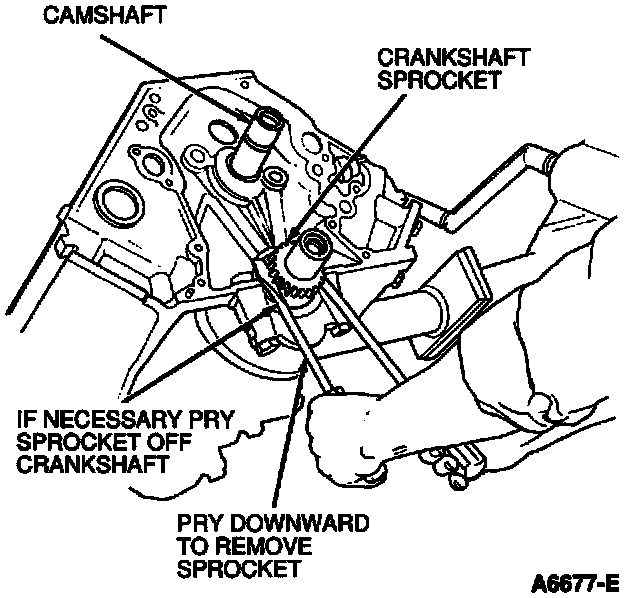
22. Remove camshaft sprocket, the crankshaft sprocket and the timing chain.
CAUTION: Use care to prevent damage to finished areas on the crankshaft or engine damage may occur.
NOTE: If the crankshaft sprocket is difficult to remove, it can be pried off using two large pry bars.
23. Remove camshaft thrust plate bolts and camshaft thrust plate from the end of the camshaft.
24. Remove camshaft. Use care to prevent damage to camshaft bearing surfaces.
25. If necessary, remove camshaft rear bearing cover from the back of the cylinder block.
26. Before removing the piston, inspect the top of the cylinder bores. If necessary, remove the ridge and/or carbon deposits from each cylinder using Rotunda Cylinder Ridge Reamer. Before the ridge or deposits are removed, turn the crankshaft until the piston is at the bottom of its stroke. Cover the piston with a clean shop towel to collect the cuttings. After the cutting operation, turn the crankshaft until the piston is at the top of its stroke and remove the shop towel with the cuttings.
CAUTION: Never cut into the ring travel area in excess of 0.794 mm (0.031 inch) or damage to engine may occur.
27. Note the location of each piston, connecting rod bearing and connecting rod cap. When the engine is assembled each component must be installed in its original position.
Remove connecting rod caps and pistons.
NOTE: The cylinder number is stamped on the top of the piston. Matched letters are stamped on the sides of corresponding connecting rod and connecting rod cap.
28. Remove crankshaft main bearing caps and crankshaft.
NOTE: Identify the location of the crankshaft main bearings. When the engine is assembled, each crankshaft main bearing must be installed in its original position.
29. For cleaning purposes, oil gallery and cooling jacket plugs can be removed.