Late Build
SAFETY CANOPY MODULE - LATE BUILD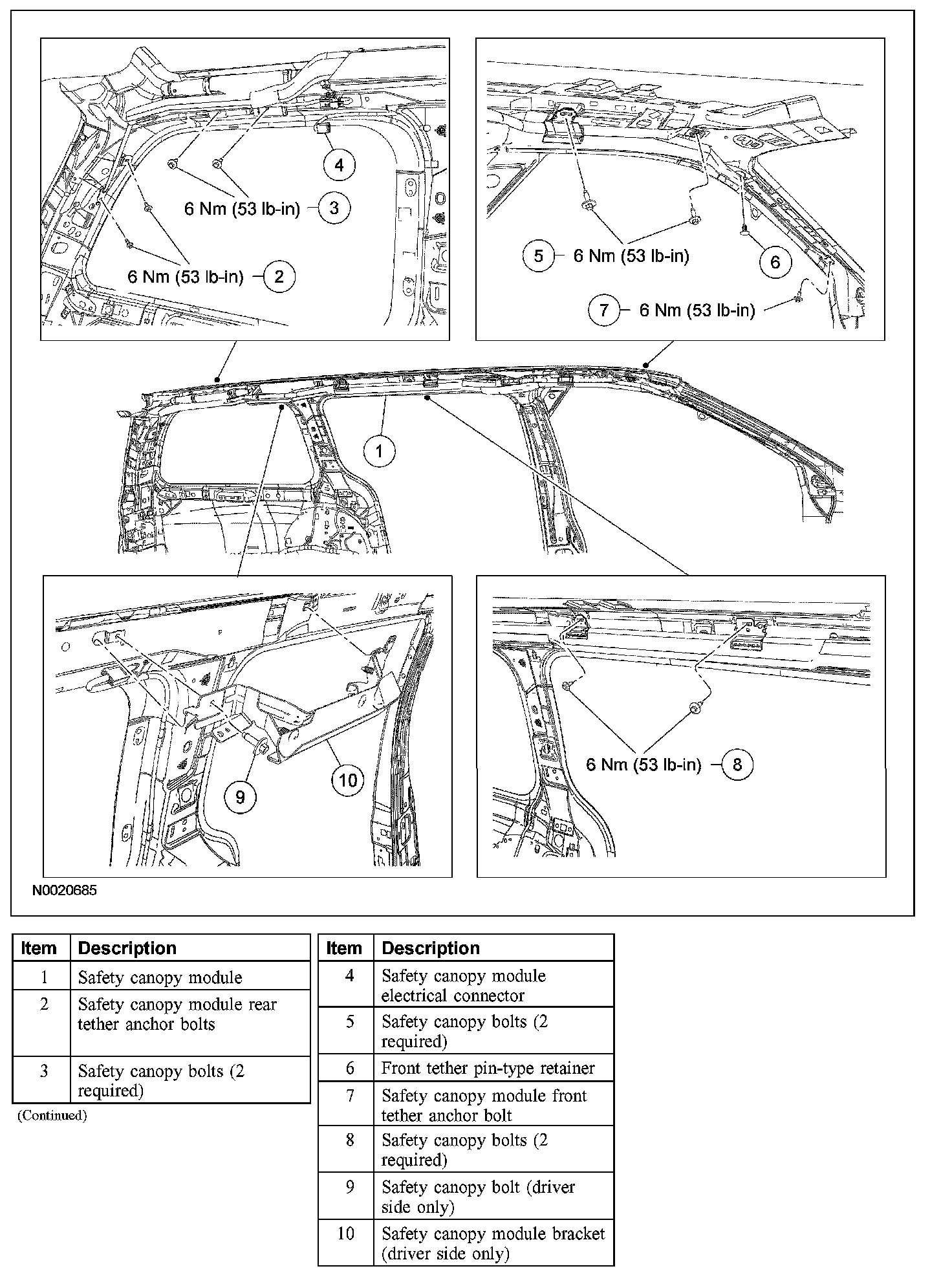
Removal and Installation
WARNING:
- Always wear safety glasses when repairing an air bag supplemental restraint system (SRS) vehicle and when handling an air bag module. This will reduce the risk of injury in the event of an accidental deployment.
- To reduce the risk of personal injury from an accidental deployment, always carry or place a live safety canopy module with the safety canopy and tear seam pointed away from your body. Failure to do so can result in personal injury in the event of a safety canopy module deployment.
- After deployment, the surface of the safety canopy can contain deposits of sodium hydroxide, a product of the gas generant combustion that is irritating to the skin. Wash your hands with soap and water afterwards.
- Never probe the connector on the safety canopy module. Doing so can result in side safety canopy deployment which can result in personal injury.
- Anytime the safety canopy has deployed, the headliner, and all A-, B-, C- and D-pillar upper trim panels and attaching hardware must be replaced along with any other damaged components and hardware. Failure to do so may result in personal injury in the event of a safety canopy deployment.
- Vehicles equipped with safety canopy modules require a specific headliner. When installing a new headliner on a vehicle equipped with safety canopy modules, make sure a headliner for safety canopy modules is being used. The word "AIRBAG" will appear on the headliner where it meets each B-pillar trim panel. Failure to do so can result in personal injury in the event of a safety canopy module deployment.
- Before installing a safety canopy module, inspect the roofline for any damage. If necessary, the sheet metal must be reworked to its original condition and structural integrity. All damaged fasteners must be replaced and any foreign objects removed. Failure to do so may result in personal injury in the event of a safety canopy deployment.
- The safety canopy must be installed in the vehicle using new torque-prevailing type J-nuts, part number W709759. Use of this J-nut is mandatory so as to reduce the risk of loss of fastener effectiveness. Failure to follow these instructions may result in personal injury in the event of a safety canopy deployment.
- Inspect the safety canopy before installation. If the safety canopy is damaged or the cover has separated and the canopy material has been exposed, a new safety canopy module must be installed. Do not attempt to repair the safety canopy module. Failure to follow these instructions can result in personal injury in the event of a safety canopy module deployment.
- To reduce the risk of injury, do not obstruct or place objects in the deployment path of the safety canopy module. Failure to follow these instructions can result in personal injury in the event of a safety canopy module deployment.
- Never put any type of fastener or tie strap around any part of the safety canopy module or interior trim panel. This will prevent the safety canopy module from deploying correctly. Failure to follow this instruction can result in personal injury in the event of a safety canopy module deployment.
- To reduce the risk of personal injury, do not use any memory saver devices.
NOTE:
- There are 2 different safety canopy modules. The early build safety canopy module has 2 fasteners and a hook retainer that attaches onto the roofline sheetmetal at the B-pillar, the late build safety canopy module will not. The early build and late build safety canopy modules are not interchangeable.
- To identify between an early build and a late build vehicle, inspect the driver safety canopy module. The late build vehicle has a bracket located at the C-pillar, the early build will not.
- The air bag warning lamp illuminates when the RCM fuse is removed and the ignition switch in ON. This is normal operation and does not indicate a supplemental restraint system (SRS) fault.
- The SRS must be fully operational and free of faults before releasing the vehicle to the customer.
- Driver safety canopy module shown, passenger similar.
- Repair is made by installing a new part only. If the new part does not correct the condition, install the original part and carry out the diagnostic procedure again.
All safety canopies
1. Depower the system.
2. WARNING: Anytime the safety canopy has deployed, the headliner, and all A-, B-, C- and D-pillar upper trim panels and attaching hardware must be replaced along with any other damaged components and hardware. Failure to do so may result in personal injury in the event of a safety canopy deployment.
Remove the headliner.
3. Remove the front tether anchor bolt located at the A-pillar.
- To install, tighten to 6 Nm (53 lb-in).
4. Remove the front tether anchor pin-type retainer
5. Remove the 2 safety canopy module bolts located above the front door.
- To install, tighten to 6 Nm (53 lb-in).
6. Remove the 2 rear tether anchor bolts located at the lower D-pillar.
- To install, tighten to 6 Nm (53 lb-in).
7. Remove the 2 safety canopy module bolts located above the rear quarter glass.
- To install, tighten to 6 Nm (53 lb-in).
Driver safety canopy
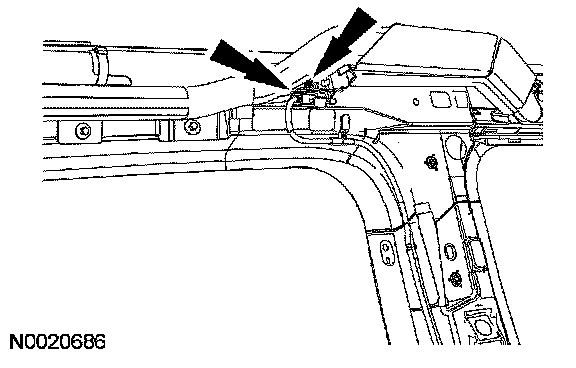
8. NOTE: The driver safety canopy module electrical connector is located just behind the C-pillar.
Disconnect the driver safety canopy module electrical connector, then detach the safety canopy module harness electrical connector from the driver safety canopy module bracket.
Passenger safety canopy
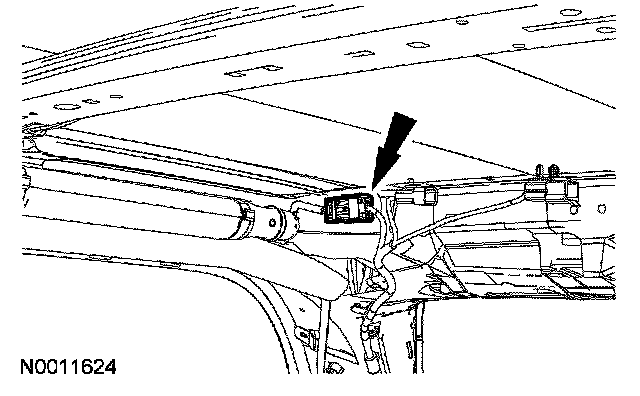
9. NOTE: The passenger safety canopy module electrical connector is located at the top of the D-pillar.
Disconnect the passenger safety canopy module electrical connector and detach it from the D-pillar.
All canopies
10. Remove the 2 safety canopy bolts located above the rear sliding door.
- To install, tighten to 6 Nm (53 lb-in).
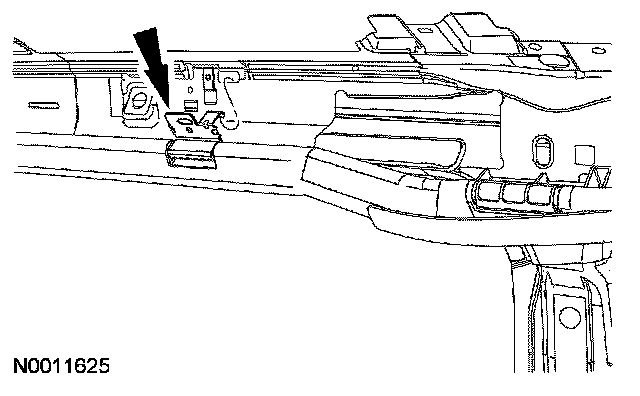
11. Just rear of the B-pillar, slide the safety canopy module up and rotate the middle retainer out of the sheet metal.
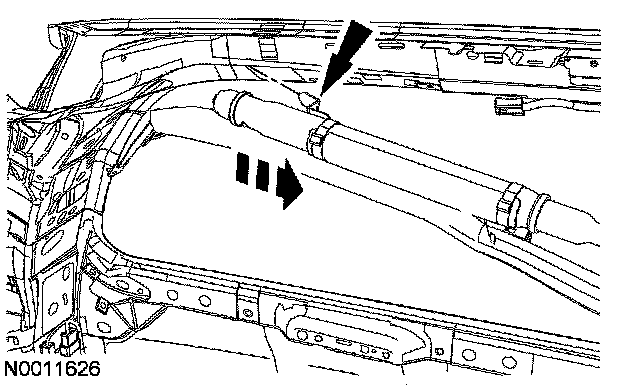
12. Angle the front of the safety canopy module toward the opposite side of the vehicle, then slide forward, disengaging the rear retainer near the D-pillar from the sheet metal and then remove the safety canopy module.
Driver safety canopy
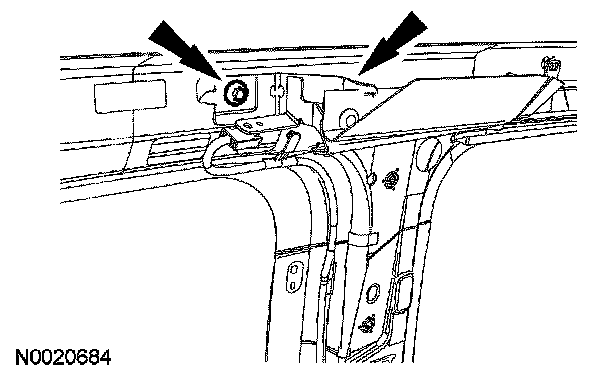
13. NOTE:
- In the event of a driver safety canopy module deployment or a driver safety canopy module bracket with damage, a new driver safety canopy module bracket, J-nuts and retainers must be installed.
- Note the position of the driver safety canopy module bracket front and rear locator hooks in the roof sheet metal for installation.
Remove the bolt and the driver safety canopy module bracket if necessary.
- To install, tighten to 6 Nm (53 lb-in).
All safety canopies
14. WARNING: The safety canopy must be installed in the vehicle using new torque-prevailing type J-nuts, part number W709759. Use of this J-nut is mandatory to reduce the risk of loss of fastener effectiveness. Failure to follow these instructions may result in personal injury in the event of a safety canopy deployment.
Remove all J-nut fasteners and install new J-nut fasteners.
15. WARNING:
- Before installing a safety canopy module, inspect the roofline for any damage. If necessary, the sheet metal must be reworked to its original condition and structural integrity. Install new fasteners if damaged and remove foreign material. Failure to do so can result in personal injury in the event of a safety canopy deployment.
- Inspect the safety canopy module before installation. If the safety canopy module is damaged or the cover has separated and the canopy material has been exposed, a new safety canopy module must be installed. Do not attempt to repair the safety canopy module. Failure to follow these instructions can result in personal injury in the event of a safety canopy module deployment.
- Never put any type of fastener or tie-strap around any part of the safety canopy module or interior trim panel. This will prevent the safety canopy module from deploying correctly. Failure to follow this instruction can result in personal injury in the event of a safety canopy module deployment.
To install, reverse the removal procedure.
16. WARNING: Anytime the safety canopy has deployed, the headliner, and all A-, B-, C- and D-pillar upper trim panels and attaching hardware must be replaced along with any other damaged components and hardware. Failure to do so may result in personal injury in the event of a safety canopy deployment.
Install the headliner.
17. Repower the system.
18. Check the active restraint system for correct operation.