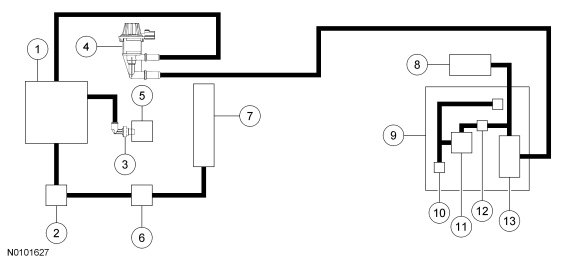
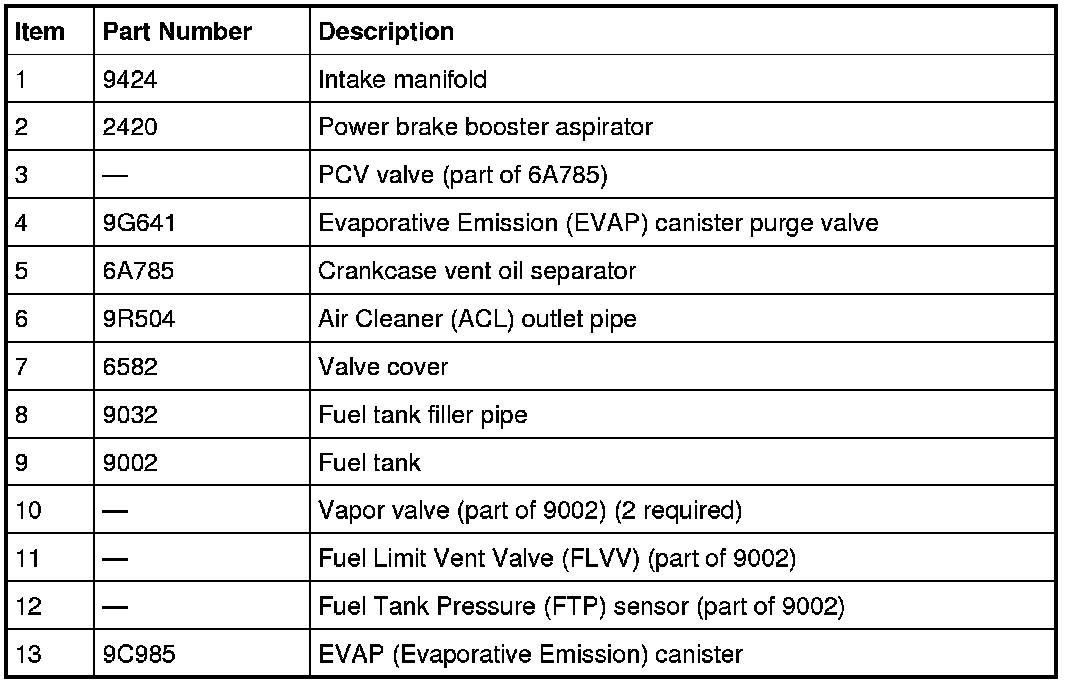
Evaporative Emissions
Evaporative Emissions
The Evaporative Emission (EVAP) system consists of the:
- EVAP (Evaporative Emission) canister purge valve.
- EVAP (Evaporative Emission) canister.
- EVAP (Evaporative Emission) canister vent solenoid.
- Fuel Tank Pressure (FTP) sensor (part of 9002).
- fuel tank filler cap.
The EVAP (Evaporative Emission) system:
- utilizes an On-Board Refueling Vapor Recovery (ORVR) system that captures the fuel vapors from the vehicle's fuel tank during refueling.
- prevents hydrocarbon emissions from reaching the atmosphere.
- stores fuel vapors in the EVAP (Evaporative Emission) canister, that are generated during vehicle operation or hot soak, until they can be consumed by the engine during normal engine operation.
- routes the stored fuel vapors to the engine during engine operation.
- is controlled by the PCM which, using various sensor inputs, calculates the desired amount of purge flow. The PCM regulates the purge flow, induced by the application of intake manifold vacuum, by varying the duty cycle applied to the EVAP (Evaporative Emission) canister purge valve.
The fuel vapors are routed:
- from the fuel tank through the fill limit valve and fuel vapor vent valve.
- to the EVAP (Evaporative Emission) canister through the fuel vapor tube assembly.
- to the engine when the EVAP (Evaporative Emission) canister purge valve is opened by the PCM.
The EVAP (Evaporative Emission) canister:
- is mounted on the top of the fuel tank.
- contains activated carbon.
- stores fuel vapors.
The fuel tank filler cap:
- relieves system vacuum below 5.4 kPa (22.642 in H2O) and system pressure above 23.3 kPa (93.54 H2O).
The EVAP (Evaporative Emission) canister vent solenoid:
- is normally open.
- seals the EVAP (Evaporative Emission) system for the inspection and maintenance (I/M 240) test and OBD (On-Board Diagnostic) II leak and pressure tests.
- is mounted to the EVAP (Evaporative Emission) canister.
- is serviced as a separate item.
The EVAP (Evaporative Emission) canister purge valve:
- is normally closed.
- regulates the purging of the EVAP canister.
- is controlled by the PCM.
- is repaired as a separate item.
The FTP (Fuel Tank Pressure) sensor:
- monitors the pressure levels in the fuel tank.
- communicates the pressure reading to the PCM during the OBD (On-Board Diagnostic) II leak test.
- is located in the fuel vapor tube assembly and is serviced as part of the fuel tank.
The EVAP (Evaporative Emission) system monitor:
- is a self-test strategy within the PCM which tests the integrity of the EVAP (Evaporative Emission) system.
- monitors the EVAP (Evaporative Emission) system for leaks.
- monitors electronic EVAP (Evaporative Emission) components for irrationally high or low voltages.
- monitors for correct EVAP (Evaporative Emission) system operation.
- uses negative and positive leak test methods to test and activate the EVAP (Evaporative Emission) system.
The engine ON EVAP (Evaporative Emission) leak-check monitor:
- is executed by the individual components of the enhanced EVAP (Evaporative Emission) system. Intake manifold vacuum is utilized to reach a target vacuum on the EVAP (Evaporative Emission) system. The FTP (Fuel Tank Pressure) sensor is used by the engine ON EVAP (Evaporative Emission) leak-check monitor to determine if the target vacuum necessary to carry out the leak-check on the FTP (Fuel Tank Pressure) system has been reached. Once target vacuum on the EVAP (Evaporative Emission) system is achieved, the change in EVAP (Evaporative Emission) system vacuum over a calibrated period of time determines if a leak exists.
The Engine Off Natural Vacuum (EONV) EVAP (Evaporative Emission) leak-check monitor is executed:
- once the engine ON EVAP (Evaporative Emission) leak-check monitor is completed and the key is turned OFF. The EONV (Engine Off Natural Vacuum) EVAP (Evaporative Emission) leak-check monitor determines if a leak is present when the naturally occurring change in the fuel tank pressure or vacuum does not exceed a calibrated limit during a calibrated amount of time. A separate, low-power consuming microprocessor in the PCM manages the EONV (Engine Off Natural Vacuum) leak-check. The engine OFF EVAP (Evaporative Emission) leak-check monitor is executed by the individual components of the enhanced EVAP (Evaporative Emission) system.
Vehicle Emission Vacuum Routing