HVAC Control Unit A/C Signal Circuit Troubleshooting (Without Climate Control)
HVAC Control Unit A/C Signal Circuit Troubleshooting
NOTE:
- Use this troubleshooting procedure if the A/C compressor, the A/C condenser fan, and radiator fan are inoperative.
- Before doing symptom troubleshooting, check for and resolve any powertrain DTCs. Initial Inspection and Diagnostic Overview
1. Turn the ignition switch to ON (II).
2. Check if the blower motor operates at all speeds.
Does the blower motor operate at all speeds?
YES - Go to step 3.
NO - Repair the problem in the blower motor circuit.
3. Turn the ignition switch to LOCK (0).
4. Disconnect the HVAC control unit 28P connector.
5. Turn the ignition switch to ON (II).
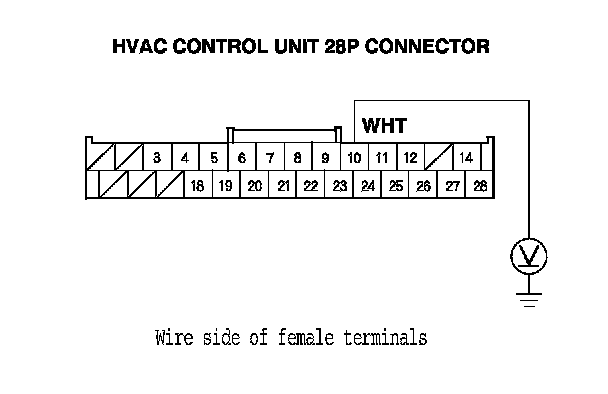
6. Measure the voltage between the HVAC control unit 28P connector No. 10 terminal and body ground.
Is there voltage?
YES - Go to step 13.
NO - Go to step 7.
7. Turn the ignition switch to LOCK (0).
8. Disconnect the A/C compressor clutch 3P connector.
9. Turn the ignition switch to ON (II).
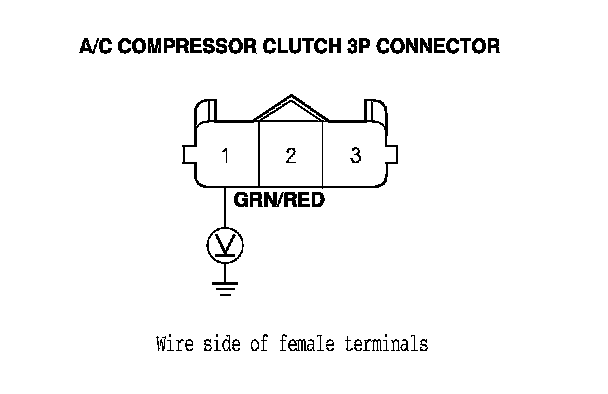
10. Measure the voltage between the A/C compressor clutch 3P connector No. 1 terminal and body ground.
Is there battery voltage?
YES - Go to step 11.
NO - Repair open in the wire between the A/C compressor and the under-dash fuse/relay box. If the wire is OK, substitute a known-good under-dash fuse/relay box, and recheck. If the symptom goes away, replace the original under-dash fuse/relay box. Under-dash Fuse/Relay Box Removal and Installation
11. Test the A/C compressor thermal protector. Testing and Inspection
Is the A/C compressor thermal protector OK?
YES - Go to step 12.
NO - Replace the A/C compressor thermal protector. Service and Repair
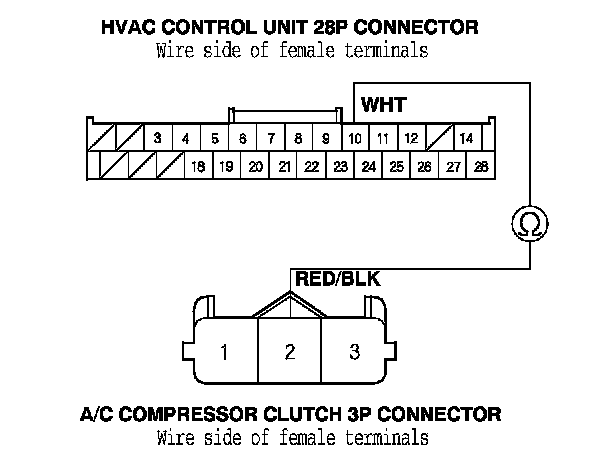
12. Check for continuity between the HVAC control unit 28P connector No. 10 terminal and the A/C compressor clutch 3P connector No. 2 terminal.
Is there continuity?
YES - Check for loose wires or poor connections at the HVAC control unit 28P connector and at the A/C compressor clutch 3P connector.
NO - Repair open in the wire between the HVAC control unit and A/C compressor.
13. Turn the ignition switch to LOCK (0).
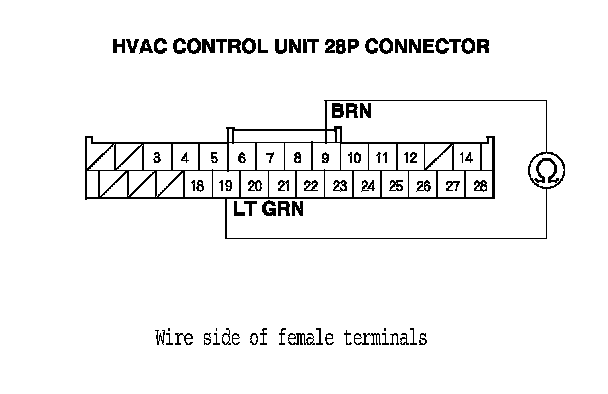
14. Measure the evaporator temperature sensor resistance between the HVAC control unit 28P connector No. 9 and No. 19 terminals.
Is the resistance less than 24 kOhms?
YES - Check for loose wires or poor connections at the HVAC control unit 28P connector. If the connections are good, substitute a known-good HVAC control unit, and recheck. If the symptom goes away, replace the original HVAC control unit. HVAC Control Unit Removal/Installation (Without Climate Control)
NO - Test the evaporator temperature sensor. Evaporator Temperature Sensor Test