California
The following procedures will allow a basic operational test of the EGR system. Since the EGR operation is controlled by the ECU, refer to COMPUTERIZED ENGINE CONTROLS for further information concerning testing of the systems operation.With engine at operating temperature, (coolant temperature greater than 70 degrees C or 158 degrees F) rev engine and verify that EGR valve diaphragm moves.
If no movement is found, see EGR Valve Inspection.

1. Disconnect the vacuum hose (green strip) from the EGR valve and connect a manual vacuum pump to the three way terminal.
2. While the engine is cold (coolant temperature less than 60 degrees C or 140 degrees F) verify that when suddenly accelerating the engine from idle, there is no vacuum present.
3. Allow the engine to warm up (coolant temperature greater than 80 degrees C or 176 degrees F) and verify that when suddenly accelerating the engine from idle, vacuum rises temporarily to 14 kPa (3.9 in.Hg) or more.
EGR Valve Testing:
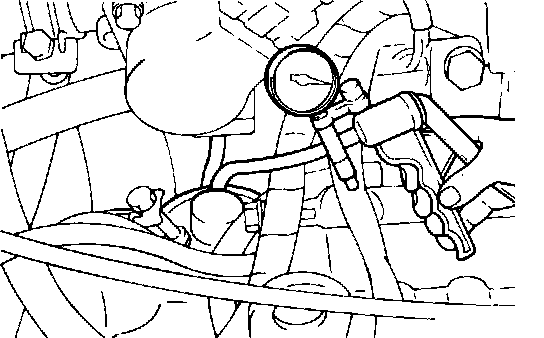
4. Disconnect the three-way terminal and connect the hand vacuum pump directly to the exhaust gas recirculation (EGR) valve.
5. Check whether the engine stalls or the idle becomes unstable when a vacuum of 26 kPa (5.9 in.Hg) or higher is applied.