Malfunction Indicator Lamp: Testing and Inspection

A malfunction indicator lamp illuminates to notify the driver that there is a problem with the vehicle. However, the MIL will go off automatically after 3 subsequent sequential driving cycles without the same malfunction. Immediately after the ignition switch is turn on (ON position - do not start), the MIL will illuminate continuously to indicate that the MIL operates normally.
Faults with the following items will illuminate the MIL
- Catalyst
- Fuel system
- Mass Air Flow Sensor
- Intake Air Temperature Sensor
- Engine Coolant Temperature Sensor
- Throttle Position Sensor
- Upstream Oxygen Sensor
- Downstream Oxygen Sensor Heater
- Downstream Oxygen Sensor
- Upstream Oxygen Sensor Heater
- Injector
- Misfire
- Crankshaft Position Sensor
- Camshaft Position Sensor
- Evaporative Emission Control System
- Vehicle Speed Sensor
- Idle Control Valve
- Power Supply
- ECM
- MT/AT Encoding
- Acceleration Sensor
- MIL-on Request Signal
- Power Stage
1. After turning ON the ignition key, ensure that the light illuminates for about 5 seconds and then goes out.
2. If the light does not illuminate, check for an open circuit in the harness, a blown fuse or a blown bulb.
SELF-DIAGNOSIS
The ECM monitors the input/output signals (some signals at all times and the others under specified conditions). When the ECM detects an irregularity, it records the diagnostic trouble code, and outputs the signal to the Data Link connector. The diagnosis results can be read with the MIL or HI-SCAN. Diagnostic trouble codes (DTC) will remain in the ECM as long as battery power is maintained. The diagnostic trouble codes will, however, be erased when the battery terminal or the engine control module (ECM) connector is disconnected or by HI-SCAN.
NOTE: If a sensor connector is disconnected with the ignition switch turned on, the diagnostic trouble code (DTC) is recorded. In this case, disconnect the battery negative terminal (-) for 15 seconds or more, and the diagnosis memory will be erased.
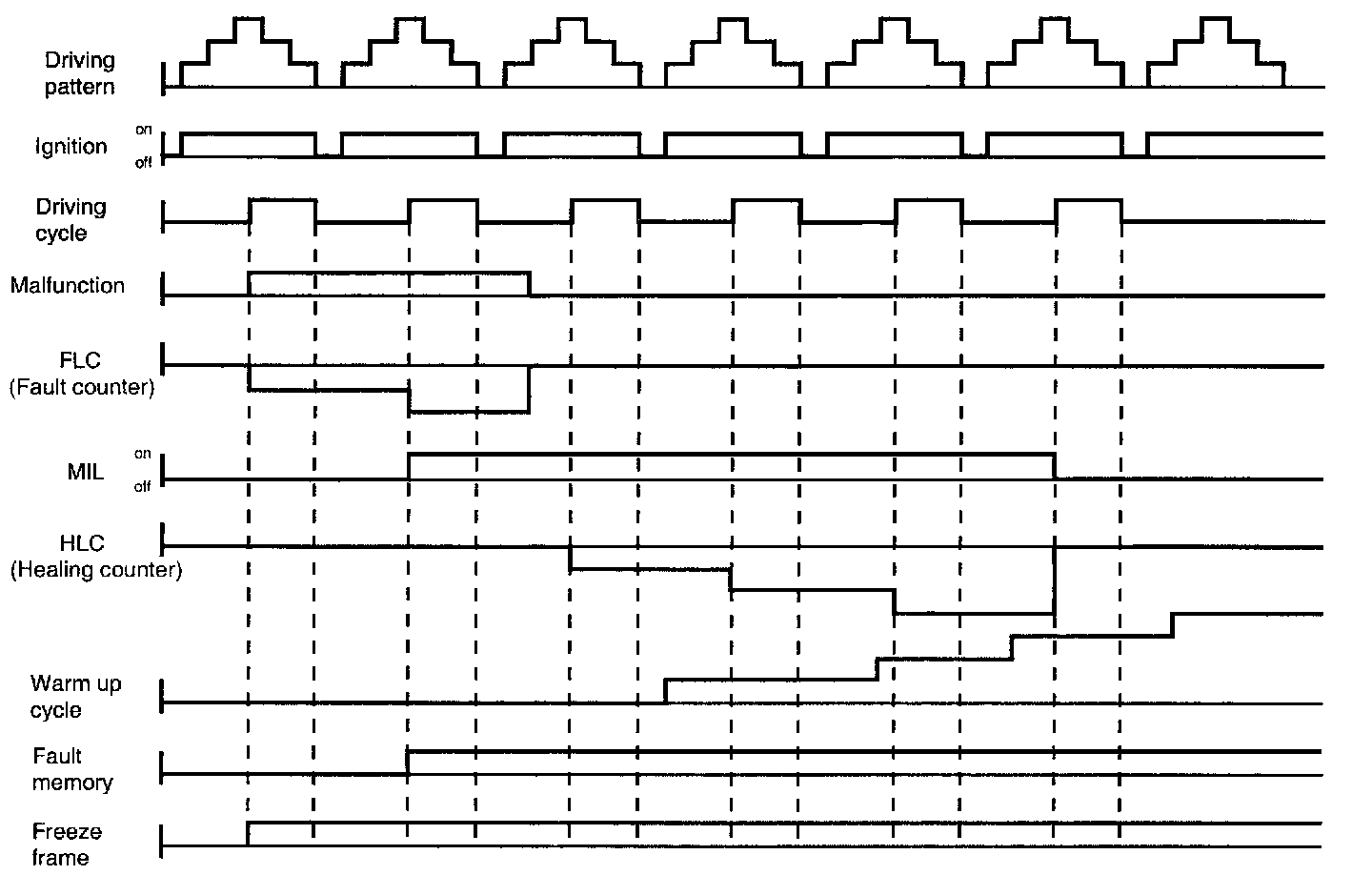
THE RELATION BETWEEN DTC AND DRIVING PATTERN IN OBD-II SYSTEM
1. When the same malfunction is detected and maintained during two sequential driving cycles, the MIL will automatically illuminate.
2. The MIL will go off automatically if no fault is detected after 3 sequential driving cycles.
3. A Diagnostic Trouble Code (DTC) is recorded in ECM memory when a malfunction is detected after two sequential driving cycles. The MIL will illuminate when the malfunction is detected on the second driving cycle.
If a misfire is detected, a DTC will be recorded, and the MIL will illuminate, immediately after a fault is first detected.
4. A diagnostic Trouble Code (DTC) will automatically erase from ECM memory if the same malfunction is not detected for 40 driving cycles.
NOTE:
- A "warm-up cycle" means sufficient vehicle operation such that the coolant temperature has risen by at least 40 degrees Fahrenheit from engine starting and reaches a minimum temperature of 160 degrees Fahrenheit.
- A "driving cycle" consists of engine start-up, vehicle operation beyond the beginning of closed loop operation.