Procedure
NOTE: Perform the test at normal operating fluid temperature (50 - 80°C or 122 - 176°F).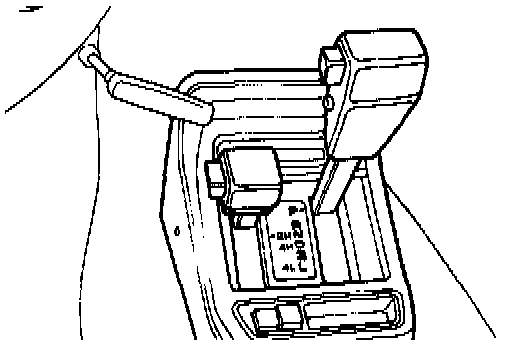
NOTE: The transmission shift points for the 2H, 4H and 4L transfer positions are different. Also, the OD gear and lock-up are canceled when 4L is engaged.
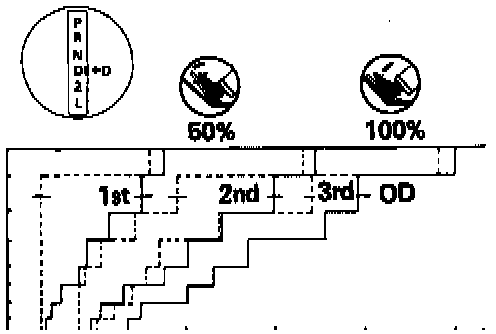
"D" RANGE TEST IN "NORM", AND POWER PATTERN RANGES
Shift into the "D" range and hold the accelerator pedal constant at the 50% and 100% throttle valve opening positions.
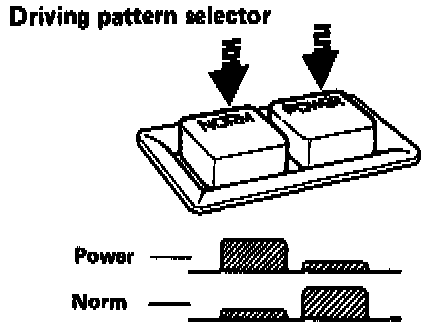
Push in one of the pattern selector buttons and check the following:
1) 1-2, 2-3, 3-OD and lock-up, up-shifts should take place, and shift points should conform to those shown in the automatic shift diagram.
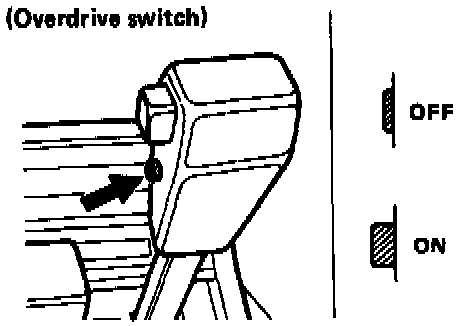
NOTE: There is no OD up-shift or lock-up when the coolant temp. is below 70°C (158°F) or if there is a 10 km/h (6 mph) difference between the set cruise control speed and real speed.
EVALUATION
(1) If there is no 1 --> 2 up-shift:
^ No. 2 solenoid is stuck
^ 1-2 shift valve is stuck
(2) If there is no 2 --> 3 up-shift:
^ No. 1 solenoid is stuck
^ 2-3 shift valve is stuck
(3) If there is no 3 --> OD up-shift (throttle valve opening 1/2):
^ 3-OD shift valve is stuck
(4) If the shift point is defective:
^ Throttle valve, 1-2 shift valve, 2-3 shift valve, 3-OD shift valve etc., are defective.
(5) If the lock-up is defective:
^ No. 3 solenoid is stuck
^ Lock-up relay valve is stuck
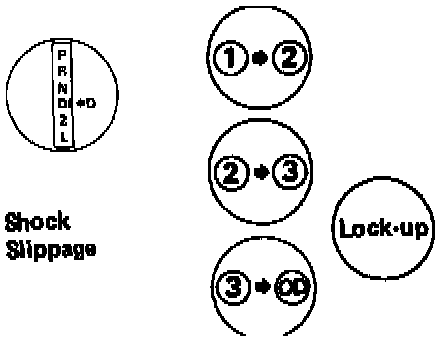
2) In the same manner, check the shock and slip at the 1 --> 2, 2 --> 3 and 3 --> OD up-shifts.
EVALUATION
If the shock is excessive:
^ Line pressure is too high
^ Accumulator is defective
^ Check ball is defective
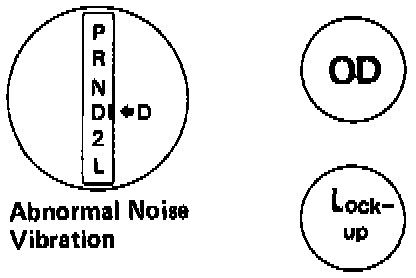
3) Run at "D" range lock-up or OD gear and check for abnormal noise and vibration.
NOTE: The check for the cause of abnormal noise and vibration must be made with extreme care as it could also be due to loss of balance in the propeller shaft, differential, the torque converter, etc. or insufficient bending, rigidity, etc. in the power train.
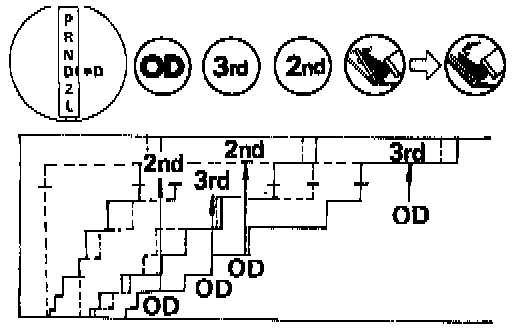
4) While running in "D" range, 2nd, 3rd gears and OD, check to see that the possible kick-down vehicle speed limits for 2 --> 1, 3 --> 1, 3 --> 2, OD --> 3 and OD --> 2 kick-downs conform to those indicated on the automatic shift diagram.
5) Check for abnormal shock and slip at kick-down.
6) While running in "D" range, OD gear or "lock-up", shift to "2" and "L" ranges and check the engine braking effect at each of these ranges.
7) Also check to see that downshift is made from 3 --> 2 or from O.D. to 3 and then to 2 immediately and that 2 --> 1 downshift point is within the limits shown in the diagram when tested by releasing the accelerator pedal and shifting into position of "L" while driving in the third gear or in overdrive.
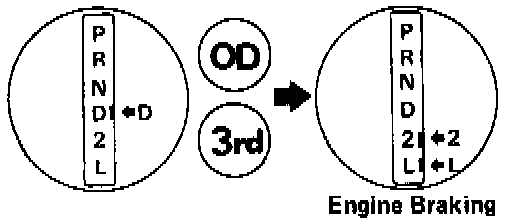
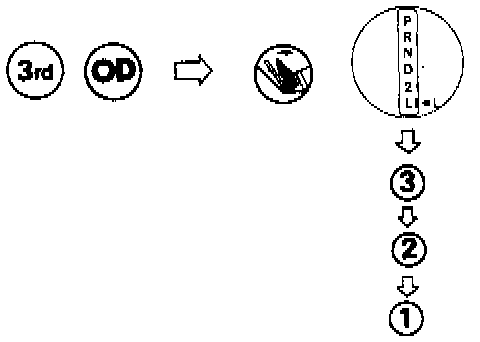
EVALUATION
(1) If there is no engine braking effect in the "2" range:
^ Second coast (No. 1) brake is defective
(2) If there is no engine braking effect in the "L" range:
^ First and reverse (No. 3) brake is defective
^ Second coast (No. 1) brake is defective
(3) Also check to see that downshift is made from 3 --> 2 or from O.D. to 3 and then to 2 immediately and that 2 --> 1 downshift point is within the limits shown in the diagram when tested by releasing the accelerator pedal and shifting into "L" position while driving in the third gear or in overdrive.
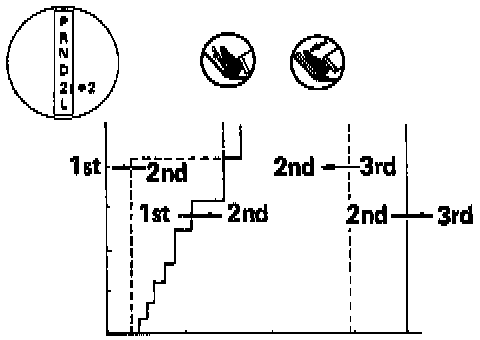
"2" RANGE TEST
Shift into "2" range and, while driving with the accelerator pedal held constantly at the specified point (throttle valve opening 50% and 100%), push in one of the pattern selectors (only for 4x4) and check on the following points.
1) At each of the above throttle openings, check to see that the 1 --> 2 up-shift takes place and that the shift points conform to those shown on the automatic shift diagram.
NOTE: There is no OD and no lock-up in the "2" range.

2) While running in the "2" range and 2nd gear, release the accelerator pedal and check the engine's braking effect.
3) Check for 2 --> 1 down-shift and abnormal noise at acceleration and deceleration, and for shock at upshift and down-shift.
4) Make a kickdown from the second gear and check the limit of vehicle speeds at which kickdown from "2" to "1" takes place (4x2 only).
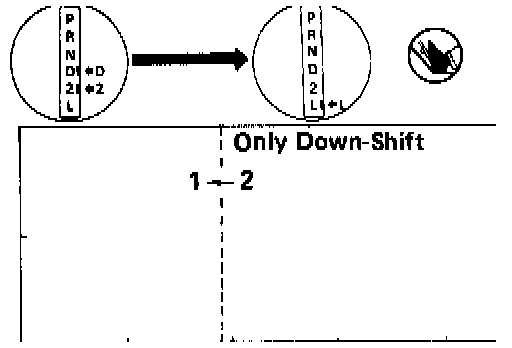
"L" RANGE TEST
1) While running above 80 km/h (50 mph) in the "D" range, release your foot from the accelerator pedal and shift into the "L" range.
Then check to see that the 2 --> 1 down-shift occurs at the specified point shown on the automatic shift diagram.
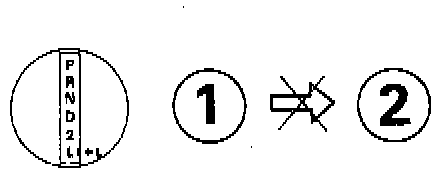
2) While running in the "L" range, check to see that there is no up-shift to 2nd gear.
3) While running in the "L" range, release the accelerator pedal and check the engine braking effect.
4) Check for abnormal noise during acceleration and deceleration.
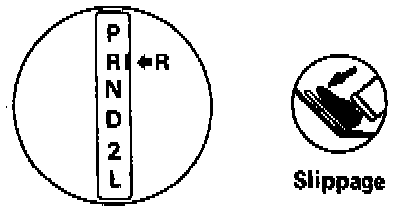
"R" RANGE TEST
Shift into the "R" range and, while starting at full throttle, check for slipping.
"P" RANGE TEST
Stop the vehicle on a grade (more than 9%) and after shifting into the "P range, release the parking brake. Then check to see that the parking lock pawl holds the vehicle in place.
TRANSFER TEST
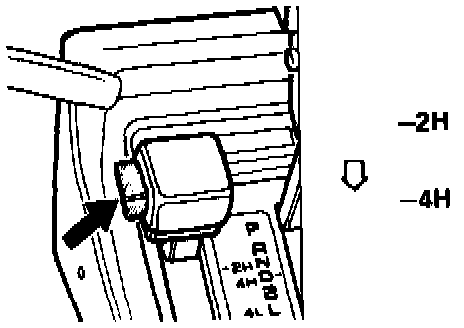
1) When the shift lever is shifted from "2H" to "4H", confirm that the vehicle changes from 2 to 4 wheel drive. If it does not, the transfer is faulty.
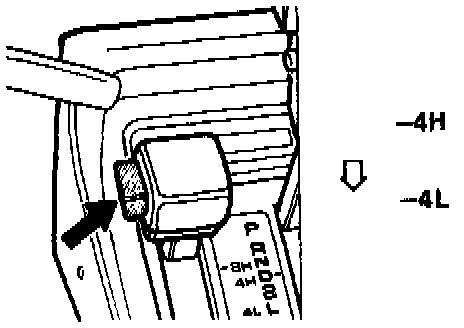
2) When the transfer lever is shifted from "4H" to "4L", confirm that the gear changes according to the shift diagram. If it does not, the No. 4 solenoid, ECT computer or transfer may be faulty.