Crankshaft Position Sensor: Description and Operation
PURPOSEThe signal from the Crankshaft Position (CKP) Sensor, located on the bellhousing of the transmission, is used to determine crankshaft angle, engine speed, and basic timing.
Powertrain Control Module (PCM) also uses the signal from the CKP sensor combined with the input signal from the camshaft position sensor to properly synchronize injection.
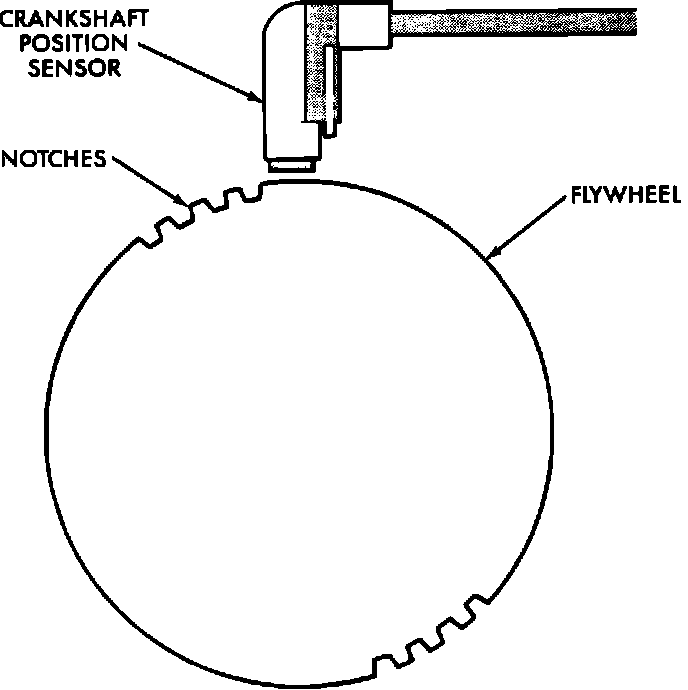
Crankshaft Position (CKP) Sensor Operation:
OPERATION
The crankshaft position sensor is a hall effect switch that detect notches on a pulse ring mounted to the crankshaft.
The notches cause a pulse to be generated when they pass under the sensor. The pulses are input to the PCM. For each engine revolution there are 2 groups of 4 pulses generated.
The trailing edge of the fourth notch is 4 degrees before top dead center of its corresponding cylinder.
If the PCM does not sense input from the crankshaft position sensor, PCM will deactivate Automatic Shutdown (ASD) and fuel pump relay, interrupting voltage to fuel pump, fuel injectors, and ignition coil, (no start condition).
CIRCUIT OPERATION
The Powertrain Control Module (PCM) supplies 8 Volts to the crankshaft position sensor on circuit K7. Circuit K7 connects to cavity 7 of the PCM.
The PCM receives the crankshaft position sensor signal on circuit K24. Circuit K24 connects to cavity 24 of the PCM.
The PCM provides a ground for the crankshaft position sensor (circuit K24) through circuit K4. Circuit K4 connects to cavity 4 of the PCM.