Flywheel: Description and Operation
FLYWHEELDESCRIPTION
Standard Flywheel
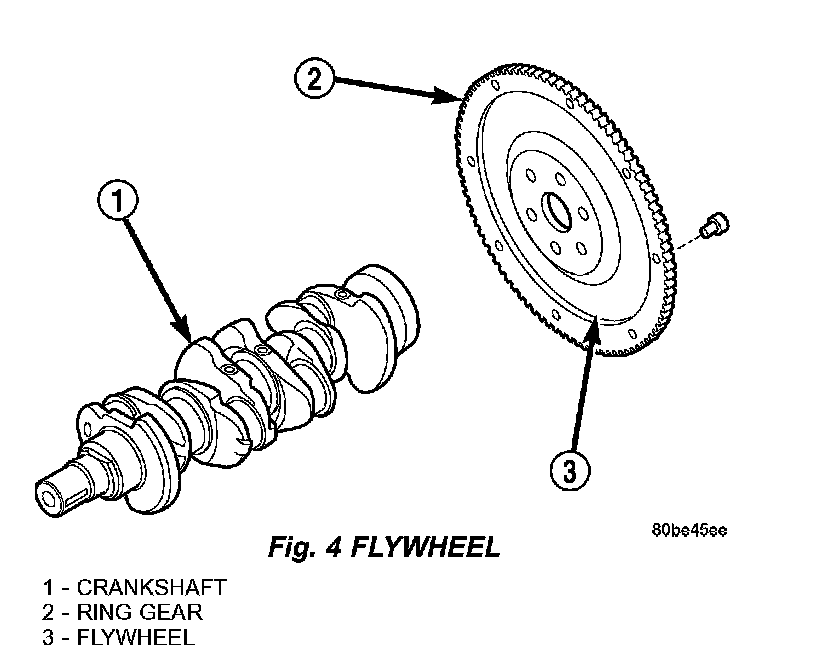
The standard flywheel is used on the 4.0L engine. The flywheel (Fig. 4) is a heavy plate bolted to the rear of the crankshaft. The flywheel incorporates the ring gear around the outer circumference to mesh with the starter to permit engine cranking. The rear face of the flywheel serves as the driving member to the clutch disc.
Dual Mass Flywheel
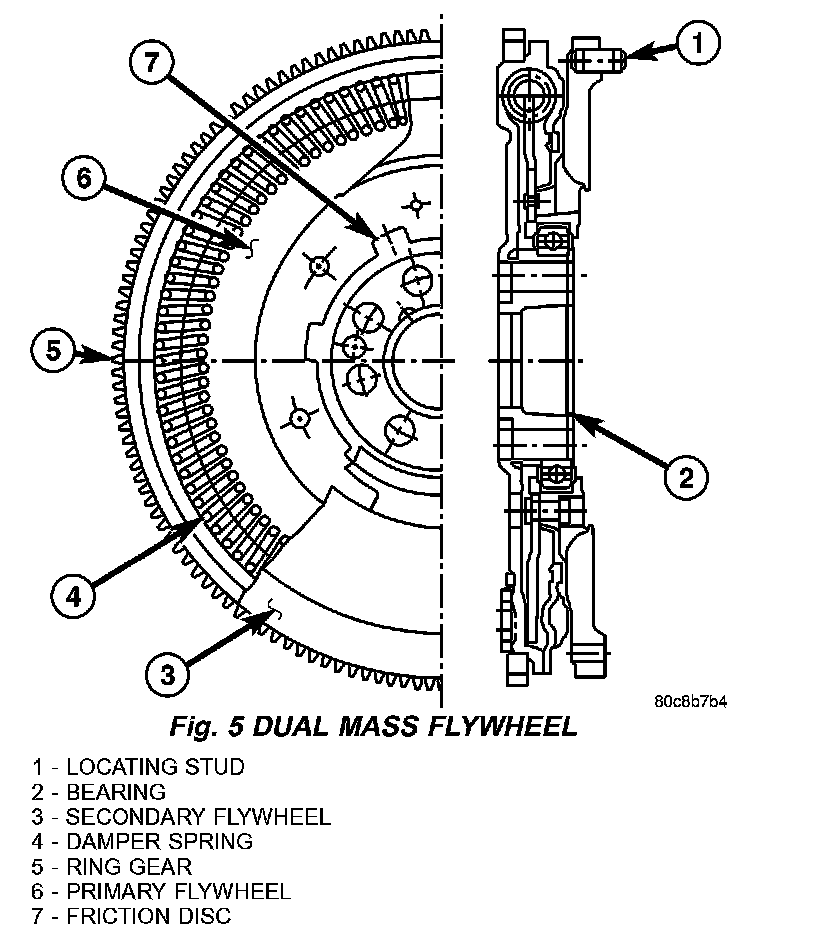
The Dual Mass Flywheel is used on the 2.4L engine (Fig. 5). The flywheel incorporates the ring gear around the outer circumference to mesh with the starter to permit engine cranking. The primary flywheel side is bolted to the crankshaft. The secondary flywheel face serves as the driving member to the clutch disc. Internal springs between the flywheels are use to dampen energy
OPERATION
The flywheel serves to dampen the engine firing pulses. The heavy weight of the flywheel relative to the rotating mass of the engine components serves to stabilize the flow of power to the remainder of the drivetrain. The crankshaft has the tendency to attempt to speed up and slow down in response to the cylinder firing pulses. The flywheel dampens these impulses by absorbing energy when the crankshaft speeds and releasing the energy back into the system when the crankshaft slows down.
On a Dual Mass Flywheel the additional secondary mass coupled to the transmission lowers the natural frequency of the transmission rotating elements. This decreases the transmission gear rattle. The damper springs between the two flywheel masses replace the clutch disc damper springs and assist in a smooth transfer of torque to the transmission.
CAUTION: The Dual Mass Flywheel is serviced as an assembly only and should never be taken apart.