Evaporative Emissions System: Description and Operation
Evaporative Emission Control System (EVAP):
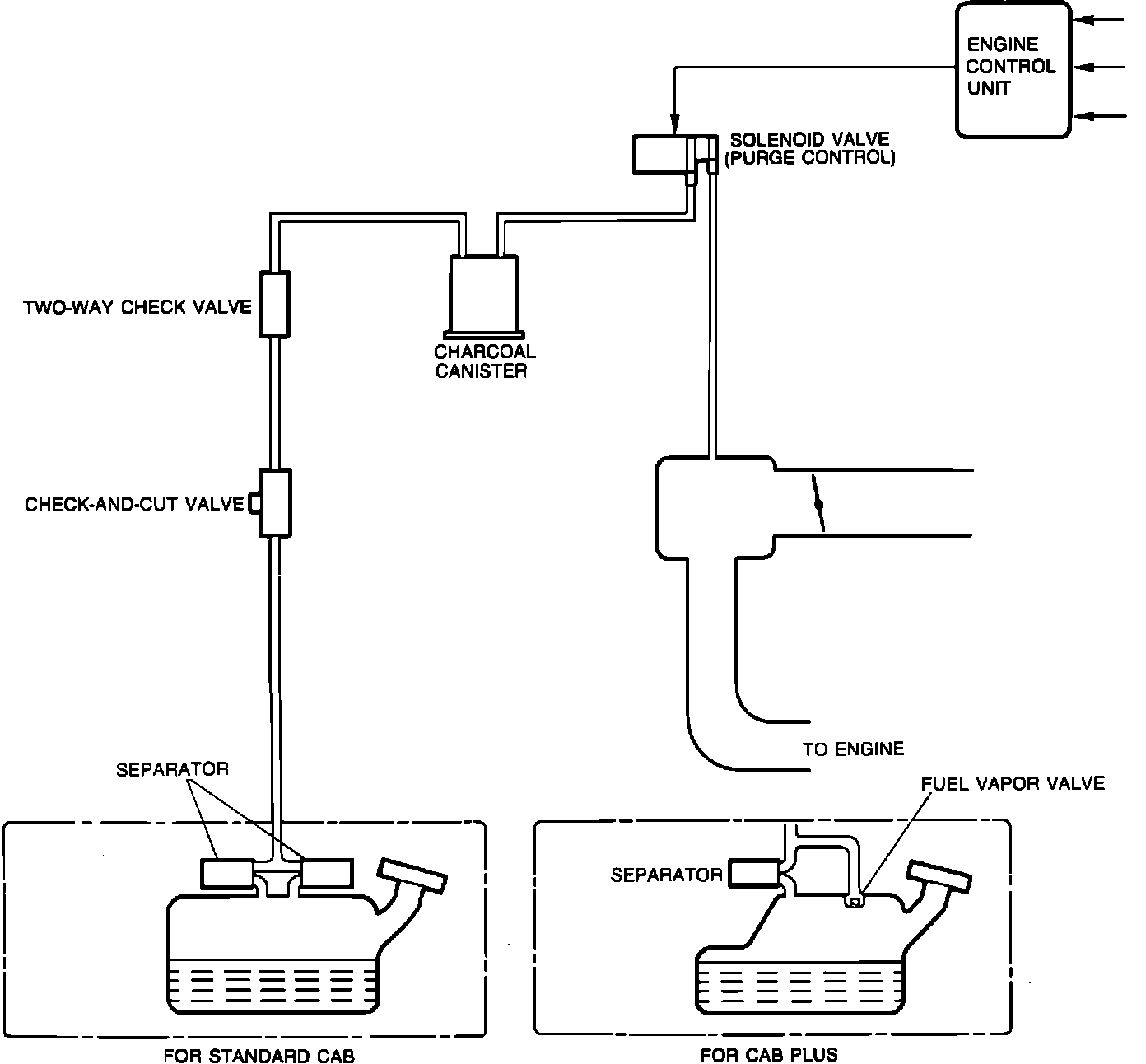
When the engine is not running, the EVAP system collects fuel vapors that would otherwise be discharged into the atmosphere and temporarily stores them in a charcoal canister. When the engine is started, stored vapors are directed to the intake to be burned in the engine. This system of vapor recovery helps reduce raw hydrocarbon emissions and promotes fuel economy by eliminating fuel loss through evaporation.
The EVAP system is ECU controlled and consists of a vapor separator, purge control solenoid valve, charcoal canister, two-way check valve, check-and cut valve, vapor separator, ECU, and engine sensors.
The ECU monitors operating conditions through various engine mounted sensors mounted and regulates amount of vapors drawn into the engine by alternately energizing and de-energizing the solenoid valve (duty cycle signal - "ON" time vs. "OFF" time). The system operates when the following conditions are met.
^ Engine at normal operating temperature.
^ Driving in gear.
^ Accelerator depressed (idle switch off).
^ ECU in "closed loop" operation (oxygen sensor functioning normally).
CHARCOAL CANISTER
The charcoal canister is filled with activated charcoal to condense and store gasoline vapors from the fuel tank when the engine is not running.
VAPOR SEPARATOR
The fuel/vapor separator mounted outside the fuel tank, separates fuel vapors from liquid fuel to prevent charcoal canister saturation. Liquid fuel drains back to the tank from the bottom of the separator. A hose at separator top routes vapors to the canister through the check-and-cut valve and two-way check valve.
FUEL VAPOR VALVE
The fuel vapor valve, installed in top of fuel tank, prevents liquid fuel from entering the EVAP system and saturating the charcoal canister if the fuel tank is overfilled.
CHECK AND CUT VALVE
The check and cut valve has three functions:
^ Vents the fuel tank to the atmosphere if the pressure in the tank exceeds approx. 0.78 - 1.0 psi (5.37 - 6.87 kPa), to prevent fuel tank damage.
^ Allows air from the atmosphere to enter the tank, if the pressure in the tank is approx. 0.14 - 0.71 psi (0.98 - 4.91 kPa) less than atmospheric, to prevent fuel tank damage.
^ Blocks fuel from leaking through the evaporative system in the event the vehicle is overturned.
TWO-WAY CHECK VALVE
The two-way check valve prevents stored fuel vapors from returning to the tank.
PURGE CONTROL SOLENOID VALVE
The purge control solenoid valve is a normally closed, electrically operated vacuum solenoid valve. It gets battery power from the main relay when the ignition is turned "ON" and is energized when the ECU completes the circuit to ground. The solenoid operates on a duty cycle ("ON" time vs "OFF" time). It is connected in-line between PCV valve and charcoal canister and vents charcoal canister to intake manifold under specified operating conditions.