Fuel Tank Pressure Sensor: Testing and Inspection
FUEL TANK PRESSURE SENSOR TESTINGNOTE: The following vacuum and pressure values are indicated by relative pressure from atmospheric pressure.
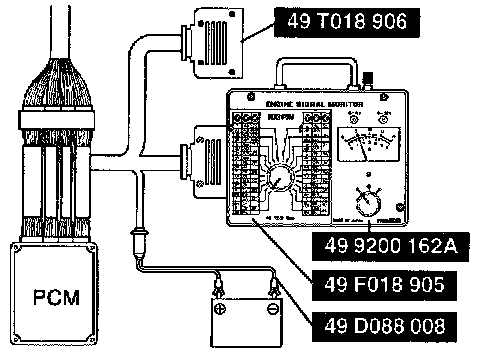
1. Connect the Special Service Tools (Engine Signal Monitor) to the ECM as shown.
CAUTION: Do not apply a vacuum or pressure outside of the specified limits. Doing so will damage the fuel tank pressure sensor
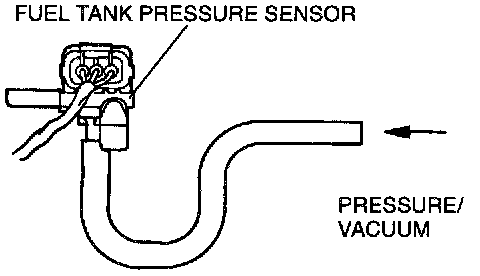
2. Apply pressure then a vacuum to the fuel tank pressure sensor according to the following procedure.
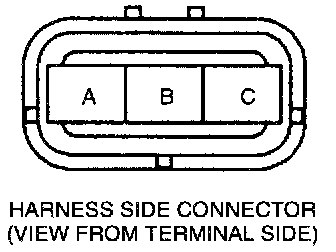
3. Decrease the applied pressure from 6.66 kPa (1.97 in.Hg) to -6.66 kPa (-1.97 in.Hg) and verify that the ECM terminal 3F voltage decreases accordingly.

NOTE: The output voltage varies with the measuring condition.
- Input voltage - 5.0 V
- Atmospheric pressure - 101.3 kPa (760 mmHg, 29.9 in.Hg)
- Outside temperature - 30-100°C (0-182°F)
4. If not as specified inspect harness continuity:
- Between ECM terminal 3F and fuel tank pressure sensor terminal A
- Between ECM terminal 3AB and fuel tank pressure sensor terminal B
- Between ECM terminal 3A and fuel tank pressure sensor terminal C
Terminal voltage:
- Fuel tank pressure sensor terminal B voltage: Ground (Below 1.0 V)
- Fuel tank pressure sensor terminal C voltage: Constant voltage (4.5-5.5 V)
5. If terminal voltage is correct and if there is harness continuity, replace the fuel tank pressure sensor.