Starter Motor: Testing and Inspection
On-vehicle Inspection1. Verify that the battery is furry charged.
2. Crank the engine and verify that the starter turns smoothly without any noise.
3. If not as specified, measure the voltage at terminals S and B when the ignition switch is in START position.
Specification : Above 8V
4. If the voltage is within the specification, remove the starter and inspect the magnetic switch and the starter.
5. If the voltage is not as specified, inspect the wiring harness, ignition switch, and transaxle range switch (AT).
No Load Test
1. Verify that the battery is fully charged.
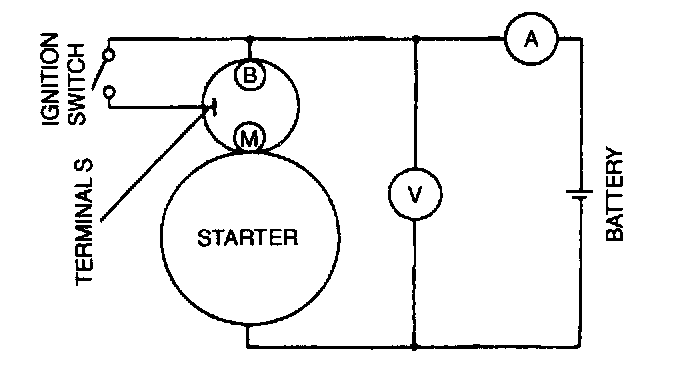
2. Connect the starter, battery, voltmeter, and ammeter as shown.
3. Operate the starter and verify that it turns smoothly.
4. Measure the voltage and current while the starter is operating.
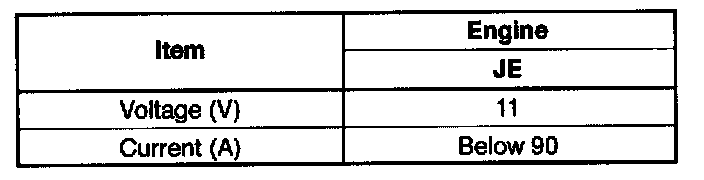
Specification
5. If not as specified, repair or replace the inner parts as necessary.
Starter Inner Parts
Armature
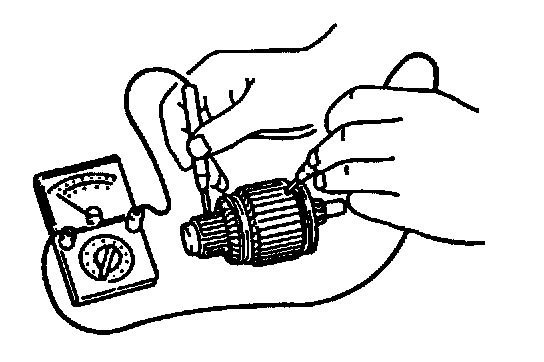
1. Ground of armature coil
Check for no continuity between the commutator and the core by using a circuit tester. Replace the armature if there is continuity.
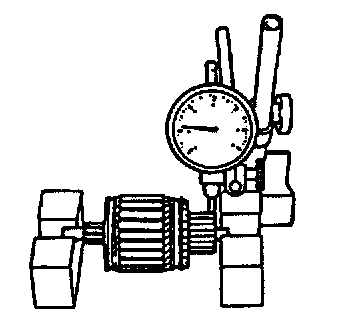
2. Runout of commutator
1. Place the armature on V-blocks, and measure the runout by using a dial indicator.
2. If the runout is at the limit or more, repair by using a lathe or replace the armature.
Standard runout
0.05 mm (0.002 in)
Limit
0.1 mm (0.004 in)
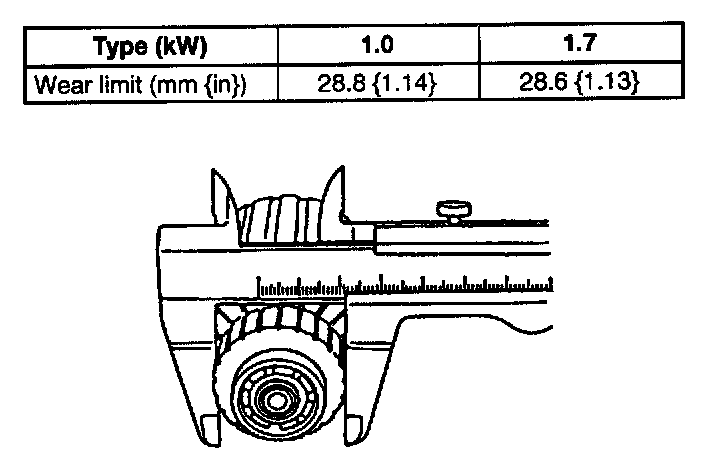
3. Outer diameter of commutator
Replace the armature if the outer diameter of the commutator is at the wear limit or less.
4. Roughness of commutator surface
If the commutator surface is dirty, wipe it with a cloth; if it is rough, repair by using a lathe or fine sandpaper.
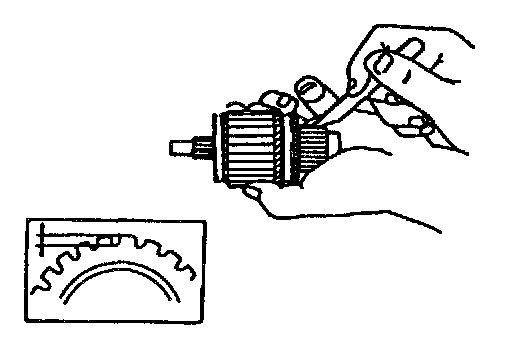
5. Segment groove depth
If the depth of the mold between segments is at the minimum depth or less, undercut the grooves to the standard depth.
Standard depth
0.5 mm (0.020 in)
Minimum depth
0.2 mm (0.008 in)
Yoke
Field coil
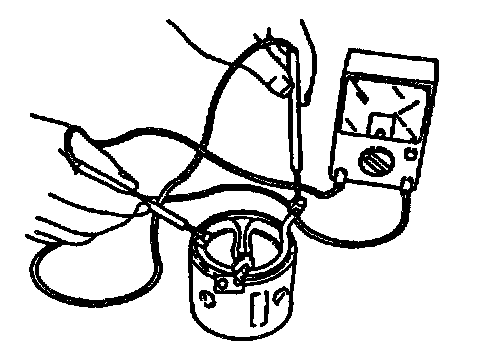
1. Wiring damage
1. Check for continuity between the connector and the brushes by using a circuit tester.
2. Replace the yoke if there is no continuity.
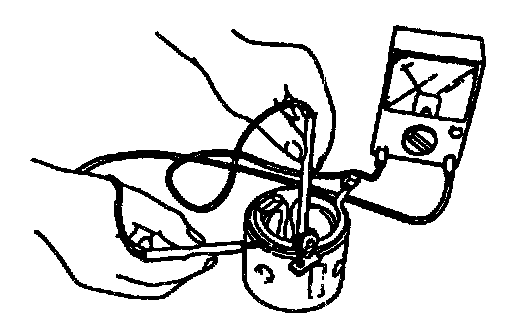
2. Ground of field coil
1. Check for no continuity between the connector and the yoke by using a circuit tester.
2. Repair or replace the yoke if there is continuity.
3. Installation of field coil
^ Replace the yoke if the field coil is loose.
Magnetic switch
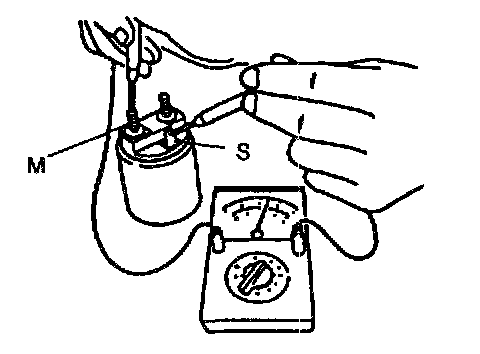
1. Wiring damage (terminal S-terminal M) Check for continuity between terminals S and M by using a circuit tester. Replace the magnetic switch if there is no continuity.
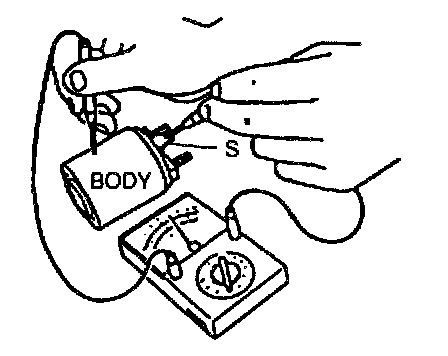
2. Wiring damage (terminal S-body)
^ Check for continuity between terminal S and the body by using a circuit tester. Replace the magnetic switch if there is no continuity.
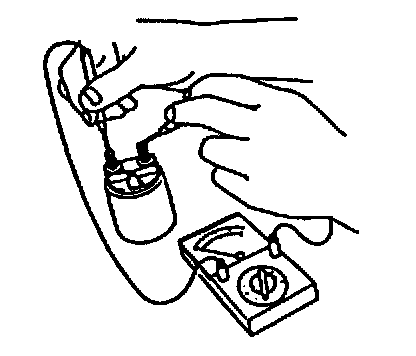
3. Ground of magnetic switch
^ Check for no continuity between terminals M and B by using a circuit tester. Replace the magnetic switch if there is continuity.
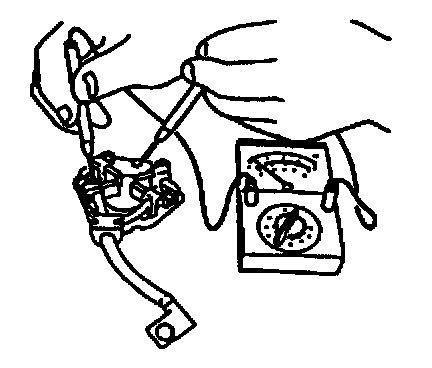
Brush holder
^ Check for continuity between the insulated brush and the plate by using a circuit tester. Replace the brush holder if there is continuity.
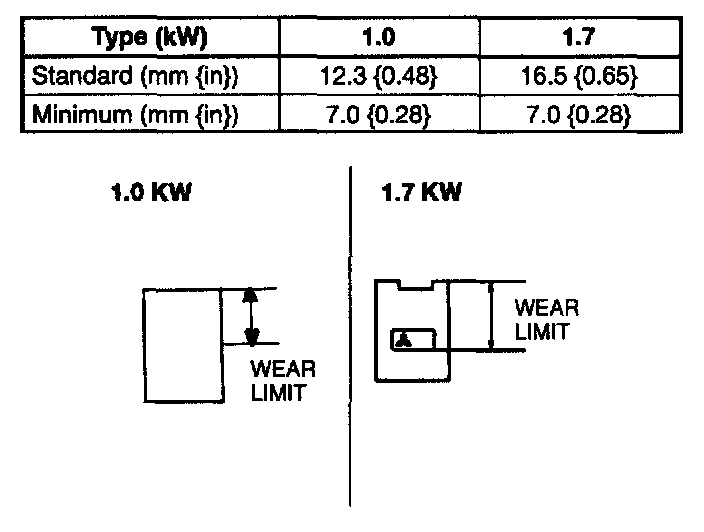
Brush
^ If any brush is worn almost to or beyond the wear limit, replace all of the brushes.
Checking Operation
Magnetic switch
^ Make the following tests:
Pull-out test
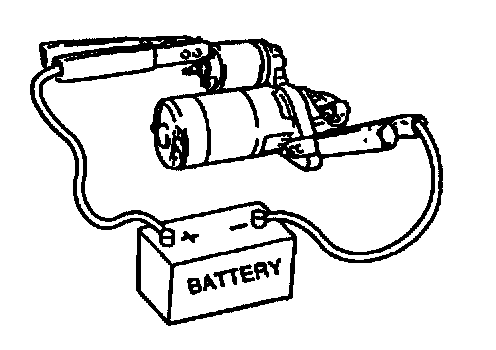
^ Apply battery positive voltage to terminal S and ground the body, and verify that the pinion is pulled out.
^ Measure the pinion gap while the pinion is pulled out.
Specification
0.5-2.0 mm (0.02-0.08 in)
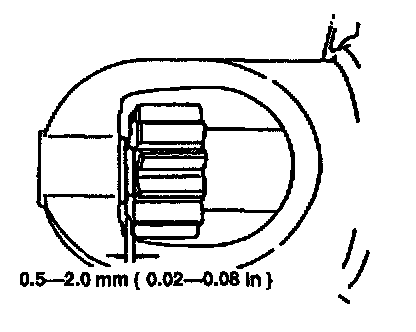
^ If not within the specification, adjust with an adjustment washer (drive housing front cover-magnetic switch).
Return test
1. Disconnect the motor wire from terminal M, and then connect the battery power to terminal M and ground the body.
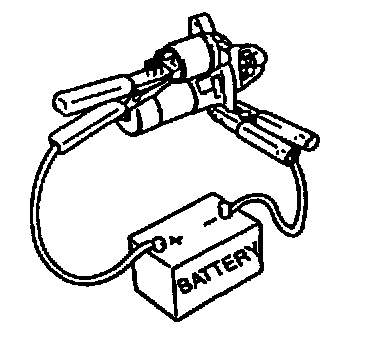
2. Pull out the drive pinion by using a screwdriver. Verify that the drive pinion returns to its original position when released.