Manual Transmission/Transaxle: Description and Operation
MANUAL TRANSAXLE AND CLUTCHManual Transaxle
The manual transaxle is a fully synchronized five-speed transaxle. The forward gears are selected by a synchronizer mechanism. The third gear (3GR), fourth gear (4GR) and fifth speed cluster gear are mounted on the input shaft. First gear (1GR) and second gear (2GR) are mounted on the main shaft. The helical-cut forward gears are in constant mesh with the corresponding gears on the opposing shaft. The manual transaxle features a synchronized reverse gear. The reverse gears have helical-cut teeth and are engaged through a synchronizer.
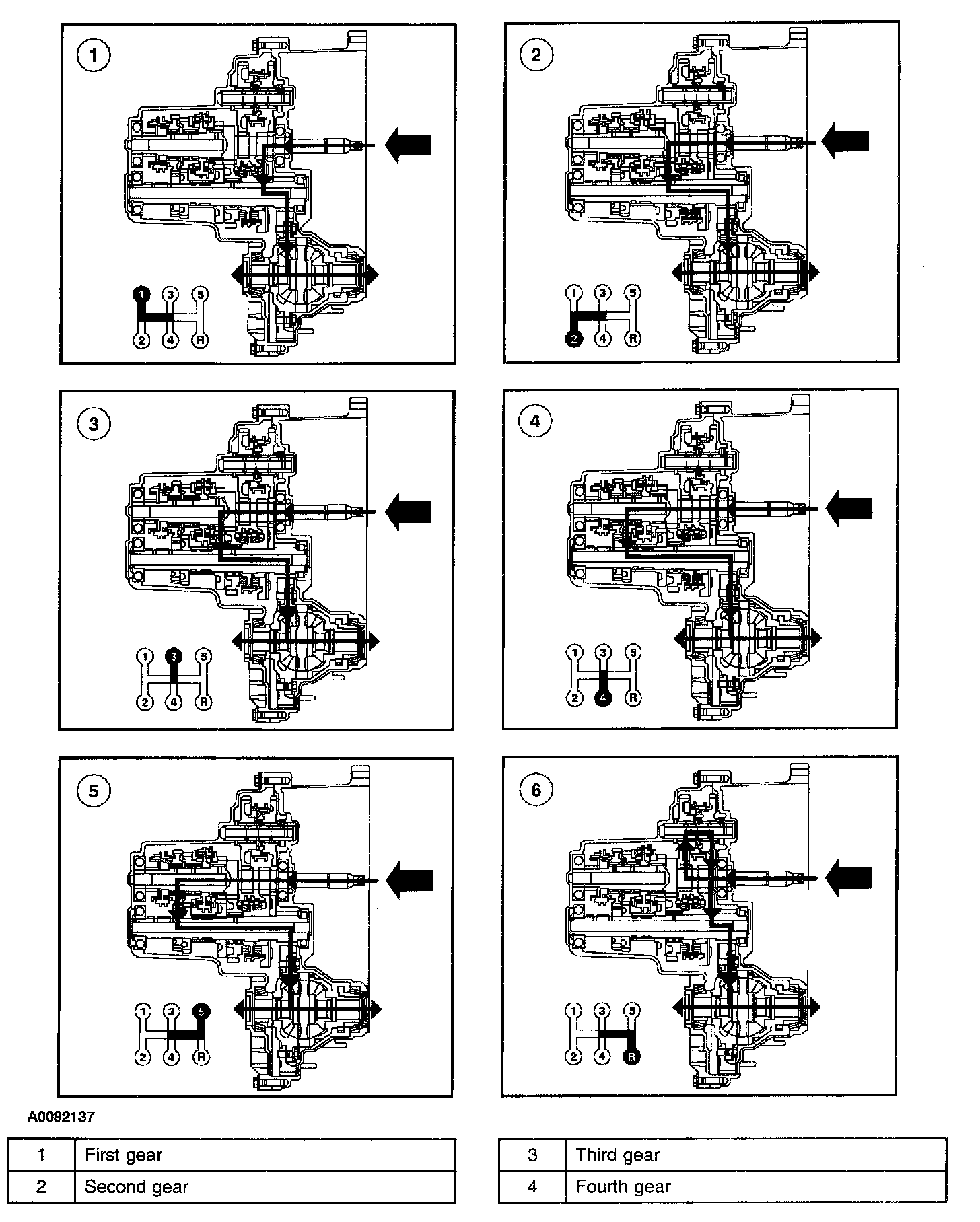

Power Flow
External Shift Linkage
The manual transaxle is controlled by a floor-mounted gearshift lever located in the floor console. Connection between the floor-mounted gear shift lever and the manual transaxle gear shift control mechanism is made through two shift cables.
Internal Shift Linkage
The manual transaxle is shifted internally by four shift forks. The first/second gears shift fork, third/fourth gears shift fork and the fifth gear shift fork controls all forward gear shifts. The reverse gear shift fork controls reverse.
Reverse Gear
The reverse idler gears are mounted on a reverse idler gear shaft supported at one end in the flywheel housing and at the other in the transaxle case. It is because the reverse idler gears rotate on the reverse idler gear shaft, they are supported by two sets of reverse idler gear needle bearings to prevent metal-to-metal contact and wear.
When the reverse idler coupling sleeve and hub engage the reverse idler gear, it reverses the power flow to the main shaft.
Differential
The ends of the differential are supported on tapered roller differential bearings. The cups for these differential bearings are seated in the transaxle case and the flywheel housing. Differential bearing preload is set using a selective differential bearing shim that is installed under the differential bearing cup in the transaxle case. The differential includes the differential side gears and the shaft mounted differential pinion gears. Direct contact between the gears and the differential case is prevented by the differential side gear thrust washers installed under the gears. The differential pinion shaft is held in position by a differential pinion shaft lock pin that extends through the end of the differential pinion shaft and the differential case.
The speedometer drive gear is also mounted on the differential case. It is located between the tapered roller differential bearing and the differential case. A tab on the speedometer drive gear and a matching slot in the differential case prevent the speedometer drive gear from spinning on the differential case.
Clutch
The clutch system includes:
^ flywheel
^ clutch disc
^ clutch pressure plate
^ clutch master cylinder
^ clutch slave cylinder
^ hydraulic line
^ clutch pedal
The clutch system transmits fluid pressure to the slave cylinder, which in turn moves the clutch diaphragm spring.
The clutch master cylinder uses brake fluid and shares a common reservoir with the brake master cylinder.
The clutch is a single plate, dry-friction disc with a diaphragm-style spring clutch pressure plate. The clutch disc has a hub which is splined to the input shaft. The clutch disc has friction material where it contacts the flywheel and the clutch pressure plate. Torsion springs on the flywheel help absorb the engine torque pulses. The clutch pressure plate applies pressure to the clutch disc, holding it tightly against the surface of the flywheel.
In the engaged position, the diaphragm spring holds the clutch pressure plate against the clutch disc, so that engine torque is transmitted to the input shaft. When the clutch pedal is pressed, the clutch release hub and bearing pushes the diaphragm spring center toward the flywheel. The diaphragm spring pivots at the fulcrum, relieving the load on the clutch pressure plate. Steel spring straps riveted to the clutch pressure plate cover pull the clutch pressure plate from the clutch disc, disengaging the engine torque from the transaxle and enabling the gears to be changed.