Initial Inspection
Inspection and Verification1. Verify the customer concern.
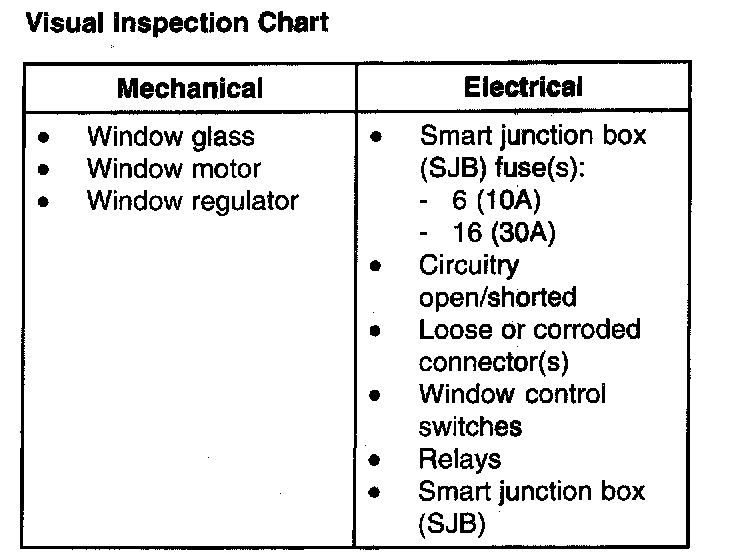
2. Visually inspect for obvious signs of mechanical and electrical damage.
3. If an obvious cause for unobserved or reported concern is found, correct the cause if possible before proceeding to the next step.
4. If the cause is not visually evident, connect the WDS or equivalent tester to the data link connector (DLC) and select the vehicle to be tested from the WDS or equivalent tester menu. If the WDS or equivalent tester does not communicate with the vehicle:
- check that the program card is correctly installed.
- check the connections to the vehicle.
- check the ignition switch position.
5. If the WDS or equivalent tester still does not communicate with the vehicle, see the WDS or equivalent tester operating manual.
6. Carry out the DATA LINK DIAGNOSTIC TEST. If the WDS or equivalent tester responds with:
- SCP+, SCP- or UBP circuit fault; all ECUs no response/not equipped, see COMMUNICATIONS NETWORK.
- NO RESP/NOT EQUIP for SJB, see SYMPTOM TROUBLESHOOTING CHART - POWER WINDOWS. Symptom Related Diagnostic Procedures
- SYSTEM PASSED, retrieve and record the continuous diagnostic trouble codes (DTCs), erase the continuous DTCs and carry out the self-test for the SJB.
7. If the DTCs retrieved are related to the concern, see SMART JUNCTION BOX (SJB) DIAGNOSTIC TROUBLE CODE (DTC) INDEX. Diagnostic Trouble Code Descriptions
8. If no DTCs related to the concern are retrieved, see SYMPTOM TROUBLESHOOTING CHART - POWER WINDOWS. Symptom Related Diagnostic Procedures