Seat Belt Systems: Description and Operation
OCCUPANT RESTRAINT SYSTEMWARNING:
- All safety belt assemblies including retractors, buckles, belt tension sensor (BTS), if equipped, front seat belt buckle support assemblies (slide bar), if equipped, shoulder belt height adjusters, if equipped, child safety seat tether bracket assemblies, if equipped, and attaching hardware should be inspected after any collision. Mazda recommends new safety belt assemblies be installed unless a qualified technician finds the assemblies show no damage and operate correctly. Safety belt assemblies not in use during a collision should also be inspected and new assemblies installed if either damage or incorrect operation is noted.
- The automatic locking retractor (ALR) feature of the safety belt retractor must be checked by a qualified technician to verify that the AIR feature for a child seat is functioning properly, in addition to other checks for proper safety belt system function. A belt and retractor assembly must be replaced if the safety belt assembly's automatic locking retractor feature or any other safety belt function is not operating properly when inspected according to the functional inspection procedures in the workshop manual. Failure to replace the belt and retractor assembly could increase the risk of injury in collisions.
- Each seating position in the vehicle has a specific safety belt assembly which consists of one buckle and one tongue. The safety belt assembly is designed to be used as a pair and is not to be used across seating positions. Failure to follow these instructions may result in personal injury.
- Never put a rear-facing child seat on the front seat of a vehicle with a passenger air bag. If the air bag deploys, it can hit the back of the child seat with enough force to cause severe personal injury or death to the infant.
- A forward-facing child safety seat should only be placed in the front seat when it is unavoidable. If you must place a forward facing child seat in the front, always move the seat as far back as possible, because the force of the deploying front passenger air bag could cause death or serious injury to the infant. If the vehicle is equipped with a passenger air bag deactivation switch, the passenger air bag must be deactivated.
When replacing any active occupant restraint components, use only the replacement parts specified in the Mazda Customer Service Division Master Parts Catalog.
The active restraint system consists of the following:
- front row safety belt buckles and pretensioners, attached to the inboard side of the seats
- front row safety belt retractors, located behind the lower B-pillar trim panels
- second row outboard safety belt retractors, located behind the rear quarter trim panels
- second row 60/40 seat center safety belt retractor and LH safety belt buckle assembly integrated into the 60 percent seat back
- second row dual safety belt buckle assembly for the 60/40 seat attached to the floor pan under the RH seat cushion
- second row lower anchors and tethers for children (LATCH) at all outboard seating positions, welded to the seat backrest frame
- child safety seat tether anchors are attached to the roof near the rear liftgate door
Safety Belt Buckle and Pretensioner
The safety belt buckle and pretensioner is a pyrotechnic device that removes excess webbing from the safety belt when deployed. The pretensioner works in conjunction with the front air bag system. When the front air bags deploy, the pretensioners deploy, causing the buckle to move downward, removing excess webbing from the lap and shoulder safety belts.
If the vehicle is involved in a collision that results in deployment of the front air bags and safety belt pretensioners, a new driver and passenger seat belt system (including safety belt buckle and pretensioners, safety belt retractors, and height adjusters), must be installed.
For safety belt buckle pretensioner diagnostic information, see AIR BAG AND SAFETY BELT PRETENSIONER SUPPLEMENTAL RESTRAINT SYSTEM (SRS).
For safety belt buckle pretensioner disposal information, see SAFETY BELT PRETENSIONER DISPOSAL - DEPLOYED.
Belt Tension Sensor (BTS)
The BTS is part of the passenger front outboard safety belt and retractor assembly. The BTS is located at the safety belt anchor point and is used in conjunction with the occupant classification sensor (OCS) system.
Dual Locking Mode Retractors
WARNING: After any vehicle collision, the safety belt system at all outboard seating positions (except driver, which has no automatic locking retractor feature) must be checked by a qualified technician to verify that the automatic locking retractor feature for child seats is still functioning properly, in addition to other checks for proper safety belt system function. A belt and retractor assembly must be replaced if the safety belt assembly's automatic locking retractor feature or any other safety belt function is not operating properly when checked according to the procedures in the workshop manual. Failure to replace the belt and retractor assembly could increase the risk of injury in collisions.
NOTE: When replacing a dual locking mode retractor, the retractor should be checked to make sure it is not in the automatic locking retractor (ALR) mode after installation in the stowed position.
All outboard continuous-loop, three-point retractor systems, except the driver position, are equipped with the dual locking mode system.
The emergency locking retractor (ELR) mode will allow the occupant freedom of movement, locking tight only on hard braking, hard cornering, or an impact of approximately 8 km/h (5 mph). The ELR mode helps to reduce the forward movement of the driver and passengers. The ELR mode is continuously in operation at all seating positions.
The ALR portion of this system does not allow the occupant freedom of movement. The ALR mode is used when locking a child seat in an outboard seating position or when a tight belt fit is desired. The ALR mode is disengaged when the webbing is free to move in or out of the retractor. The ALR mode is automatically engaged when the webbing is fully extracted from the retractor and then allowed to retract. As the webbing is retracted back onto the spool, an audible clicking sound is made, indicating that the retractor is in ALR mode. The ALR mode is automatically disengaged when most of the webbing is retracted back onto the spool.
The automatic locking mode must be used when installing a child safety seat in the front or rear passenger seating positions where dual locking mode retractors are provided.
Energy Management Retractor
This vehicle has a safety belt system with an energy management feature at the front seating positions to help further reduce the risk of injury in the event of a head-on collision.
The energy management retractor feature is designed to pay out webbing in a controlled manner. This feature is designed to help reduce the belt force acting on an occupant's chest.
Fastening Safety Belts
WARNING: Do not introduce slack into the safety belt system because the belt locks upon impact where it is positioned. Use the shoulder safety belt on the outside shoulder only. Never wear the shoulder safety belt under the arm. Never swing the shoulder safety belt around the neck over the inside shoulder. Never use a single belt for more than one person. Make sure the lap portion of the belt is fitted snugly and as low as possible around the hips, not the waist. Failure to follow these precautions could increase the chance and severity of injury in a collision.
Always follow the preceding safety precautions when fastening the safety belts.
Safety Belt Extension Assembly
In certain cases, the safety belt may be too short even when it is fully extended. About 20 cm (8 in) can be added to the belt length by using a safety belt extension. Safety belt extensions are available at no cost from any Mazda dealer parts department. Safety belt extensions are only available with black webbing.
Use only extensions manufactured by the same supplier as the safety belt. Manufacturer identification is located at the end of the webbing on the label. Also, use the safety belt extension only if the safety belt is too short for you when fully extended. Do not use an extension to change the fit of the shoulder belt across the torso.
Child Safety Seat Tether Anchors
WARNING: The child safety seat tether anchor/bolt MUST be securely tightened to specification. Otherwise, the child safety seat may not be correctly secured and the child could be injured if the vehicle is involved in a collision or stops suddenly.
The child safety seat tether anchors are attached to the roof near the rear liftgate.
If the child safety seat tether anchors were in use during a collision, inspect and install new anchors as necessary. Return the vehicle structure to its original production configuration.
Attaching Safety Seats With Tether Straps
Some manufacturers make child safety seats that include a tether strap that goes over the back of the vehicle seat and attaches to an anchoring point. Other manufacturers offer the tether strap as an accessory. Contact the manufacturer of the child safety seat for information about ordering a tether strap.
The removal and installation portion of this section or the Owner's Literature for usage information.
Lower Anchors and Tethers for Children (LATCH)
The lower anchors and tethers for children (LATCH) system is a standardized and uniform attachment system for installing child safety seats in passenger vehicles. LATCH-equipped child safety seats have two lower attachments that connect to the vehicle portion of the LATCH system.
The vehicle portion of the system consists of two attachment points (6 mm wires) welded to the 60 percent and the 40 percent rear seat backrest frame. The attachment points protrude from the bite line between the seat cushion and seat backrest.
If a child safety seat was in use during a collision, inspect the vehicle portion of the system for damage. If any of the attachment points (6mm wires) are damaged, install a new seat backrest frame.
Safety Belt Warning Indicator and Chime
The warning indicator and chime are reminders to fasten the safety belt. The system operates as follows:
- If the driver safety belt is not buckled before the ignition switch is turned to the ON position, the safety belt warning indicator illuminates for one minute and the warning chime sounds for 6 seconds.
- If the driver safety belt is buckled while the warning indicator is illuminated and the warning chime is sounding, the safety belt warning light and warning chime turn off.
- If the driver safety belt is buckled before the ignition switch is turned to the ON position, the safety belt warning indicator and warning chime remain off.
Belt-Minder
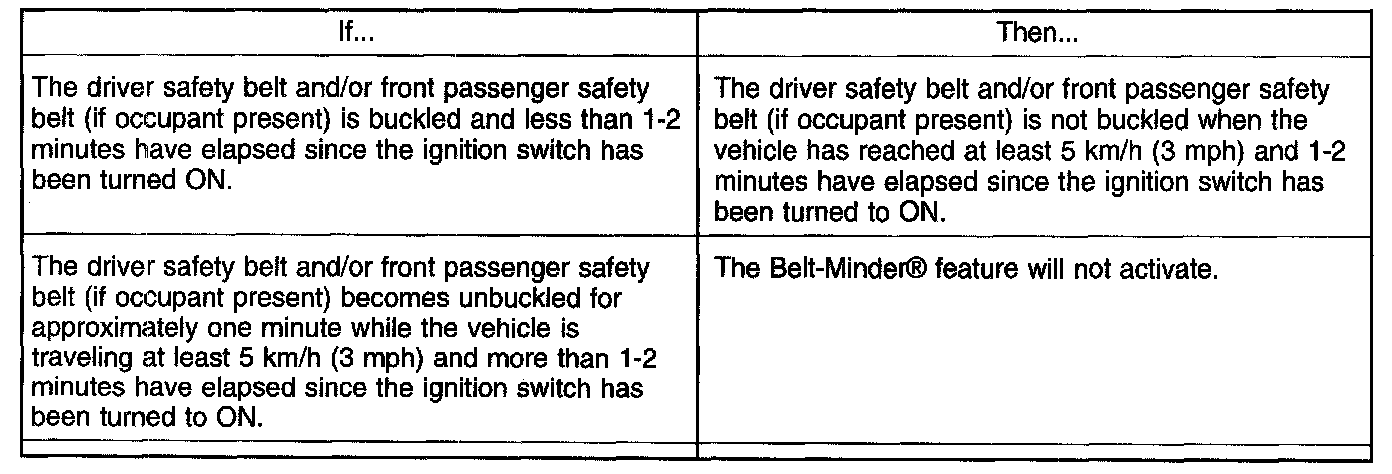
The Belt-Minder(R) feature is a supplemental warning to the safety belt warning function. This feature provides an additional reminder to the driver that the driver's safety belt is unbuckled by intermittently sounding a chime and illuminating the safety belt warning lamp in the instrument cluster.
Both the driver and passenger safety belts are monitored and either may activate the Belt-Minder(R) feature. The warnings are the same for the driver and the front passenger. If the Belt-Minder(R) warnings have expired (warnings for approximately 5 minutes) for one occupant (driver or front passenger), the other occupant can still activate the Belt-Minder(R) feature.
The driver and front passenger Belt-Minder(R) feature is deactivated/activated independently. When deactivating activating the Belt-Minder(R) for a seat, do not buckle the safety belts on the other seat, or the process will be terminated.
To activate or deactivate the Belt-Minder(R) feature, see BELT-MINDER(R) DEACTIVATING/ACTIVATING.