Exhaust Gas Recirculation: Description and Operation
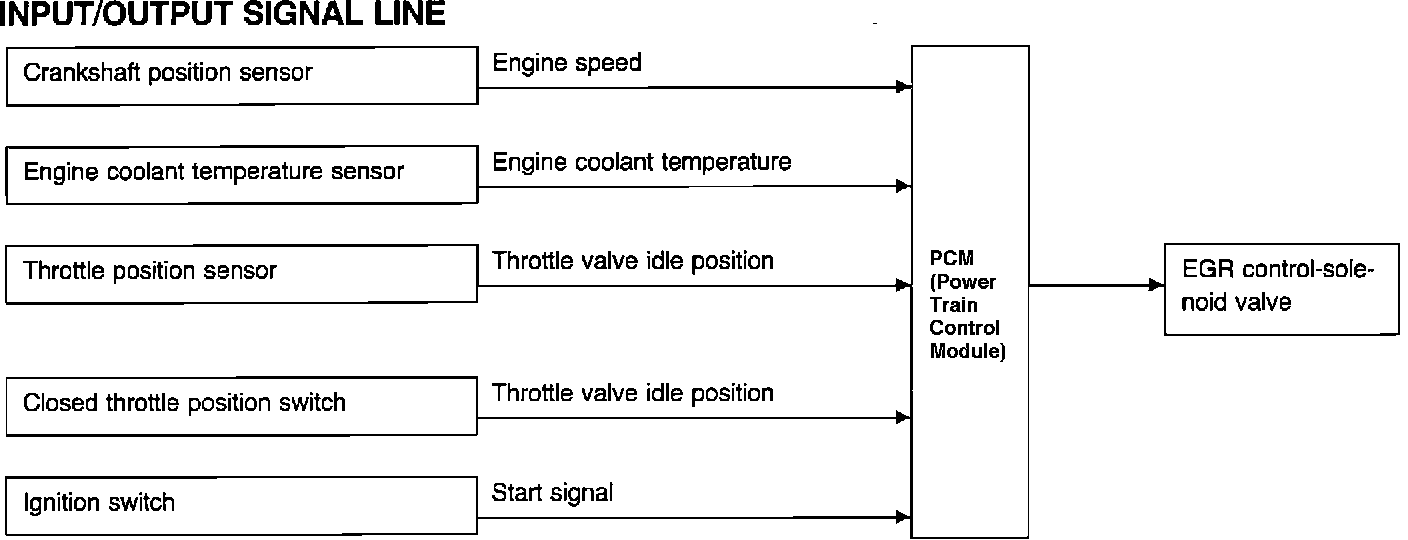
EGR Control System Input/Output Chart:
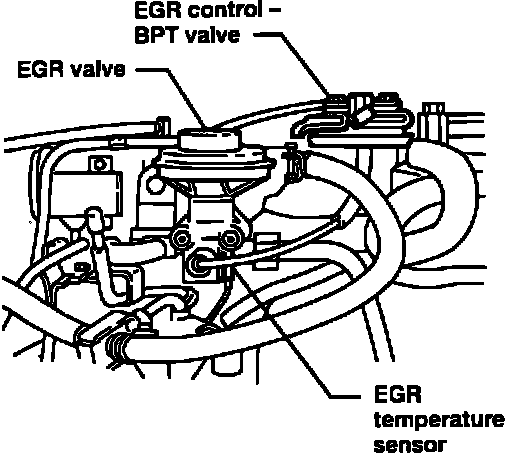
ECCS Component Locations:
PURPOSE
To reduce the formation of NOx by introducing recirculated exhaust gasses into the combustion chamber, thereby lowering combustion temperatures.
OPERATION
The Exhaust Gas Recirculation (EGR) system recirculates a portion of the exhaust gases into the intake manifold under average vehicle driving conditions. The amount of exhaust gas recirculated varies from zero with a cold engine, to a fixed rate for a hot engine with intermediate load and low engine speed. The flow rate increases steadily as coolant temperature rises above 65°C(149°F).
FEATURES
The system uses a control solenoid, activated by the Powertrain Control Module (PCM), to control the EGR system. The EGR system can be deactivated, aside from component malfunction, by the PCM and sensor inputs to the PCM. The sensors that help control the EGR system are listed below.
^ Camshaft Position (CPM) sensor
^ EGR Control (EGRC) solenoid
^ EGR temperature sensor
^ EGR valve
^ Engine Coolant Temperature (ECT) sensor
^ Idle (lDL) switch
^ Mass Air Flow (MAF) sensor
^ Powertrain Control Module (PCM)
^ Throttle Position (TP) sensor
^ EGR Backpressure Transducer
To deactivate the EGR system, the vacuum supply to the EGR valve is eliminated. The 3.OL engine deactivates the Exhaust Gas Recirculation Control (EGRC) solenoid to disable the EGR system.
The EGRC solenoid controls the EGR valve. If the PCM and the sensor inputs determine the EGR valve needs to be closed, the PCM activates the EGRC solenoid. When activated, the EGRC solenoid discharges vacuum into the atmosphere so that the EGR valve remains closed. The EGR temperature sensor detects the EGR flow and notifies the PCM with an input signal. The PCM can then determine the EGR valve's position and regulate the EGR valve.