Federal
ON-BOARD DIAGNOSTICS
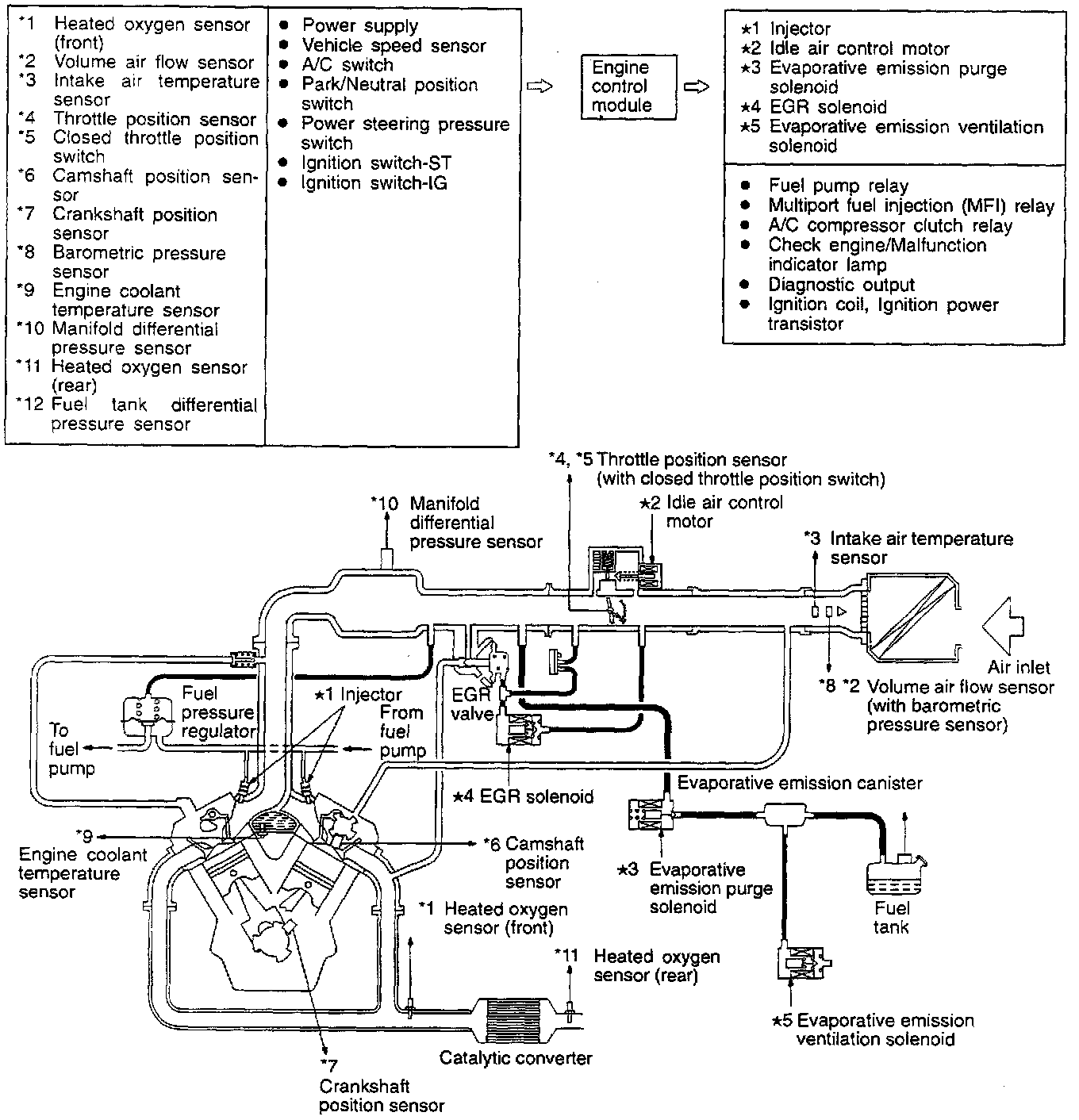
The engine control module monitors the input/output signals (some signals at all times and the others under specified conditions) of the engine control module.
When a malfunction has continued for a specified time or longer since the irregular signal is initially monitored, the engine control module judges that a malfunction has occurred.
After the ECM first detects a malfunction, a diagnostic trouble code is recorded when the engine is restarted and the same malfunction is re-detected. However, for items marked with a diagnostic trouble code is recorded on the first detection of the malfunction.
There are 51 diagnostic items, and the diagnostic results can be read out with a scan tool.
Moreover, since memorization of the diagnostic trouble codes is backed up directly by the battery, the diagnostic results are memorized even if the ignition key is turned off. The diagnostic trouble codes will, however, be erased when the battery terminal or the engine control module connector is disconnected.
In addition, the diagnostic trouble code can also be erased by turning the ignition switch to ON and sending the diagnostic trouble code erase signal from the scan tool to the engine control module.
CAUTION: If the sensor connector is disconnected with the ignition switch turned on, the diagnostic trouble code is memorized. In this case, send the diagnostic trouble code erase signal to the engine control module in order to erase the diagnostic memory.
The 51 diagnostic items are provided as follows and if plural items are activated, they are all indicated sequentially from the smallest code number.
CAUTION: The diagnostic trouble code of ignition timing adjustment signal is output whenever terminal for ignition timing adjustment is grounded.
Therefore, it is not a malfunction that the code is output when adjusting ignition timing.
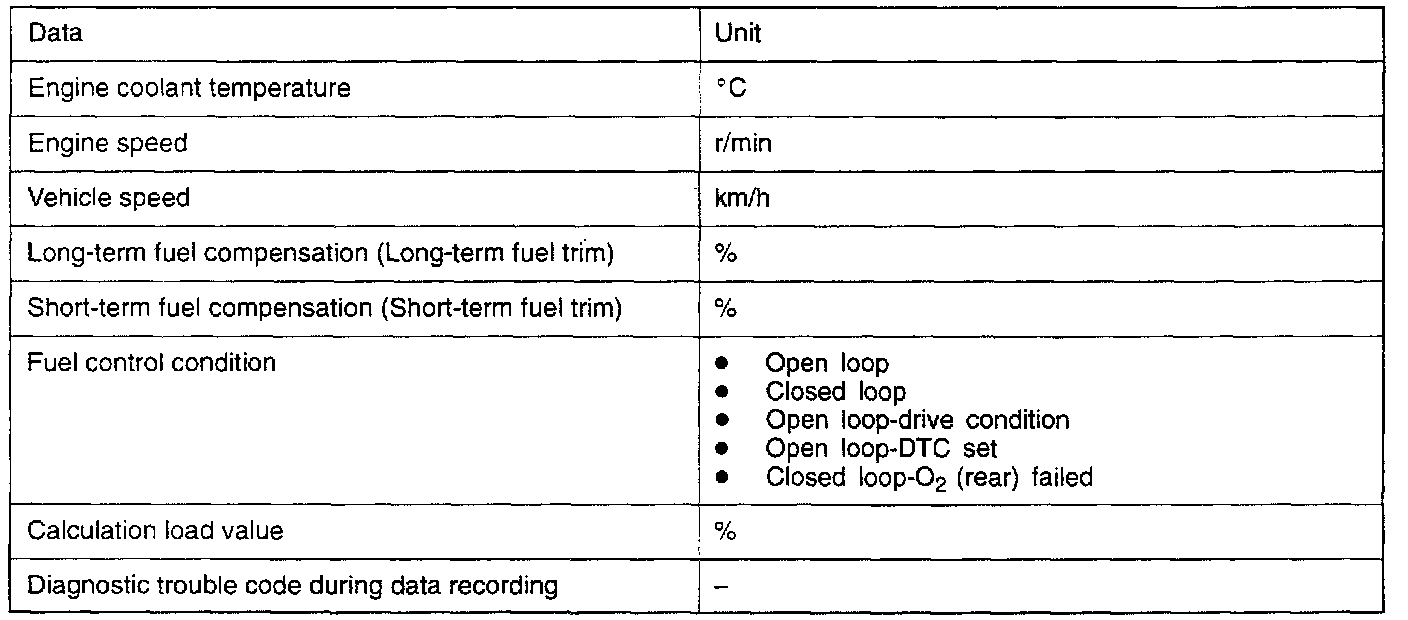
The ECM records the diagnostic trouble code and the engine operating conditions at the time the malfunction was detected. These data are called "freeze frame" data.
This data indicates the engine operating condition from when nothing at all is detected to the initial detection of malfunction.
This data can be read by using the scan tool, and can then be used in simulation tests for troubleshooting. Data items are as follows.
OBD-II DRIVE CYCLE:
All kinds of diagnostic trouble codes can be monitored by carrying out a short drive in accordance with. the following 6 drive cycle patterns. In other words, doing such a drive allows to regenerate any kind of trouble which involves illuminating the Check Engine/Malfunction Indicator Lamp and to check the repair procedure has eliminated the trouble (the Check Engine/Malfunction Indicator Lamp is no longer illuminated).
CAUTION: Two mechanics should always get on the vehicle when carrying out a drive test.
Catalytic converter monitor (P0420, P0421, P0431)
Test requirements/procedure:
1. All of the following requirements should be met when carrying out a drive test.
(1) Atmospheric temperature: -10°C (14°F) or more
(2) Condition of A/T:
- Selector lever position: D range
- Overdrive switch: ON
- Pattern select switch: OFF
(3) A/C switch: OFF
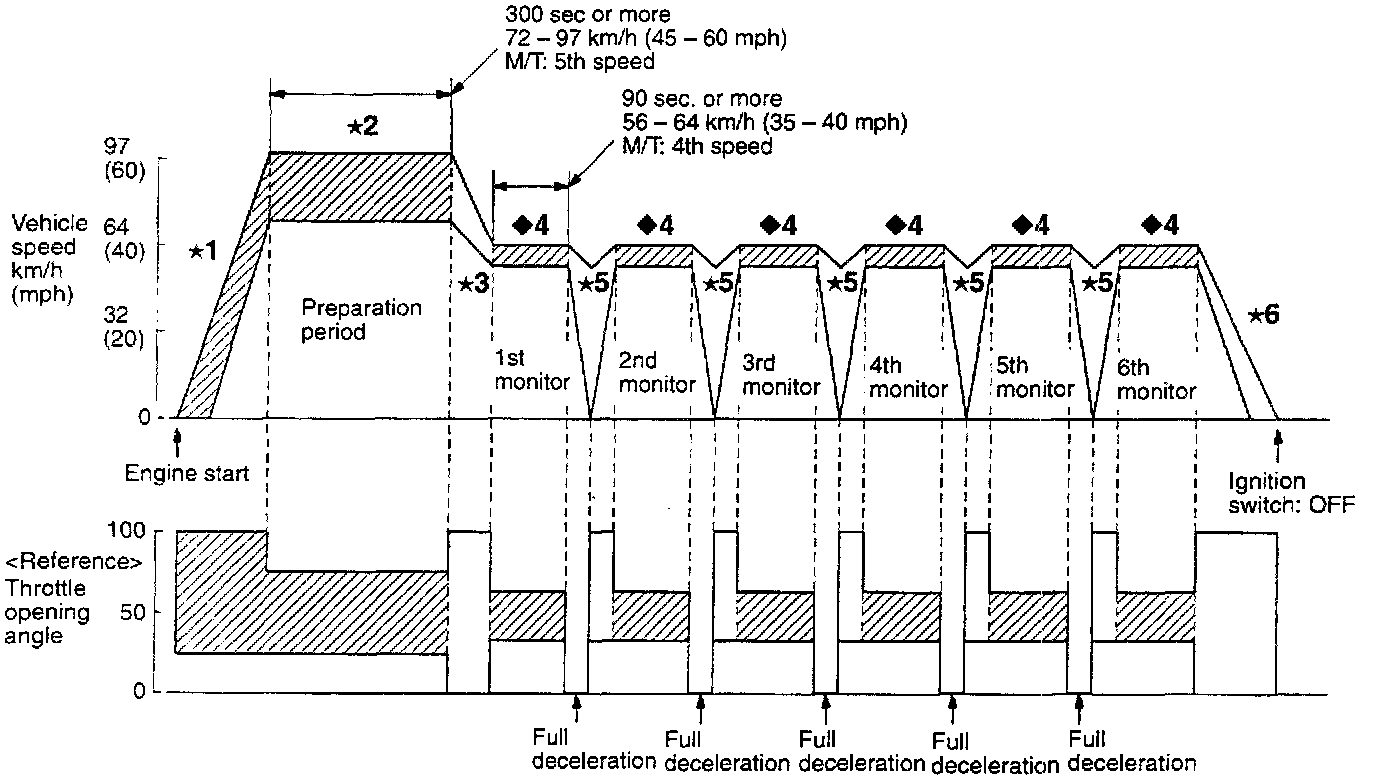
2. One trip monitor will be completed by driving according to the steps below (from start to switch off). It will take 20 minutes.
*1: Start the engine, and accelerate gradually to 72 km/h (45 mph) or more.
*2: Preparation period; continue driving between 72 and 97 km/h (45 and 60 mph) for 300 seconds. Brake may be applied for this period if it continues for only a few seconds.
*3: Decelerate to 56 - 64 km/h (35 - 40 mph).
<4>: Drive between 56 and 64 km/h (35 and 40 mph) at a constant throttle angle (by not moving the throttle pedal as much as possible) for 90 seconds or more during monitor.
*5: Decelerate with the throttle valve fully closed (Brake may be applied for this period). After the vehicle is being decelerated for ten seconds, accelerate gradually to 56 - 64 km/h (35 - mph). Then repeat <4> and *5 steps six times. (The procedure in steps <4> and *5 should be completed a total of six times.)
*6: Decelerate and stop the vehicle. Then turn off the ignition switch.
Drive cycle pattern
CAUTION: Vehicle speed and throttle opening angle should be within the shaded rage.
Evaporative emission control system leak monitor (P0442, P0450, P0455)
Test requirements/procedure:
1. Test requirements/procedure
(1) Engine coolant temperature: 45°C (113°F) or less (Before the test, engine stopped)
(2) Atmospheric temperature: 5°C (41°F) or more, 45°C (113°F) or less
(3) Condition of A/T:
- Selector lever position: D range
- Overdrive switch: ON
- Pattern select switch: OFF
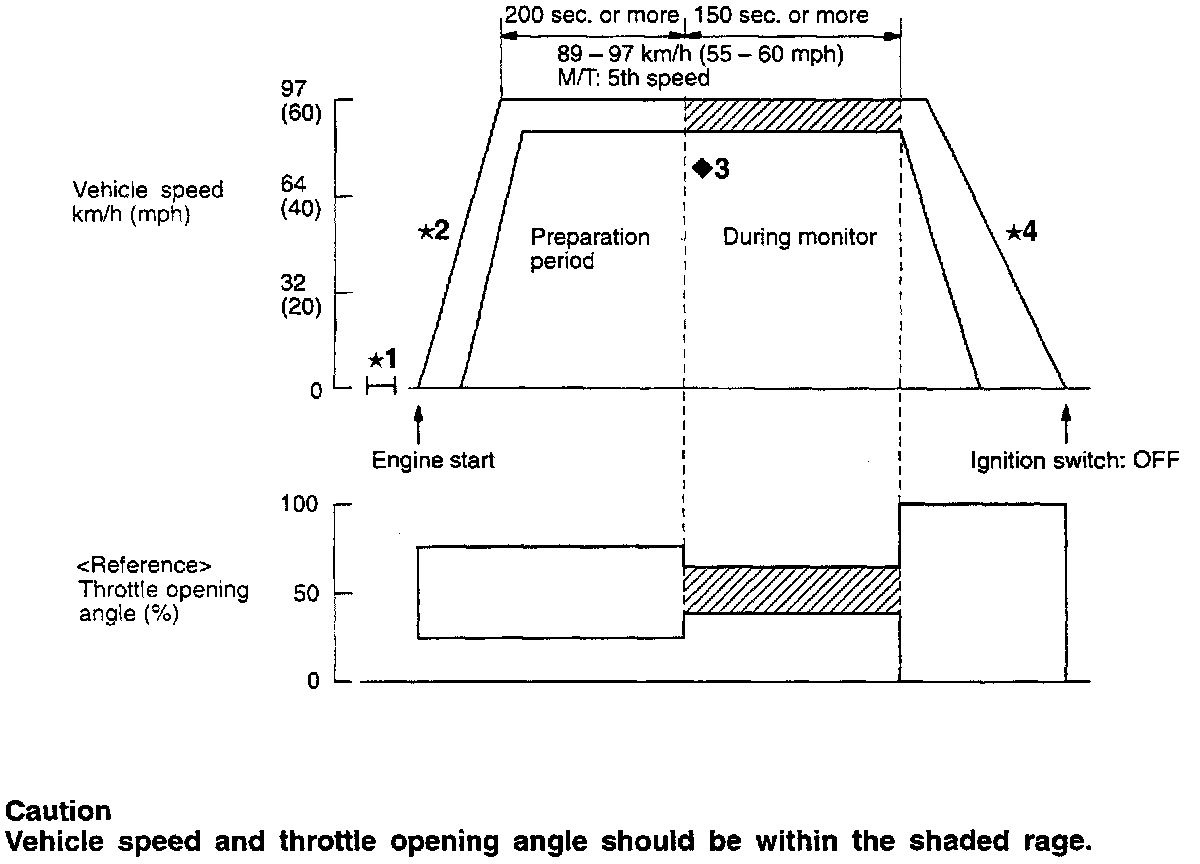
2. One trip monitor will be completed by driving according to the steps below (from start to switch off). It will take 8 minutes.
*1: Check that both the engine coolant temperature and intake air temperature satisfy the conditions in 1. above (when engine is stopped).
*2: Monitor pre-preparation period: start the engine and accelerate to a speed of between 89 - 97 km/h (55 - 60 mph). Acceleration, deceleration and braking can be carried out during this period. Drive for 200 seconds or more while maintaining the vehicle speed at between 89 - 97 km/h (55 - 60 mph). Braking and throttle operations can be carried out during this time as long as the vehicle speed remains within the specified range.
<3>: Drive between 89 and 97 km/h (55 and 60 mph) at a constant throttle angle (by not moving the throttle pedal as much as possible) for 150 seconds or more during monitor. Moreover, do not turn the steering wheel suddenly.
*4: Decelerate and stop the vehicle. Then turn off the ignition switch.
Drive cycle pattern
Heated oxygen sensor monitor (P0130, P0136, P0150, P0156)
Test requirements/Procedure:
1. Test requirements/Procedure
(1) Engine coolant temperature: 80°C (176°F) or more (Engine fully warmed up)
(2) Atmospheric temperature: -10°c (14°F) or more
(3) Condition of A/T:
- Selector lever position: D range
- Overdrive switch: ON
- Pattern select switch: OFF
2. One trip monitor will be completed by driving according to the steps below (from start to switch off).
It will take 5 minutes.
*1: After warming up the engine, turn off the ignition switch.
*2: Start the engine, and accelerate to 56 - 64 km/h (35 - 40 mph).
<3>: Drive between 56 and 64 km/h (35 and 40 mph) at a constant throttle angle (by not moving the throttle pedal as much as possible) for 120 seconds or more during monitor. Moreover, do not turn the steering wheel suddenly.
*4: Decelerate and stop the vehicle. Then turn off the ignition switch.
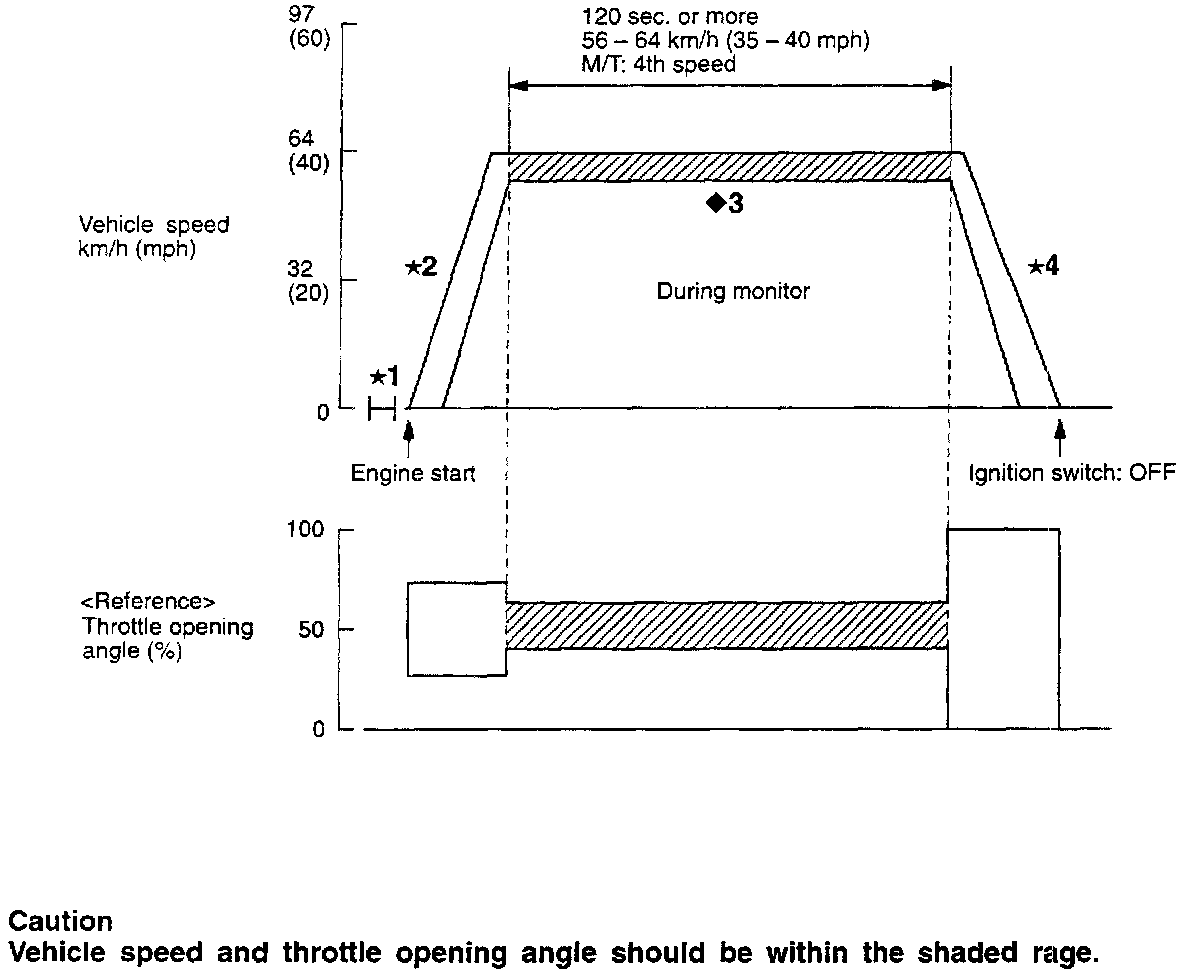
Drive cycle pattern
Exhaust gas recirculation (EGR) system monitor (P0400)
Test requirements/Procedure:
1. All of the following requirements should be met when carrying out a drive test.
(1) Engine coolant temperature: 80°C (176°F) or more (Engine fully warmed up)
(2) Atmospheric temperature: 5°C (41 °F) or more
(3) Condition of A/T:
- Selector lever position: D range
- Overdrive switch: ON
- Pattern select switch: OFF
(4) A/C switch: OFF
2. One trip monitor will be completed by driving according to the steps below (from start to switch off).
It will take approx. 10 minutes.
*1: After warming up, turn off the ignition switch.
*2: Start the engine, and accelerate to 56 - 64 km/h (35 - 40 mph).
<3>: Close the throttle fully from 2000 - 3000 r/min with the clutch engaged
*4: Accelerate to 56 - 64 km/h (35 - 40 mph), and continue driving for 20 seconds. (After 1st monitor (deceleration), wait for 20 seconds or more until the next monitor (deceleration) starts). Then repeat <3> and *4 steps eight times.
*5: Decelerate and stop. Then turn off the ignition switch.
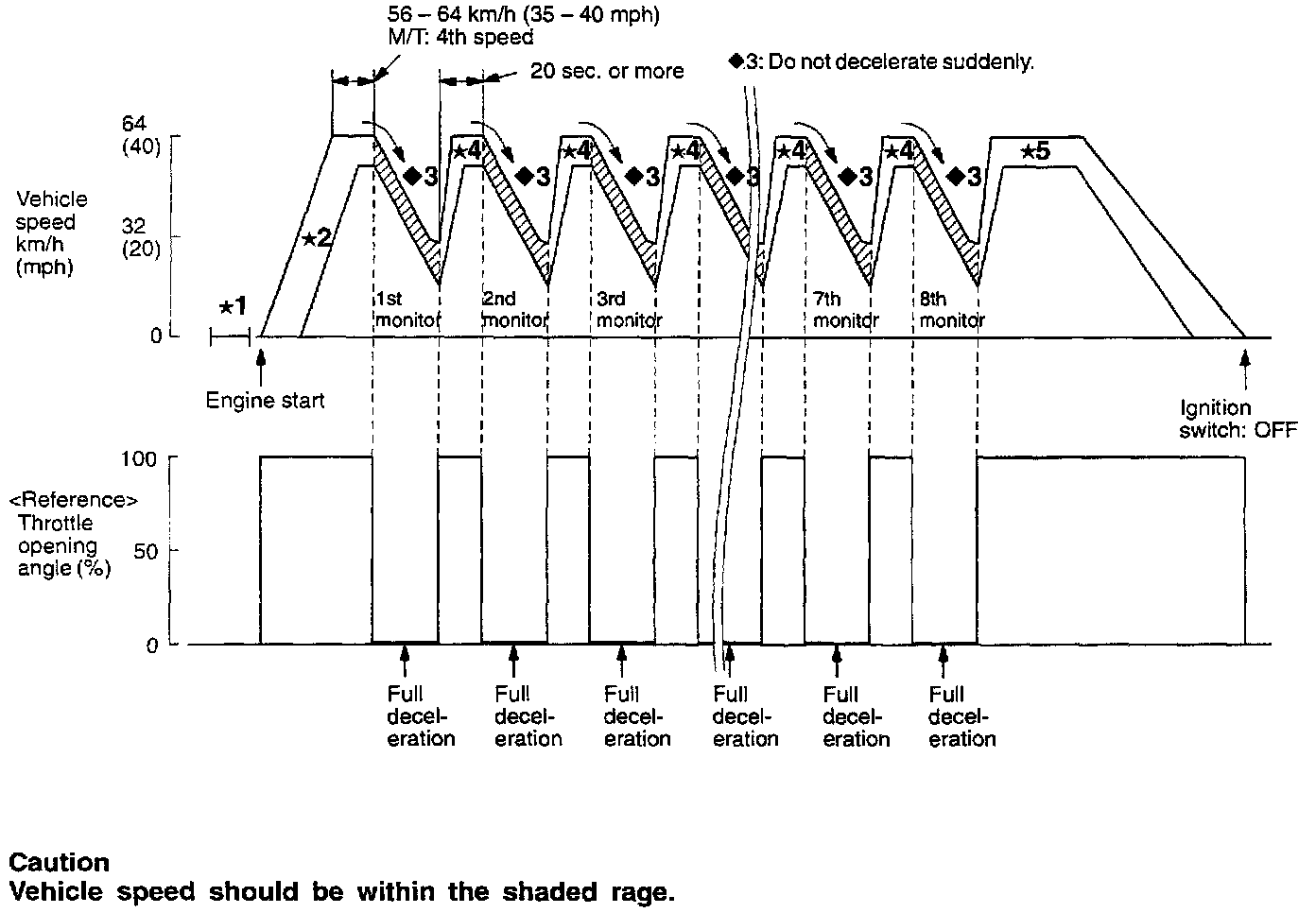
Drive cycle pattern
Fuel trim monitor (P0170, P0173)
Test requirements/procedure:
1. All of the following requirements should be met when carrying out a drive test.
(1) Engine coolant temperature: 80°C - 97°C (176 - 207°F) (Engine fully warmed up)
(2) Atmospheric temperature: 10°C (14°F) or more, 60°C (140°F) or less
(3) Condition of A/T:
- Selector lever position: D range
- Overdrive switch: ON
- Pattern select switch: OFF
2. One trip monitor will be completed by driving according to the steps below (from start to switch off).
It will take 35 minutes.
*1: After warming up the engine, turn off the ignition switch.
*2: Start the engine, and accelerate to 89 - 97 km/h (55 - 60 mph).
<3>: Drive between 89 and 97 km/h (55 and 60 mph) for 30 minutes or more during monitor. Moreover, do not drive the vehicle at the constant speed range for 120 seconds or more. (Accelerate or decelerate lightly within the 120 seconds. Brake may be applied, but avoid decelerating or accelerating suddenly).
*4: Decelerate and stop the vehicle. Then turn oft the ignition switch.
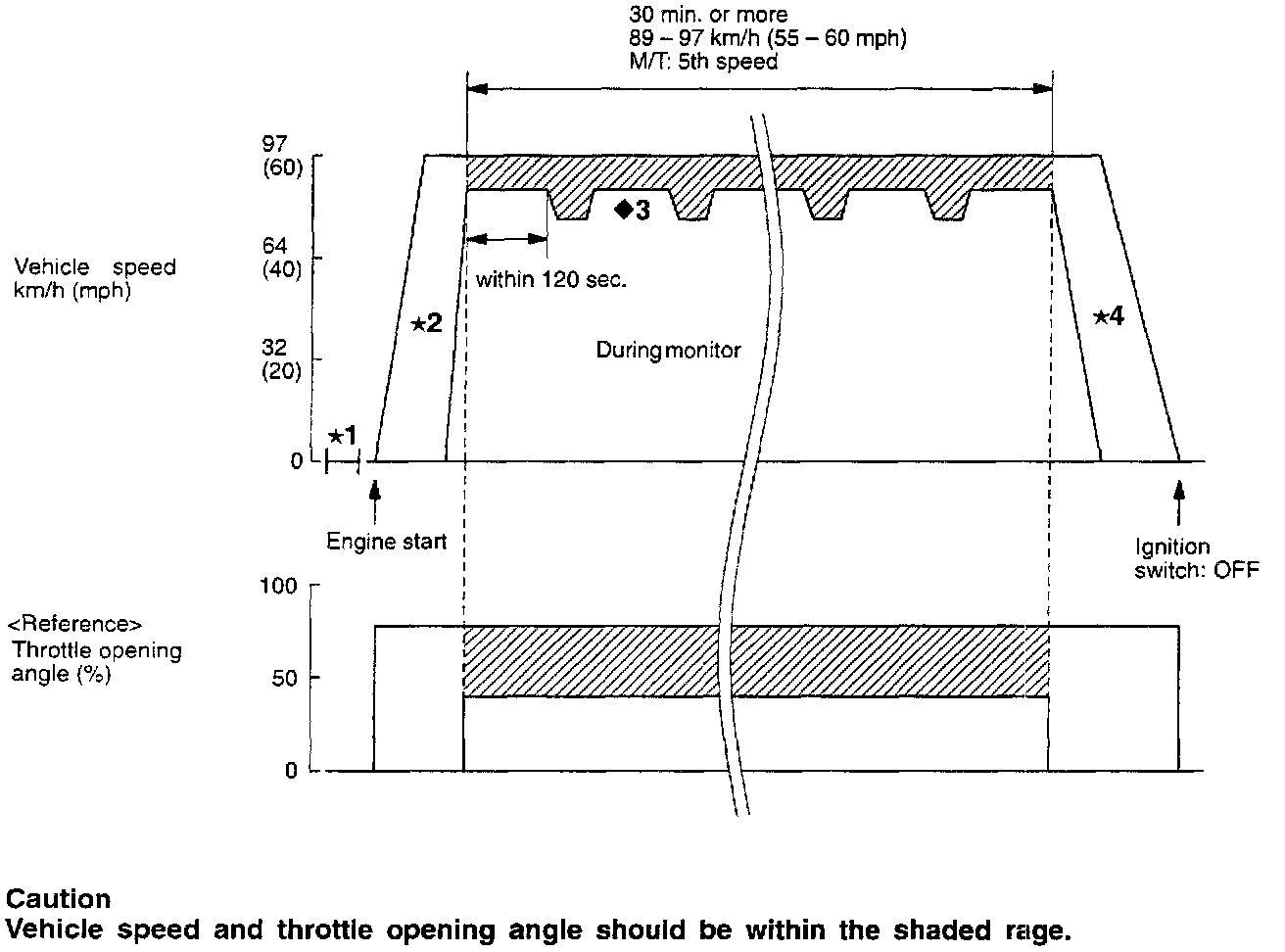
Drive cycle pattern
Other monitors:
- Misfire (P0300, P0301, P0302, P0303, P0304, P0305, P0306)
- Evaporative emission control system (P0440)
- Idle air control system (P0505)
- Manifold differential pressure sensor (P1400)
- Excessive time to enter closed loop fuel control (P0125)
- Throttle position sensor (P0120)
- Barometric pressure sensor (P0105)
- Intake air temperature sensor (P0110)
- Crankshaft position sensor (P0335)
- Camshaft position sensor (P0340)
- Volume air flow sensor (P0100)
- Engine coolant temperature sensor (P0115)
- Closed throttle position switch (P0510)
- O2 sensor circuit (P0130, P0136, P0150, P0156)
- O2 sensor heater circuit (P0135, P0141, P0155, P0161)
- EGR solenoid (P0403)
- Evaporative emission purge solenoid (P0443)
- Evaporative emission purge ventilation solenoid (P0446)
- Injector circuit (P0201, P0202, P0203, P0204, P0205, P0206)
- Serial communication link (P1600)
- Power steering pressure sensor circuit range/performance (P0551)
Test requirements/procedure:
1. All of the following requirements should be met when carrying out a drive test.
(1) Engine coolant temperature: 80°C (176°F) or more (Engine fully warmed up)
(2) Atmospheric temperature: 5°C (41°F) or more
(3) Condition of A/T:
- Selector lever position: D range
- Overdrive switch: ON
- Pattern select switch: OFF
2. One trip monitor will be completed by driving according to the steps below (from start to switch off). It will take approx. 10 minutes.
*1: After warming up, turn off the ignition switch.
*2: Start the engine, accelerate to 56 - 64 km/h (35 - 40 mph), continue driving for 300 seconds or more at that speed range and stop. Moreover, brake or throttle may be applied for this period.
*3: After stopping the vehicle, continue idling for 300 seconds or more, and then turn off the ignition switch. Moreover, the vehicle should be set to the following conditions for idling.
- A/C switch: OFF
- Lights and all accessories: OFF
- Transmission: Neutral (A/T for P range)
- Steering wheel: Straight-forward position
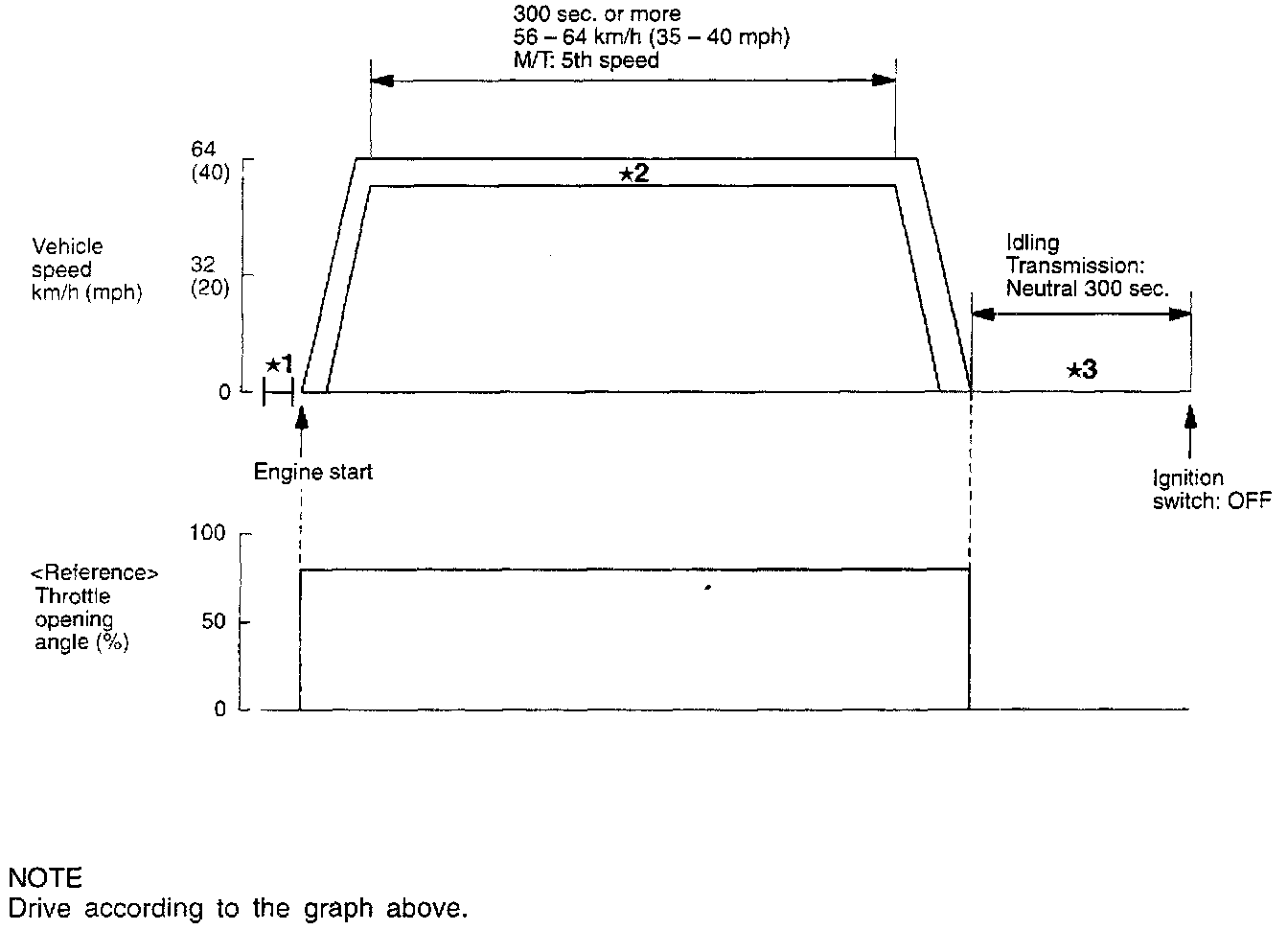
Drive cycle pattern
DIAGNOSTIC DETECTION LOGIC
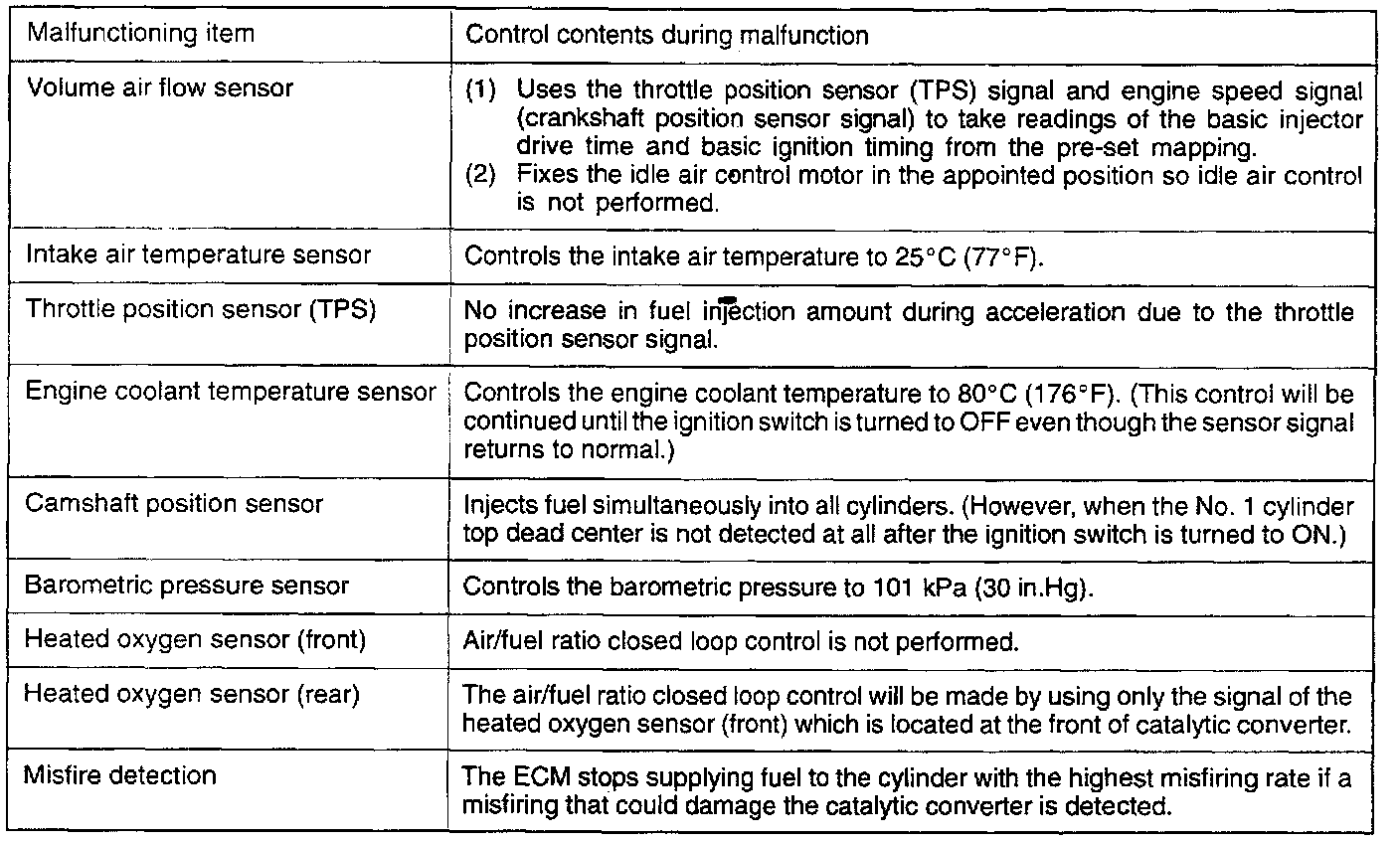
FAIL-SAFE/BACKUP FUNCTION QUICK REFERENCE TABLE:
When the main sensor malfunctions are detected by the on-board diagnostic, the vehicle is controlled by means of the pre-set control logic to maintain safe conditions for driving.