Performance Test
PERFORMANCE TEST
1. The vehicles to be tested should be in a place that is not in direct sunlight.
2. Close the high and low pressure valves of the gage manifold.
3. Connect the charging hose (blue) to the low pressure valve and connect the charging hose (red) to the high pressure valve of the gage manifold.
4. Connect the quick joint (for low pressure) to the charging hose (blue), and connect the quick joint (for high pressure) to the charging hose (red).
5. Connect the quick joint (for low pressure) to the low-pressure service valve, and connect the quick joint (for high pressure) to the high-pressure service valve.
NOTE: The high-pressure service valve should be connected to the receiver and the low-pressure service valve should be connected to the compressor.
CAUTION: To connect the quick joint, press section A firmly against the service valve until a click is heard. When connecting, run your hand along the hose while pressing to ensure that there are no bends in the hose.
6. Start the engine.
7. Set the air conditioning controls as follows:
Air conditioning switch: A/C - ON position
Mode selection: Face position
Temperature control lever: MAX. COOL
Air selection: Recirculation position
Blower switch: HI (Fast) position
8. Adjust the engine speed to 1,000 r/min with the air conditioning compressor clutch engaged.
9. The engine should be warmed up with doors and windows closed.
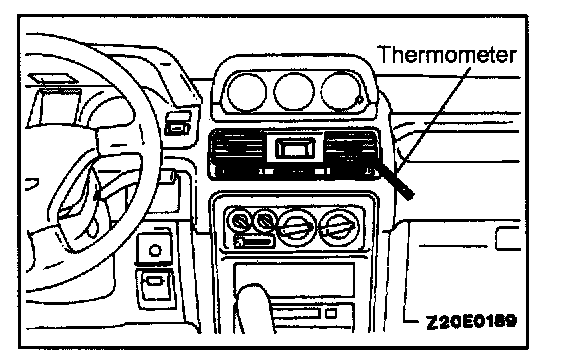
10. Insert a thermometer into the center air conditioning outlet and run the engine for 20 minutes.
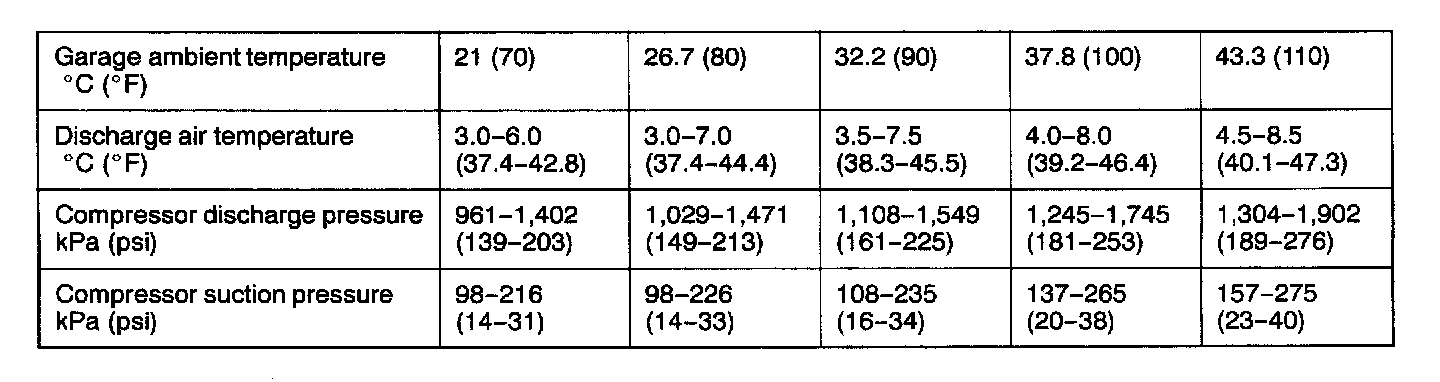
11. Note the discharge air temperature.
NOTE: If the clutch cycles, take the reading before the clutch disengages.
Performance Temperature Chart: