Starter Motor: Testing and Inspection
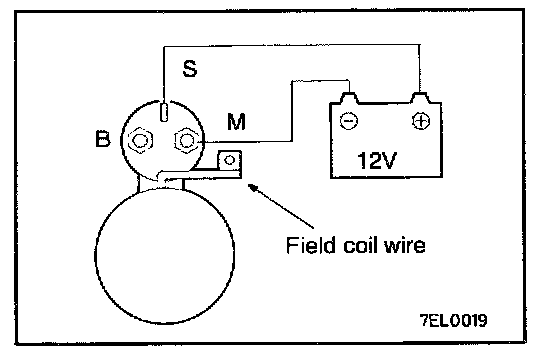
Magnetic Switch Pull-In Test
1. Disconnect the field coil wire from the M-terminal of the magnetic switch.
2. Connect a 12 V battery between the S-terminal and the M-terminal.
3. Manually pull out the pinion as far as the pinion stopper position.
CAUTION: This test must be performed quickly (within 10 seconds) to prevent the coil from burning.
4. If the pinion moves out, the pull-in coil is good. If it doesn't, replace the magnetic switch.
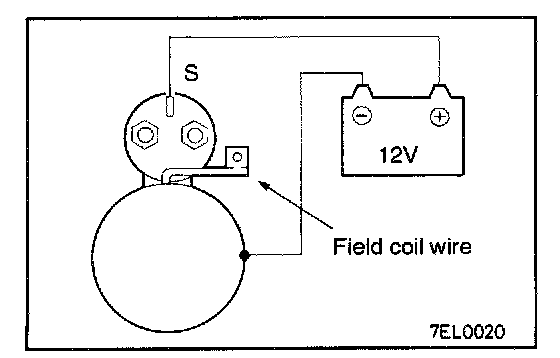
Magnetic Switch Hold-In Test
1. Disconnect the field coil wire from the M-terminal of the magnetic switch.
2. Connect a 12 V battery between the S-terminal and the body.
CAUTION: This test must be performed quickly (within 10 seconds) to prevent the coil from burning.
3. If the pinion remains out, everything is in order. If the pinion moves in, there is an open circuit in the hold-in circuit. Replace the magnetic switch.
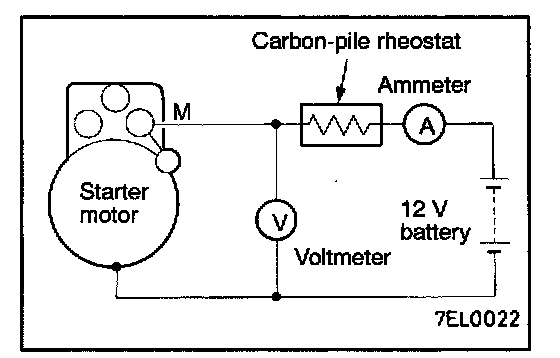
Free Running Test
1. Place starter motor in a vise equipped with soft jaws and connect a fully-charged 12-volt battery to starter motor as follows:
2. Connect a test ammeter (100-ampere scale) and carbon pile rheostat in series to the positive battery terminal and starter motor terminal.
3. Connect a voltmeter (15-volt scale) to the starter motor.
4. Rotate the carbon pile to the full-resistance position.
5. Connect the battery cable to the negative battery terminal and the starter motor body.
6. Adjust the rheostat until the battery positive voltage shown by the voltmeter is 11 V.
7. Confirm that the maximum amperage is within the specifications and that the starter motor turns smoothly and freely.
Standard value: 90 A or less
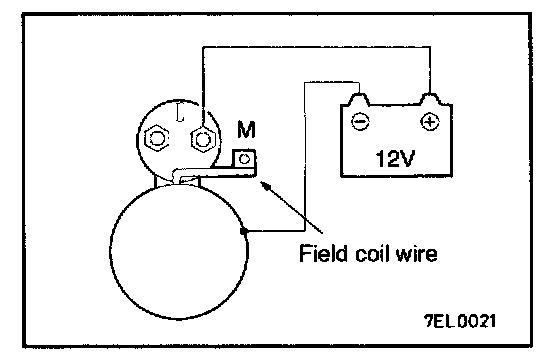
Magnetic Switch Return
1. Disconnect the field coil wire from the M-terminal of the magnetic switch.
2. Connect a 12 V battery between the M-terminal and the body.
CAUTION: This test must be performed quickly (within 10 seconds) to prevent the coil from burning.
3. Pull the pinion out and then release it. If the pinion quickly returns to its original position, everything is in order. If it doesn't, replace the magnetic switch.
CAUTION: Be careful not to get your fingers caught when pulling out the pinion.
Commutator:

Commutator Check
1. Place the armature on a pair of V-blocks, and then use a dial gage to check the deflection.
Standard value: 0.05 mm (0.002 in.)
Limit: 0.1 mm (0.004 in.)
Commutator:

2. Check the outer diameter of the commutator.
Standard value: 29.4 mm (1.158 in.)
Limit: 28.8 mm (1.134 in.)
Commutator:

3. Check the depth of the undercut between the segments.
Standard value: 0.5 mm (0.020 in.)
Brush Holder:

Brush Holder Check
Check for continuity between the brush holder plate and the brush holder.
The normal condition is no continuity.

Overrunning Clutch Check
1. While holding the clutch housing, rotate the drive pinion. The drive pinion should rotate smoothly in one direction, but should not rotate in the opposite direction. If the clutch does not function properly, replace the overrunning clutch assembly.
2. Check the pinion for wear or burrs. If the pinion is worn or burred, replace the overrunning clutch assembly. If the pinion is damaged, inspect the ring gear for wear or burrs also.
Front and Rear Bracket Bushing Check
Check the bushing for wear or burrs. If the bushing is worn or burred, replace the front bracket assembly or the rear bracket assembly.
Brushes And Springs Replacement:

Brush Check
1. Brushes that are worn beyond the wear limit line, or oil-soaked should be replaced.
2. When replacing the ground brush, slide the brush out from the brush holder by prying back the retaining spring.
Armature Check
1. Check the armature coil for short circuit.
2. Place the armature in a growler.
Armature Short Circuit Test:

3. If a thin steel blade is held parallel and just above the armature while it is rotated slowly in the growler, a shorted armature will cause the blade to vibrate and be attracted to the core. In this case, replace the shorted armature.
Armature Coil Grounding Test:

4. Check the insulation between the armature coil cores and the commutator segments. They are normal if there is no continuity.
Armature Coil Open Circuit Inspection:

5. Check for continuity between the segments. The condition is normal if there is continuity.