TCL/ASC-ECU
GENERAL INFORMATION
TCL/ASC-ECU
The ECU incorporates the ABS-ECU, ASC-ECU, and TCL-ECU. The integral design allows integrated operation of the TCL/ASC-ECU with the ABS and coordinated control of the driving force and braking force.
SYSTEM CONFIGURATION
The TCL/ASC is a system that adds a yaw rate sensor, a steering wheel sensor and master cylinder pressure sensor (incorporated in hydraulic unit) to the ABS system.
OVERVIEW OF CONTROL
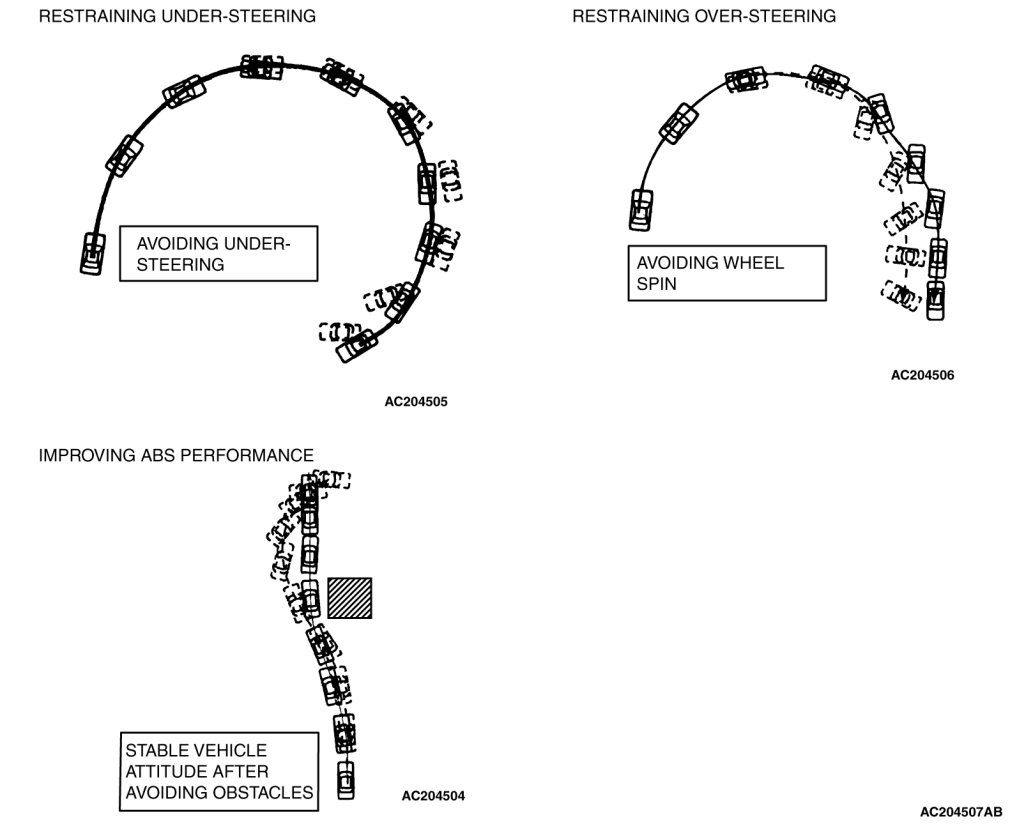
The TCL/ASC-ECU detects vehicle movement based on information from various sensors and calculates a model of ideal vehicle movement. After comparing actual and ideal movements, it acts to bring the actual vehicle movement closer to the ideal model by controlling specific wheel brake force and governing engine output. It restrains under-steering and over-steering through a corrective yaw moment, as explained on the following pages.
EXAMPLE OF ASC OPERATION
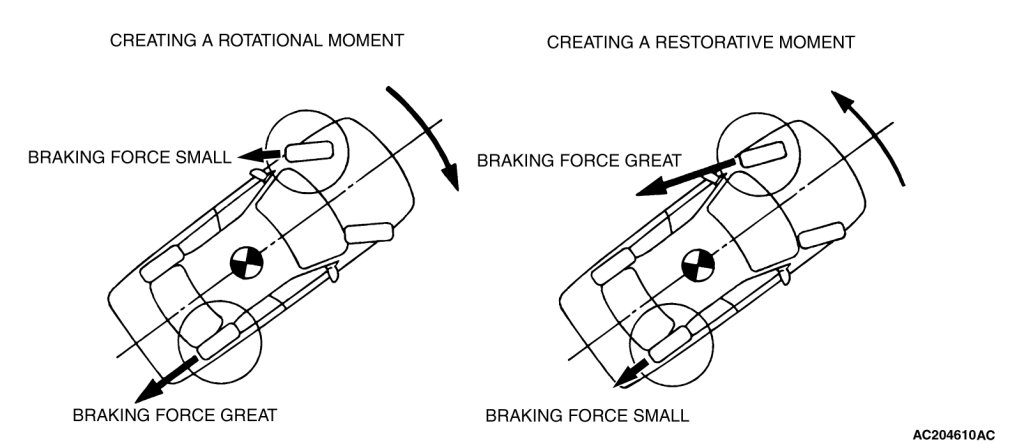
The ASC manages the vehicle attitude by creating a yaw moment from altering the balance between the cornering force and each wheel's braking mechanism.
For example, on a slippery surface, if the vehicle tends to be under-steered contrary to the driver's intention, a yaw moment (a rotational moment) is created to restrain the under-steering by increasing the rear-inside braking force. On the other hand, when the vehicle tends to be over-steered, a yaw moment (a restorative moment) is created to restrain the over-steering by increasing the front-outside braking force. Furthermore, when it is determined that the vehicle is over-speeding, safe and stable cornering is enabled by deceleration from restricting engine output.
EXAMPLE OF THE EFFECT OF CONTROL
INTEGRATED CONTROL
The ASC transmits data necessary for control of the ABS and the TCL, performing integrated control.

EXAMPLE OF OPERATION OF TRACTION CONTROL
The Traction Control prevents drive force loss during slipping of the drive wheels by automatically applying the brakes and sending engine torque reduction signal to the PCM when the drive wheels slip or when driving on partly low-friction surfaces.
FAIL-SAFE AND DIAGNOSTIC FUNCTIONS
The TCL/ASC-ECU regularly monitors input and output signals. If an error is detected in the system, the ECU sends a fail signal and the TCL/ASC indicator light is illuminated or blinks. Various controls are processed depending on the cause of malfunction as shown below.
When the ABS system fails, the TCL/ASC system is also suspended. However, when the TCL/ASC system fails, no other system is suspended. The appropriate indicator lights are illuminated/flashed.
The TCL/ASC-ECU includes the following functions to make system inspection easier.
- Diagnostic trouble code
- Displays Data list
- Actuator test
All of the above operations can be carried out using scan tool MB991958.