Part 2
YES Go to Step 23 .
NO Repair the damaged parts.
STEP 23. Check the CAN bus lines between intermediate connector C-24 and the G and yaw rate sensor. Measure the resistance between intermediate connector C-24 and G and yaw rate sensor connector C-36.
CAUTION:
A digital multimeter should be used. For details refer to Precautions When CAN Bus Line(s) are Repaired.
CAUTION:
The test wiring harness should be used. For details refer to Precautions When CAN Bus Line(s) are Repaired.
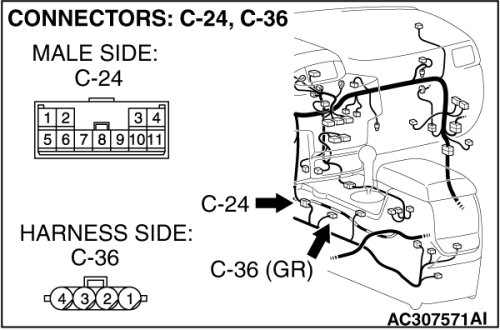
(1)Disconnect intermediate connector C-24 and G and yaw rate sensor connector C-36, and measure the resistance between the wiring harness side connector of G and yaw rate sensor connector C-36 and the male side connector of intermediate connector C-24 (at front wiring harness side).
(2)Turn the ignition switch to the "LOCK" (OFF) position.
(3)
CAUTION:
Disconnect the negative battery terminal. For details refer to Precautions When CAN Bus Line(s) are Repaired.
Disconnect the negative battery terminal.
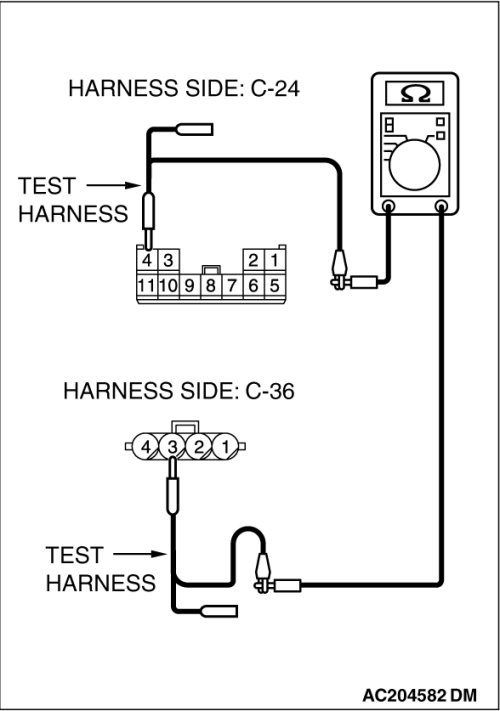
(4)Measure the resistance between intermediate connector terminal 4 and G and yaw rate sensor connector terminal 3.
OK: 2 ohms or less
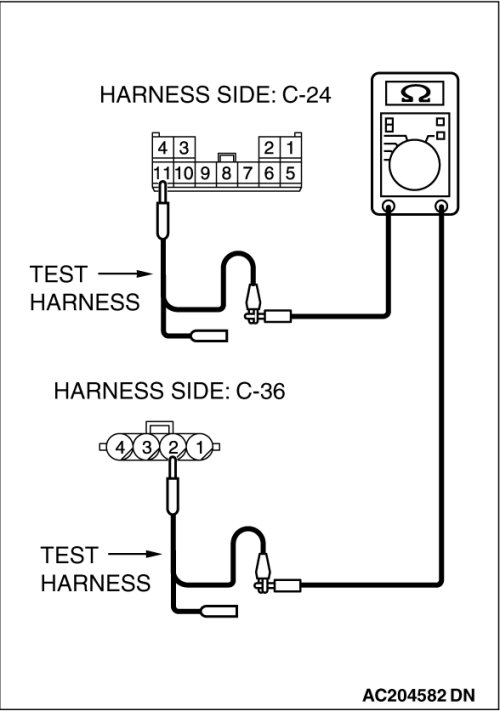
(5)Measure the resistance between intermediate connector terminal 11 and G and yaw rate sensor connector terminal 2.
OK: 2 ohms or less
CAUTION:
Strictly observe the specified wiring harness repair procedure.
For details refer to Precautions on How to Repair the CAN Bus Line(s).
Q. Do all the resistances measure 2 ohms or less?
YES [All the resistances measure 2 ohms or less] Go to Step 24
.
NO [If either of the resistances measures more than 2 ohms or all the resistances measure more than 2 ohms] Repair the wiring harness between intermediate connector C-24 and the G and yaw rate sensor connector.
STEP 24. Check the CAN bus lines between intermediate connector C-24 and the joint connector (4). Measure the resistance between intermediate connector C-24 and joint connector (4) C-101.
CAUTION:
A digital multimeter should be used. For details refer to Precautions When CAN Bus Line(s) are Repaired.
CAUTION:
The test wiring harness should be used. For details refer to Precautions When CAN Bus Line(s) are Repaired.
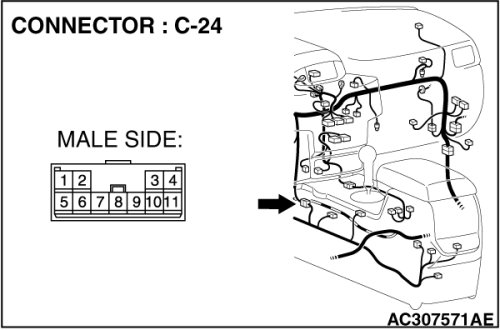
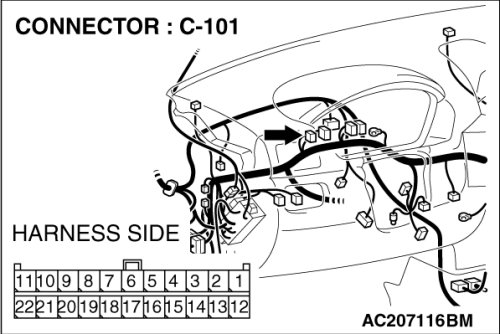
(1)Disconnect joint connector (4) C-101 and intermediate connector C-24, and measure the resistance between the wiring harness side connector of joint connector (4) C-101 and the female side connector of intermediate connector C-24 (instrument panel wiring harness side).
(2)Turn the ignition switch to the "LOCK" (OFF) position.
(3)
CAUTION:
Disconnect the negative battery terminal. For details refer to Precautions When CAN Bus Line(s) are Repaired.
Disconnect the negative battery terminal.
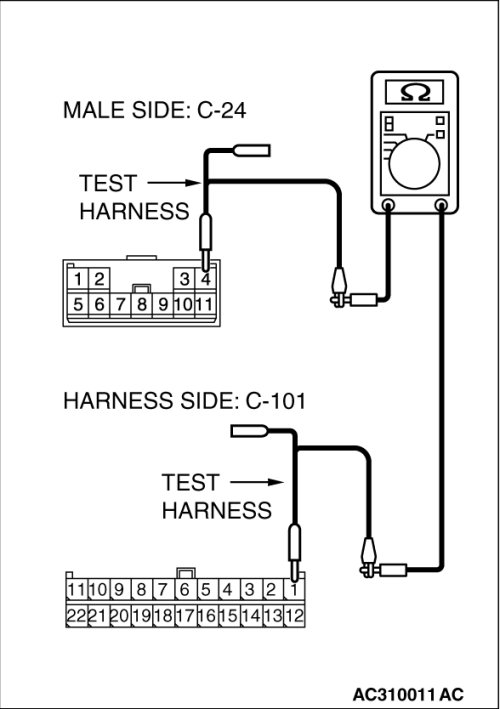
(4)Measure the resistance between joint connector (4) terminal 1 and intermediate connector terminal 4.
OK: 2 ohms or less
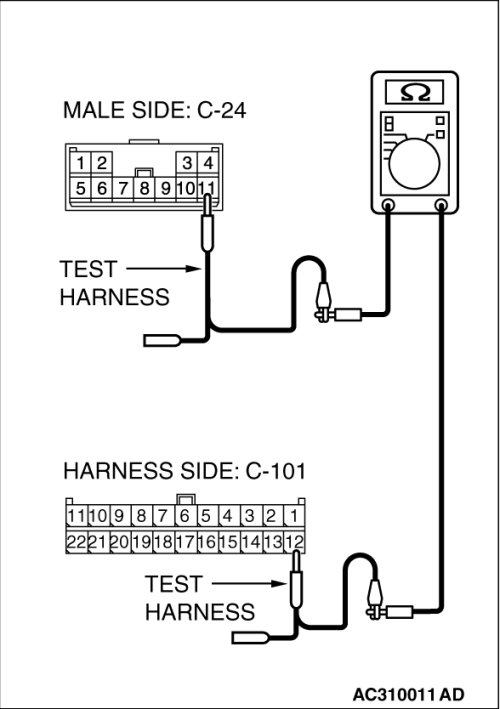
(5)Measure the resistance between joint connector (4) terminal 12 and intermediate connector terminal 11.
OK: 2 ohms or less
CAUTION:
Strictly observe the specified wiring harness repair procedure.
For details refer to Precautions on How to Repair the CAN Bus Line(s).
Q. Do all the resistances measure 2 ohms or less?
YES [All the resistances measure 2 ohms or less] Power supply to the G and yaw rate sensor may be suspected. Diagnose the ASC system. Inspection Procedure 3.
NO [If either of the resistances measures more than 2 ohms or all the resistances measure more than 2 ohms] Repair the wiring harness wires between intermediate connector C-24 and joint connector (4).
STEP 25. Check steering wheel sensor connector C-312 for loose, corroded or damaged terminals, or terminals pushed back in the connector.
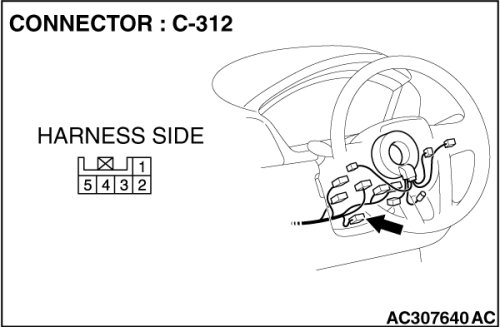
CAUTION:
The strand end of the twist wire should be within 10 cm (4 inches) from the connector. For details refer to Precautions When CAN Bus Line(s) are Repaired.
Q. Is steering wheel sensor connector C-312 in good condition?
YES Go to Step 26 .
NO Repair the damaged parts.
STEP 26. Using scan tool MB991958, diagnose the CAN bus line (Disconnect steering wheel sensor connector C-312, and check the steering wheel sensor system).
(1)Disconnect steering wheel sensor connector C-312.
(2)Turn the ignition switch to the "ON" position.
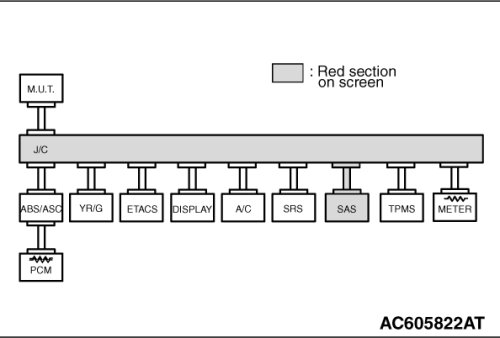
(3)Diagnose CAN bus lines, and check if the M.U.T.-III screen is as shown in the illustration.
(4)Turn the ignition switch to the "LOCK" (OFF) position.
(5)Connect steering wheel sensor connector C-312.
Q. Does the M.U.T.-III screen correspond to the illustration?
YES [The M.U.T.-III screen corresponds to the illustration] Go to Step 27 .
NO [The M.U.T.-III screen does not correspond to the illustration] Go to Step 28 .
STEP 27. Check the CAN bus lines between joint connector (4) and the steering wheel sensor. Measure the resistance between joint connector (4) C-101 and steering wheel sensor connector C-312.
CAUTION:
A digital multimeter should be used. For details refer to Precautions When CAN Bus Line(s) are Repaired.
CAUTION:
The test wiring harness should be used. For details refer to Precautions When CAN Bus Line(s) are Repaired.
(1)Disconnect joint connector (4) C-101 and steering wheel sensor connector C-312, and measure the resistance between each wiring harness side connector.
(2)Turn the ignition switch to the "LOCK" (OFF) position.
(3)
CAUTION:
Disconnect the negative battery terminal. For details refer to Precautions When CAN Bus Line(s) are Repaired.
Disconnect the negative battery terminal.
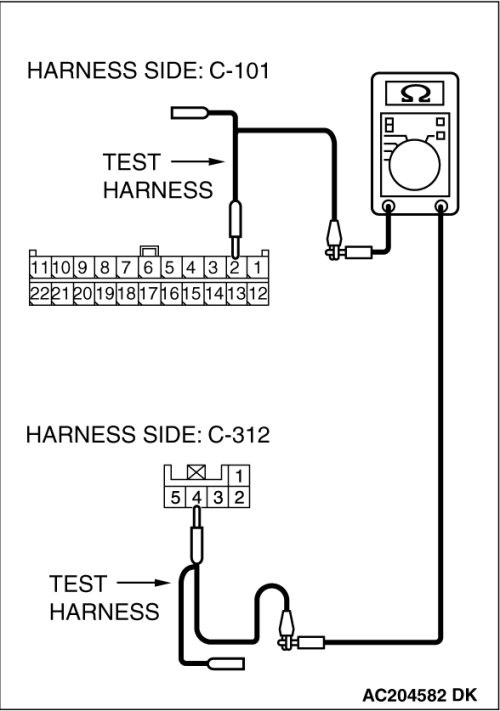
(4)Measure the resistance between joint connector (4) terminal 2 and steering wheel sensor connector terminal 4.
OK: 2 ohms or less
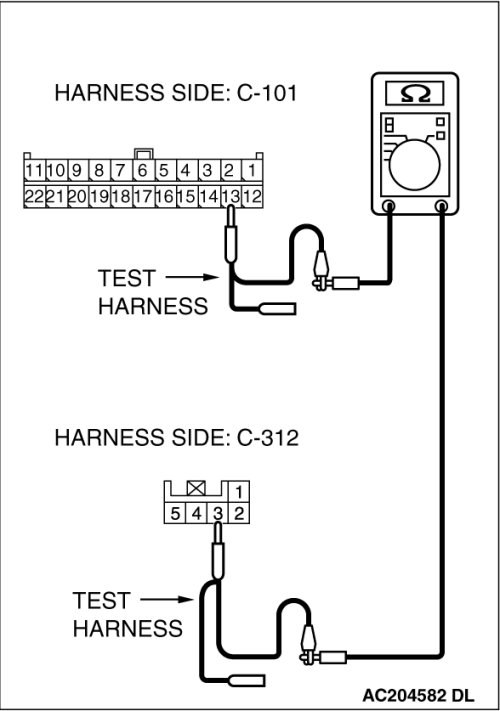
(5)Measure the resistance between joint connector (4) terminal 13 and steering wheel sensor connector terminal 3.
OK: 2 ohms or less
CAUTION:
Strictly observe the specified wiring harness repair procedure.
For details refer to Precautions on How to Repair the CAN Bus Line(s).
Q. Do all the resistances measure 2 ohms or less?
YES [All the resistances measure 2 ohms or less] Power supply to the steering wheel sensor may be suspected. Diagnose the ASC system. Inspection Procedure 3.
NO [If either of the resistances measures more than 2 ohms or all the resistances measure more than 2 ohms] Repair the wiring harness between joint connector (4) and the steering wheel sensor connector.
STEP 28. Check multi-center display unit (middle-grade type or Mitsubishi Multi Communication System) connector C-06 [multi-center display unit (middle-grade type)] or C-128 [multi-center display unit (Mitsubishi Multi Communication System)] for loose, corroded or damaged terminals, or terminals pushed back in the connector.
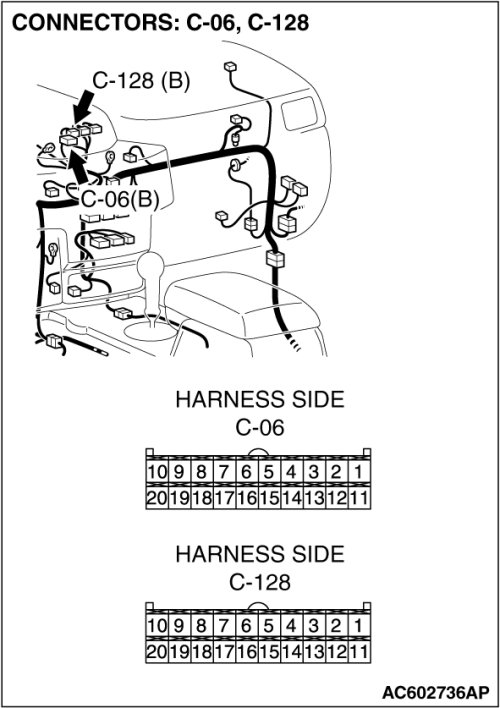
CAUTION:
The strand end of the twist wire should be within 10 cm (4 inches) from the connector. For details refer to Precautions When CAN Bus Line(s) are Repaired.
Q. Is multi-center display unit (middle-grade type or Mitsubishi Multi Communication System) connector C-06[ multi-center display unit (middle-grade type)] or C-128[ multi-center display unit (Mitsubishi Multi Communication System)] in good condition?
YES Go to Step 29 .
NO Repair the damaged parts.
STEP 29. Using scan tool MB991958, diagnose the CAN bus line [Disconnect multi-center display connector C-06 [multi-center display unit (middle-grade type)] or C-128 [multi-center display unit (Mitsubishi Multi Communication System)], and check the multi-center display system].
(1)Disconnect multi-center display unit (middle-grade type or Mitsubishi Multi Communication System) connector C-06 [multi-center display unit (middle-grade type)] or C-128 [multi-center display unit (Mitsubishi Multi Communication System)].
(2)Turn the ignition switch to the "ON" position.
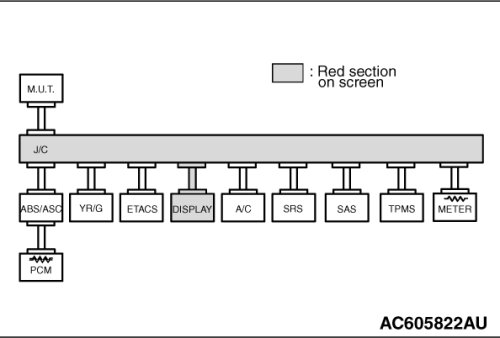
(3)Diagnose CAN bus lines, and check if the M.U.T.-III screen is as shown in the illustration.
(4)Turn the ignition switch to the "LOCK" (OFF) position.
(5)Connect the multi-center display connector C-06 [multi-center display unit (middle-grade type)] or C-128 [multi-center display unit (Mitsubishi Multi Communication System)].
Q. Does the M.U.T.-III screen correspond to the illustration?
YES : [The M.U.T.-III screen corresponds to the illustration] Go to Step 30 .
NO : [The M.U.T.-III screen does not correspond to the illustration] Go to Step 31 .
STEP 30. Check the CAN bus lines between joint connector (4) and the multi-center display unit (middle-grade type or Mitsubishi Multi Communication System). Measure the resistance between joint connector (4) C-101 and multi-center display unit (middle-grade type or Mitsubishi Multi Communication System) connector C-06 [multi-center display unit (middle-grade type)] or C-128 [multi-center display unit (Mitsubishi Multi Communication System)]
CAUTION:
A digital multimeter should be used. For details refer to Precautions When CAN Bus Line(s) are Repaired.
CAUTION:
The test wiring harness should be used. For details refer to Precautions When CAN Bus Line(s) are Repaired.
(1)Disconnect joint connector (4) C-101 and multi-center display unit (middle-grade type or Mitsubishi Multi Communication System) connector C-06 [multi-center display unit
(middle-grade type)] or C-128 [multi-center display unit (Mitsubishi Multi Communication System)], and measure the resistance at the wiring harness sides of joint connector (4) C-101 and multi-center display unit (middle-grade type or vehicles with mitsubishi multi communication system) connector C-06 [multi-center display unit (middle-grade type)] or C-128 [multi-center display unit (Mitsubishi Multi Communication System)].
(2)Turn the ignition switch to the "LOCK" (OFF) position.
(3)
CAUTION:
Disconnect the negative battery terminal. For details refer to Precautions When CAN Bus Line(s) are Repaired.
Disconnect the negative battery terminal.
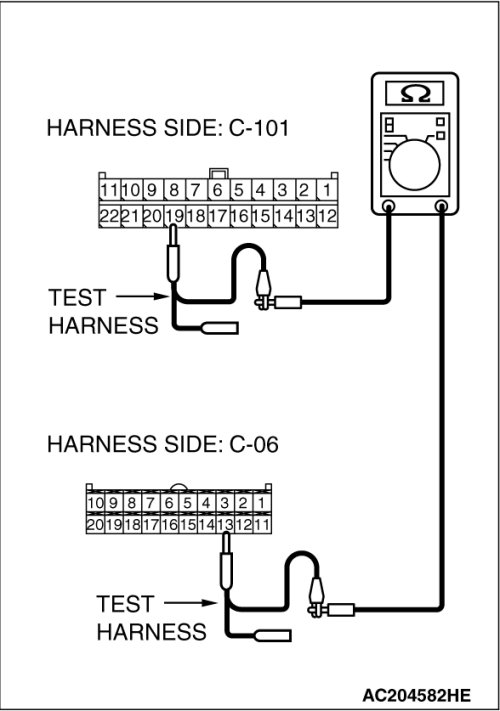
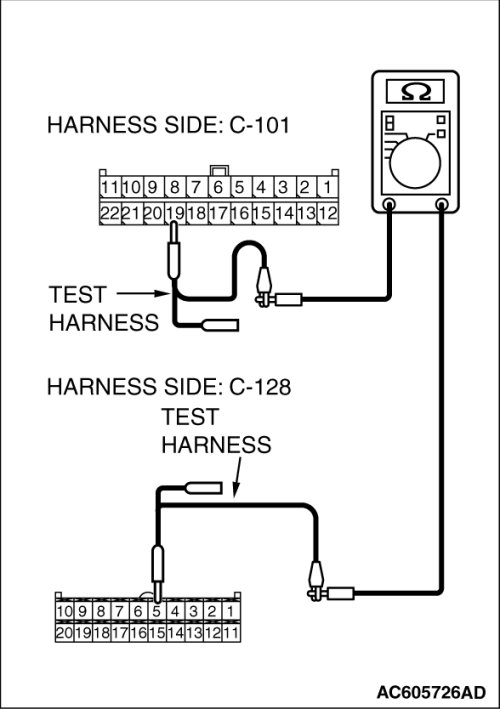
(4)Measure the resistance between joint connector (4) terminal 19 and multi-center display unit [multi-center display unit (middle-grade type)] connector terminal 13 or multi-center display unit [multi-center display unit (Mitsubishi Multi Communication System)] connector terminal 5.
OK: 2 ohms or less
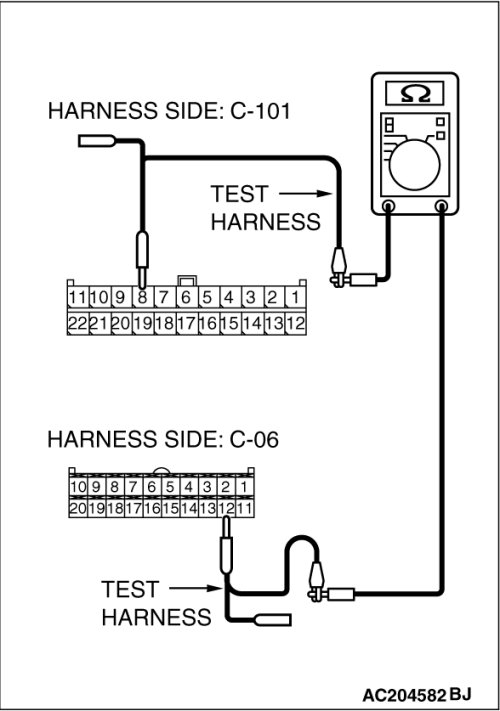
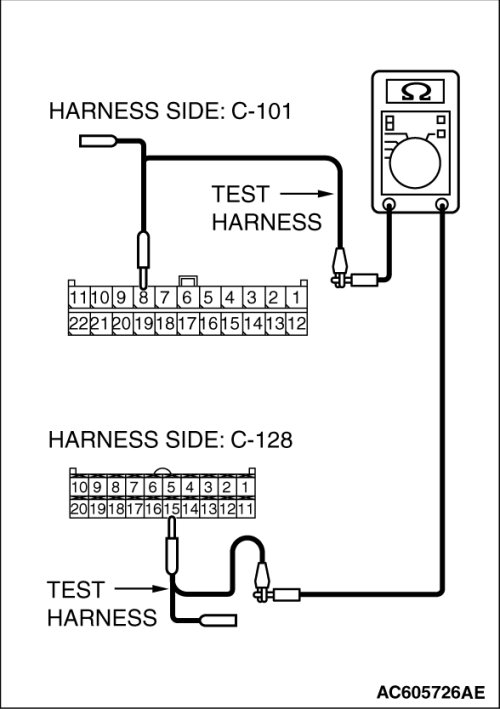
(5)Measure the resistance between joint connector (4) terminal 8 and multi-center display unit [multi-center display unit (middle-grade type)] connector terminal 12 or multi-center display unit [multi-center display unit (Mitsubishi Multi Communication System)] connector terminal 15.
OK: 2 ohms or less
CAUTION:
Strictly observe the specified wiring harness repair procedure.
For details refer to Precautions on How to Repair the CAN Bus Line(s).
Q. Do all the resistances measure 2 ohms or less?
YES : If all the resistances measure 2 ohms or less, power supply to the multi-center display (middle-grade type or Mitsubishi Multi Communication System) may be suspected. Diagnose the multi-center display (middle-grade type or Mitsubishi Multi Communication System). Inspection Procedure 1.
NO : If either of the resistances measures more than 2 ohms or all the resistances measure more than 2 ohms, repair the wiring harness between joint connector (4) and the multi-center display unit (middle-grade type or Mitsubishi Multi Communication System) connector.
STEP 31. Check the CAN bus lines between joint connector (4) and the data link connector. Measure the resistance between joint connector (4) C-101 and data link connector C-121.
CAUTION:
A digital multimeter should be used. For details refer to Precautions When CAN Bus Line(s) are Repaired.
CAUTION:
The test wiring harness should be used. For details refer to Precautions When CAN Bus Line(s) are Repaired.
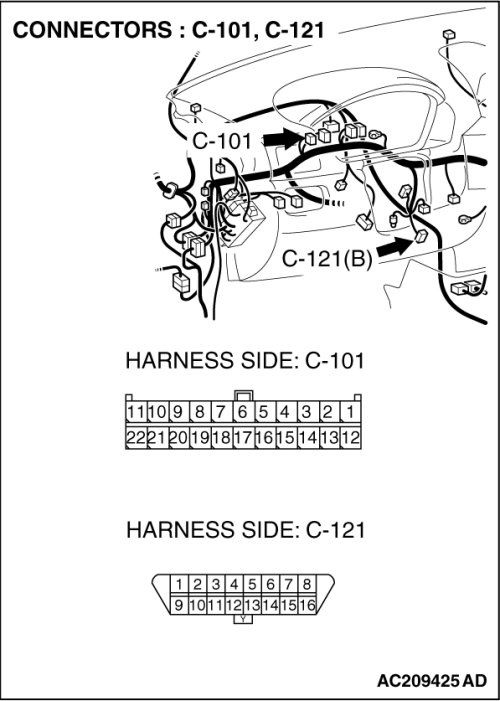
(1)Disconnect joint connector (4) C-101, and measure the resistance between the wiring harness side connector of joint connector (4) C-101 and wiring harness side connector of data link connector C-121.
(2)Turn the ignition switch to the "LOCK" (OFF) position.
(3)
CAUTION:
Disconnect the negative battery terminal. For details refer to Precautions When CAN Bus Line(s) are Repaired.
Disconnect the negative battery terminal.
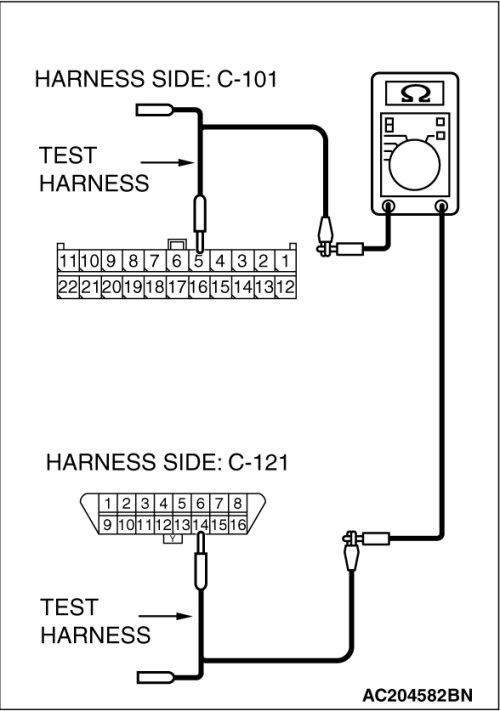
(4)Measure the resistance between joint connector (4) terminal 5 and data link connector terminal 14.
OK: 2 ohms or less
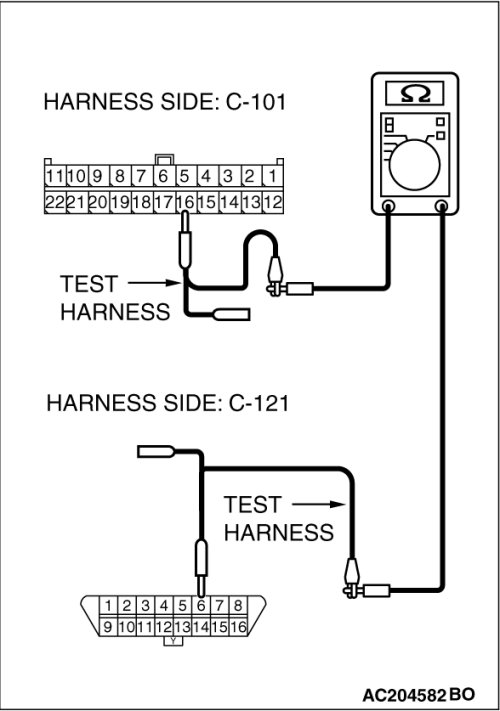
(5)Measure the resistance between joint connector (4) terminal 16 and data link connector terminal 6.
OK: 2 ohms or less
CAUTION:
Strictly observe the specified wiring harness repair procedure.
For details refer to Precautions on How to Repair the CAN Bus Line(s).
Q. Do all the resistances measure 2 ohms or less?
YES : [All the resistances measure 2 ohms or less] Check the CAN_L and H lines for short circuit (Refer to Diagnostics Item 18).
NO [If either of the resistances measures more than 2 ohms or all the resistances measure more than 2 ohms] Repair the wiring harness between joint connector (4) and the data link connector.
STEP 32. Check TCL/ASC-ECU connector A-32 and powertrain control module connector B-18 for loose, corroded or damaged terminals, or terminals pushed back in the connector.
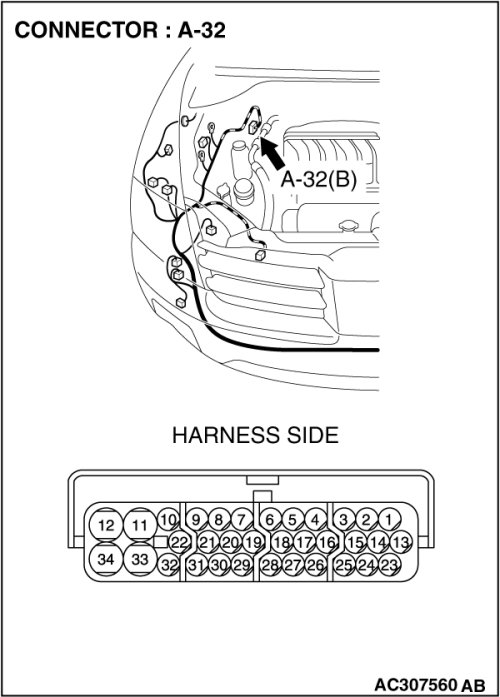
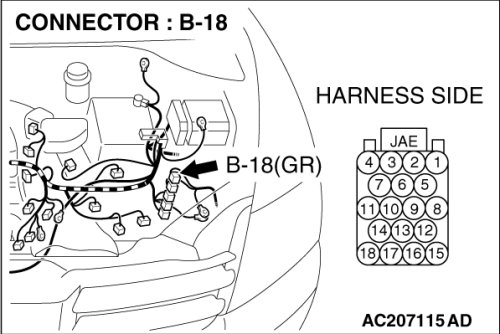
CAUTION:
The strand end of the twist wire should be within 10 cm (4 inches) from the connector. For details refer to Precautions When CAN Bus Line(s) are Repaired.
Q. Are TCL/ASC-ECU connector A-32 and powertrain control module connector B-18 in good condition?
YES Go to Step 33 .
NO Repair the damaged parts.
STEP 33. Using scan tool MB991958, diagnose the CAN bus line (Disconnect powertrain control module connector B-18, and check the powertrain control module system).
(1)Disconnect powertrain control module connector B-18.
(2)Turn the ignition switch to the "ON" position.
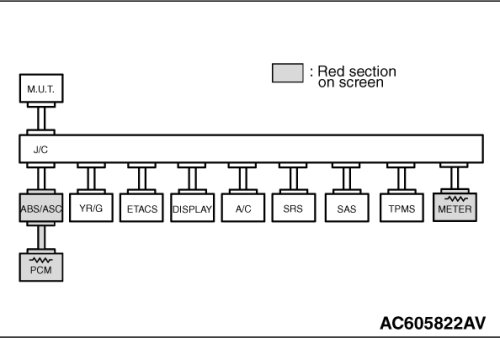
(3)Diagnose CAN bus lines, and check if the M.U.T.-III screen is as shown in the illustration.
(4)Turn the ignition switch to the "LOCK" (OFF) position.
(5)Connect powertrain control module connector B-18.
Q. Does the M.U.T.-III screen correspond to the illustration?
YES : [The M.U.T.-III screen corresponds to the illustration] Go to Step 34 .
NO : [The M.U.T.-III screen does not correspond to the illustration] Go to Step 36 .
STEP 34. Check the CAN bus lines between the TCL/ASC-ECU and the powertrain control module. Measure the resistance between TCL/ASC-ECU connector A-32 and powertrain control module connector B-18.
CAUTION:
A digital multimeter should be used. For details refer to Precautions When CAN Bus Line(s) are Repaired.
CAUTION:
The test wiring harness should be used. For details refer to Precautions When CAN Bus Line(s) are Repaired.
(1)Disconnect TCL/ASC-ECU connector A-32 and powertrain control module connector B-18, and measure the resistance between each wiring harness side connector.
(2)Turn the ignition switch to the "LOCK" (OFF) position.
CAUTION:
Disconnect the negative battery terminal. For details refer to Precautions When CAN Bus Line(s) are Repaired.
(3)Disconnect the negative battery terminal.
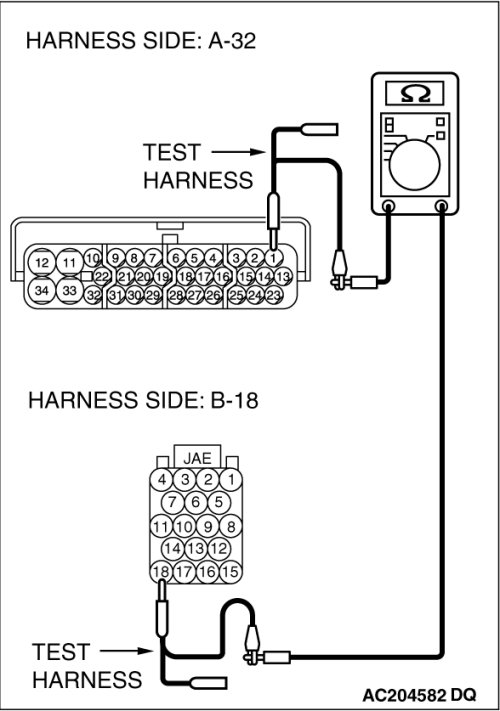
(4)Measure the resistance between TCL/ASC-ECU connector terminal 1 and powertrain control module connector terminal 18.
OK: 2 ohms or less
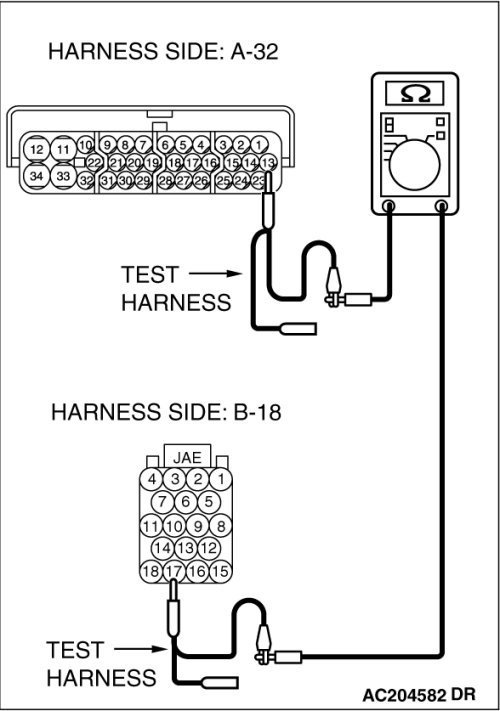
(5)Measure the resistance between TCL/ASC-ECU connector terminal 13 and powertrain control module connector terminal 17.
OK: 2 ohms or less
CAUTION:
Strictly observe the specified wiring harness repair procedure.
For details refer to Precautions on How to Repair the CAN Bus Line(s).
Q. Do all the resistances measure 2 ohms or less?
YES : [All the resistances measure 2 ohms or less] Go to Step 35
.
NO : [If either of the resistances measures more than 2 ohms or all the resistances measure more than 2 ohms] Repair the wiring harness between TCL/ASC-ECU connector and the powertrain control module connector.
STEP 35. Check the CAN bus lines inside the TCL/ASC-ECU. Measure the resistance at TCL/ASC-ECU connector A-32.
CAUTION:
A digital multimeter should be used. For details refer to Precautions When CAN Bus Line(s) are Repaired.
CAUTION:
The test wiring harness should be used. For details refer to Precautions When CAN Bus Line(s) are Repaired.
(1)Disconnect TCL/ASC-ECU connector A-32, and measure the resistance at the equipment side of TCL/ASC-ECU connector A-32.
(2)Turn the ignition switch to the "LOCK" (OFF) position.
(3)
CAUTION:
Disconnect the negative battery terminal. For details refer to Precautions When CAN Bus Line(s) are Repaired.
Disconnect the negative battery terminal.
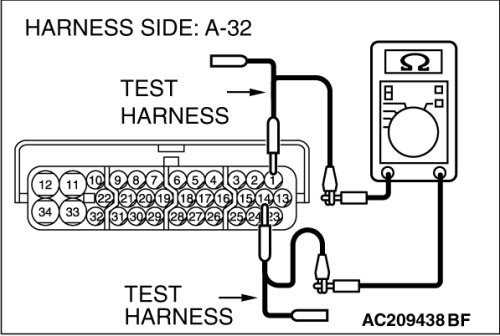
(4)Measure the resistance between TCL/ASC-ECU connector terminals 1 and 14.
OK: 2 ohms or less
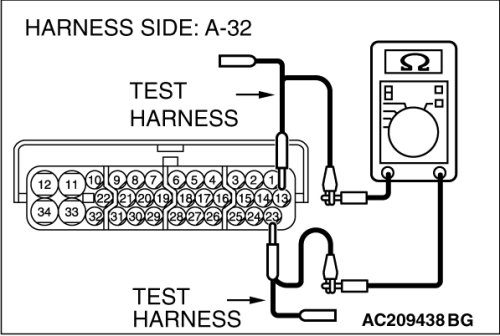
(5)Measure the resistance between TCL/ASC-ECU connector terminals 13 and 23.
OK: 2 ohms or less
CAUTION:
Strictly observe the specified wiring harness repair procedure.
For details refer to Precautions on How to Repair the CAN Bus Line(s).
Q. Do all the resistances measure 2 ohms or less?
YES : [All the resistances measure 2 ohms or less] Power supply to the powertrain control module may be suspected. Diagnose the engine. Inspection Procedure 1.
NO : [If either of the resistances measures more than 2 ohms or all the resistances measure more than 2 ohms] Replace the TCL/ASC-ECU.
STEP 36. Using scan tool MB991958, diagnose the CAN bus line (Disconnect TCL/ASC-ECU connector A-32, and check the TCL/ASC-ECU system).
(1)Disconnect TCL/ASC-ECU connector A-32.
(2)Turn the ignition switch to the "ON" position.
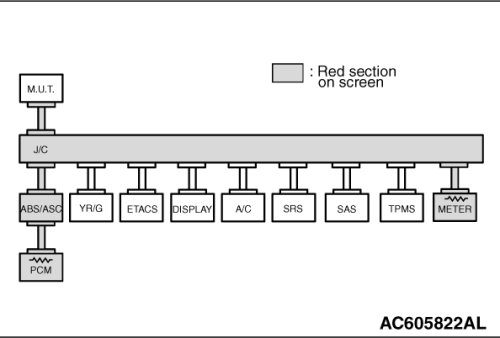
(3)Diagnose CAN bus lines, and check if the M.U.T.-III screen is as shown in the illustration.
(4)Turn the ignition switch to the "LOCK" (OFF) position.
(5)Check TCL/ASC-ECU connector A-32.
Q. Does the M.U.T.-III screen correspond to the illustration?
YES : [The M.U.T.-III screen corresponds to the illustration] Go to Step 37 .
NO : [The M.U.T.-III screen does not correspond to the illustration] Check the CAN_L and H lines for short circuit (Refer to Diagnostics Item 18).
STEP 37. Check the CAN bus lines between intermediate connector C-31 and the TCL/ASC-ECU. Measure the resistance between intermediate connector C-31 and TCL/ASC-ECU connector A-32.
CAUTION:
A digital multimeter should be used. For details refer to Precautions When CAN Bus Line(s) are Repaired.
CAUTION:
The test wiring harness should be used. For details refer to Precautions When CAN Bus Line(s) are Repaired.
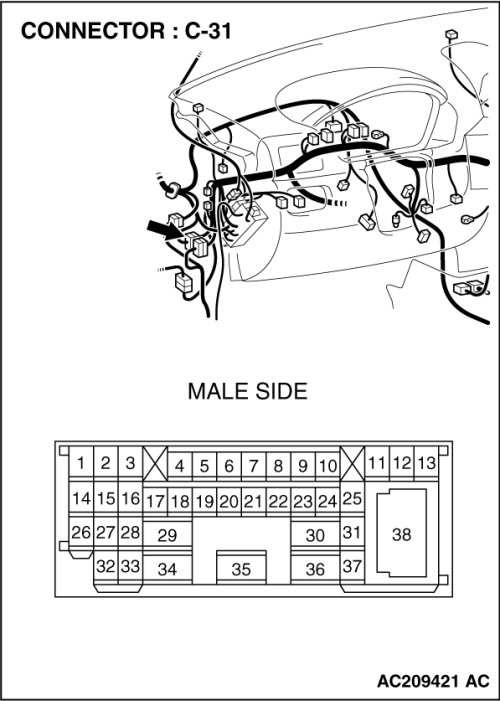
(1)Disconnect intermediate connector C-31 and TCL/ASC-ECU connector A-32, and measure the resistance between the wiring harness side connector of TCL/ASC-ECU connector A-32 and the male side connector of intermediate connector C-31 (at front wiring harness side).
(2)Turn the ignition switch to the "LOCK" (OFF) position.
(3)
CAUTION:
Disconnect the negative battery terminal. For details refer to Precautions When CAN Bus Line(s) are Repaired.
Disconnect the negative battery terminal.
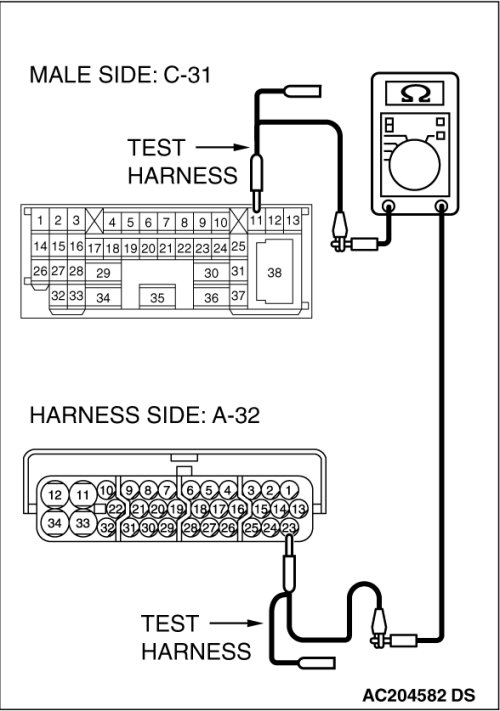
(4)Measure the resistance between intermediate connector terminal 11 and TCL/ASC-ECU connector terminal 23.
OK: 2 ohms or less
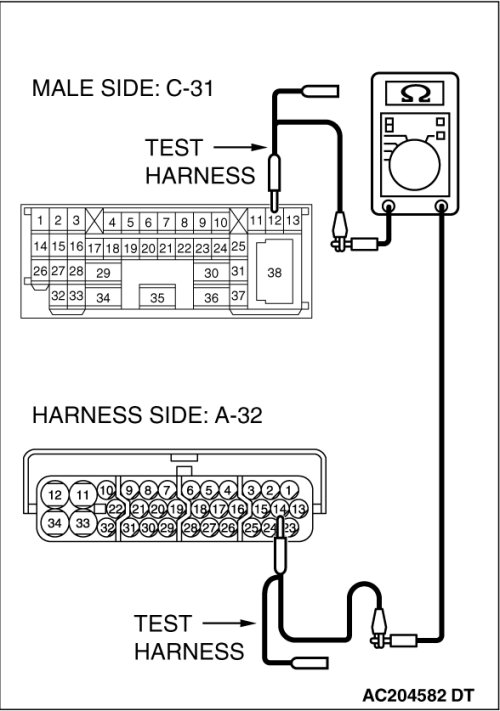
(5)Measure the resistance between intermediate connector terminal 12 and TCL/ASC-ECU connector terminal 14.
OK: 2 ohms or less
CAUTION:
Strictly observe the specified wiring harness repair procedure.
For details refer to Precautions on How to Repair the CAN Bus Line(s).
Q. Do all the resistances measure 2 ohms or less?
YES : [All the resistances measure 2 ohms or less] Go to Step 38
.
NO : [If either of the resistances measures more than 2 ohms or all the resistances measure more than 2 ohms] Repair the wiring harness between intermediate connector C-31 and the TCL/ASC-ECU connector.
STEP 38. Check the CAN bus lines between intermediate connector C-31 and the joint connector (4). Measure the resistance between intermediate connector C-31 and joint connector (4) C-101.
CAUTION:
A digital multimeter should be used. For details refer to Precautions When CAN Bus Line(s) are Repaired.
CAUTION:
The test wiring harness should be used. For details refer to Precautions When CAN Bus Line(s) are Repaired.
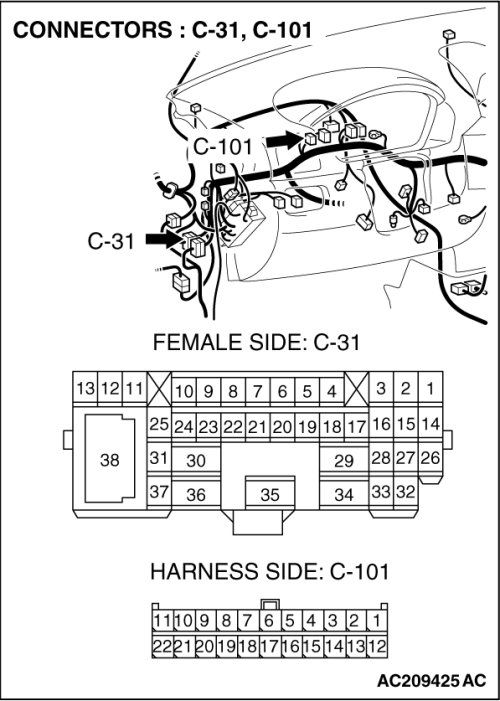
(1)Disconnect joint connector (4) C-101 and intermediate connector C-31, and measure the resistance between the wiring harness side connector of joint connector (4) C-101 and the female side connector of intermediate connector C-31 (instrument panel wiring harness side).
(2)Turn the ignition switch to the "LOCK" (OFF) position.
(3)
CAUTION:
Disconnect the negative battery terminal. For details refer to Precautions When CAN Bus Line(s) are Repaired.
Disconnect the negative battery terminal.
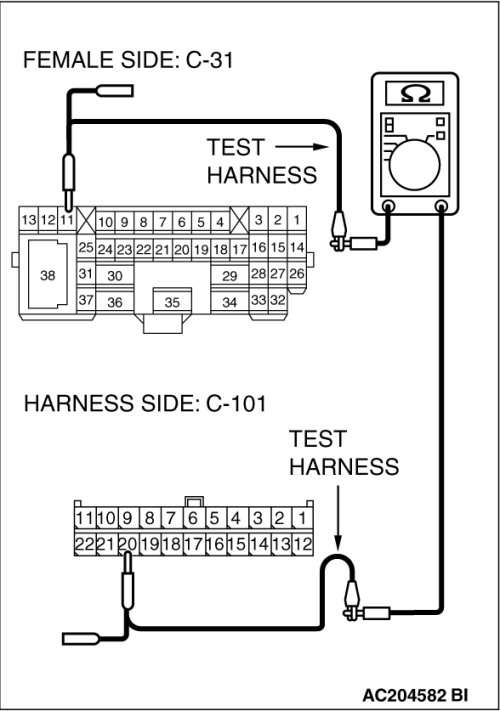
(4)Measure the resistance between joint connector (4) terminal 20 and intermediate connector terminal 11.
OK: 2 ohms or less
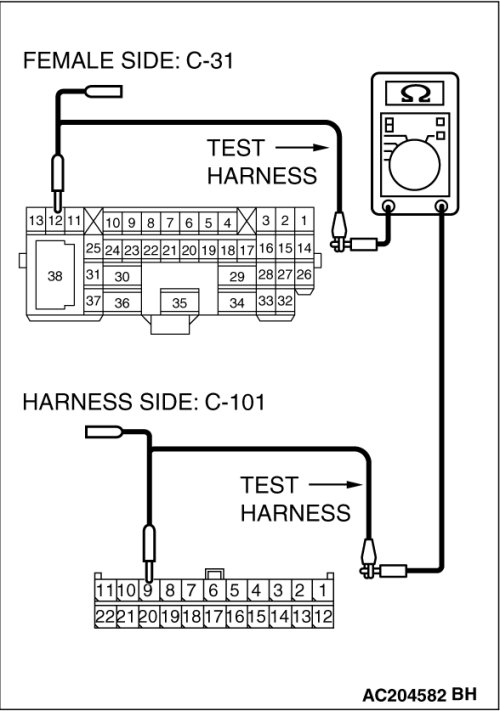
(5)Measure the resistance between joint connector (4) terminal 9 and intermediate connector terminal 12.
OK: 2 ohms or less
CAUTION:
Strictly observe the specified wiring harness repair procedure.
For details refer to Precautions on How to Repair the CAN Bus Line(s).
Q. Do all the resistances measure 2 ohms or less?
YES : [All the resistances measure 2 ohms or less] Power supply to the TCL/ASC-ECU may be suspected. Diagnose the ASC system. Inspection Procedure 3.
NO : [If either of the resistances measures more than 2 ohms or all the resistances measure more than 2 ohms] Repair the wiring harness between joint connector (4) and intermediate connector C-31.