Exhaust Gas Recirculation: Testing and Inspection
Fig. 31 EGR vacuum modulator & TVSV test.:
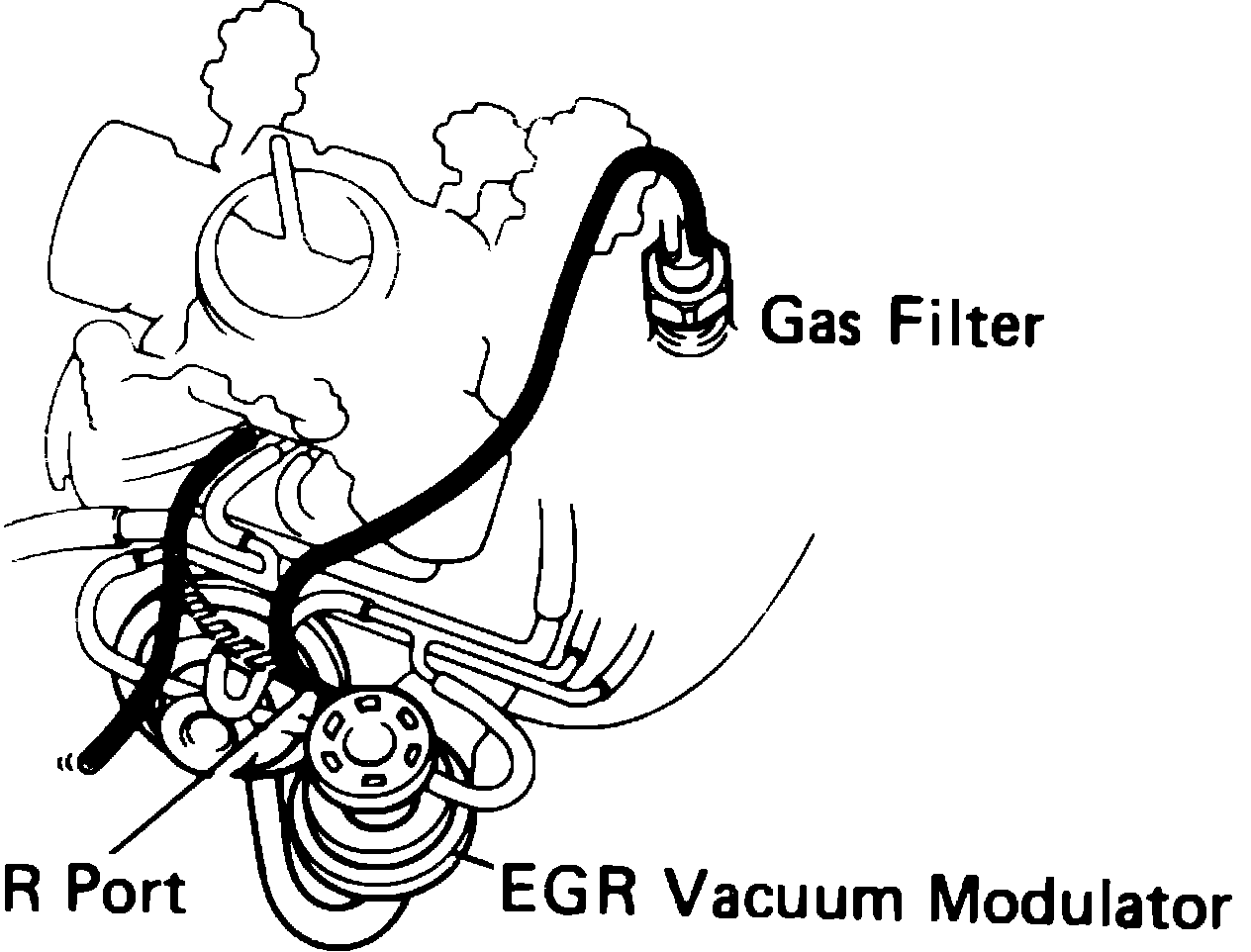
COROLLA FRONT WHEEL DRIVE W/4A-C & 4A-LC ENGINE
1. Inspect EGR vacuum modulator filter and clean or replace as needed.
2. Connect vacuum gauge in line with EGR valve vacuum hose using suitable fitting.
3. Start engine and ensure engine runs properly at idle. If engine runs rough or stalls, check for improperly seated EGR valve.
4. With coolant temperature below 122°F, run engine at 2000 RPM and observe vacuum gauge. If gauge reading is not zero, TVSV is defective.
5. Warm engine to normal operating temperature and observe gauge reading at 2000 RPM. Gauge should indicate low vacuum.
6. Disconnect vacuum hose from port ``R'' of vacuum modulator and connect manifold vacuum directly to port ``R'', Fig. 31. Vacuum gauge should indicate high vacuum at 2000 RPM.
7. If improper readings are obtained in steps 5 and 6, check for defective vacuum modulator.
8. Remove vacuum gauge and adapter, reconnect proper vacuum hose to modulator, then apply manifold vacuum directly to EGR valve.
9. If engine does not run rough at idle or stall, EGR valve is defective.
Fig. 33 EGR valve identification.:

4A-GE, 4A-GEC, 4A-GEL & 4A-GELC ENGINES
1. Inspect filter in EGR vacuum modulator and clean as necessary using compressed air.
2. Connect vacuum gauge in line between EGR valve and vacuum modulator, Fig. 33.
3. Start engine and ensure engine operates properly at idle. If engine operates rough or stalls, check for improperly seated EGR valve.
4. With coolant temperature below 95°F, operate engine at 3500 RPM and observe vacuum gauge. If gauge reading is not zero, BVSV is defective.
5. Run engine until normal operating temperature is reached and observe gauge reading at 3500 RPM. Gauge should indicate low vacuum.
6. Gradually increase engine speed to 5000 RPM and ensure gauge reading drops to zero.
7. Disconnect vacuum hose from port ``R'' of vacuum modulator, Fig. 33, and connect manifold vacuum directly to port ``R.'' Vacuum gauge should now indicate high vacuum at 3500 RPM.
8. Remove vacuum gauge and adapter and reconnect vacuum hoses, then apply manifold vacuum directly to EGR valve.
9. If engine does not run rough at idle or stall, EGR valve is defective.