Mechanical System Tests
MECHANICAL SYSTEM TESTSa. Check the stall speed.
This test checks the overall performance of the transmission and engine by measuring the stall speed in the D and R positions.
NOTE:
- Perform the test at the normal operating temperature of the ATF: 50 to 80 °C (122 to 176 °F).
- Do not run this test continuously for more than 5 seconds.
- To ensure safety, perform this test in a wide, clear and level area which provides good traction.
- The test should always be carried out in pairs. One technician should observe the conditions of the wheels or chocks outside the vehicle while the other is performing the test.
1. Chock the 4 wheels.
2. Connect the scan tool (OBD II scan tool or the hand-held tester) to the DLC3.
3. Fully apply the parking brake.
4. Keep the brake pedal depressed firmly with your left foot.
5. Start the engine.
6. Move the shift lever into the D position. Fully depress all the way down the accelerator pedal with your right foot. Quickly read the stall speed at this time.
Stall speed: 2,250 ± 150 rpm
7. Conduct the same test in the R position.
Stall speed: 2,250 ± 150 rpm
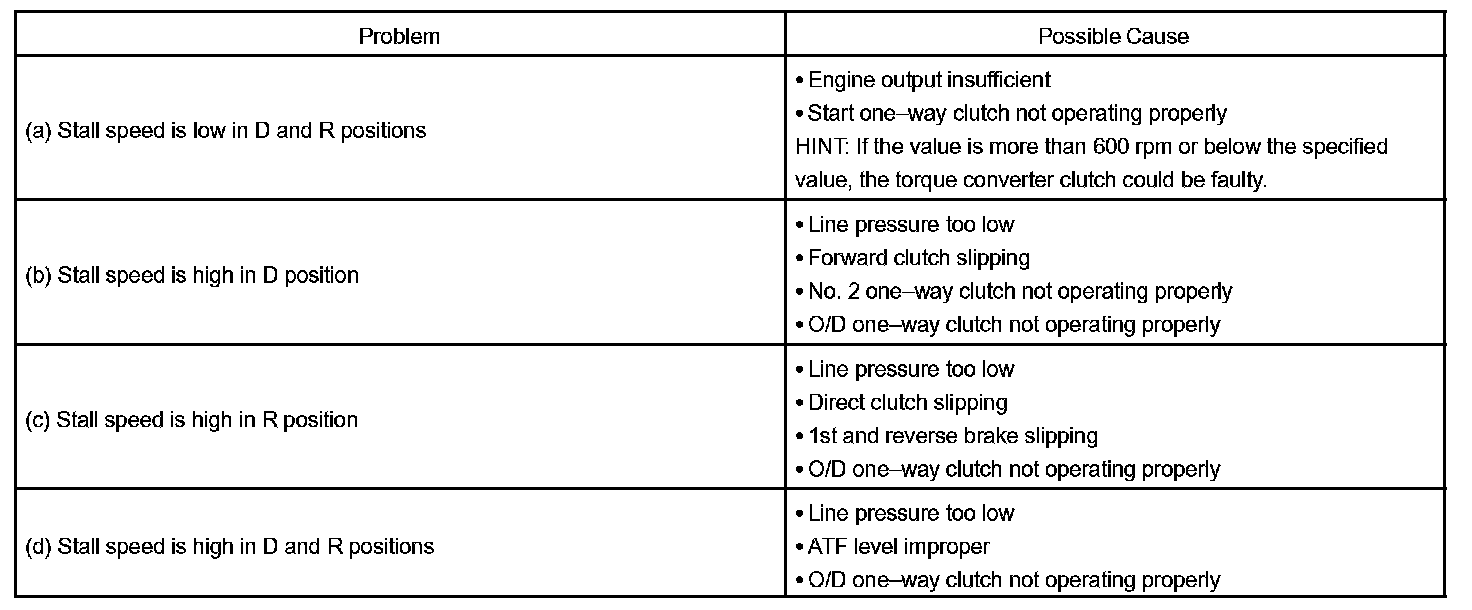
Evaluation:
b. Measure the time lag.
When the shift lever is moved while the engine is idling, there will be a certain time lapse or time lag before the shock can be felt. This is used for checking the condition of the O/D direct clutch, the forward clutch, and the 1st and reverse brake.
NOTE:
- Conduct the test at the normal operating temperature of the ATF: 50 to 80 °C (122 to 176 °F)
- Be sure to allow 1 minute interval between the tests.
- Perform measurement 3 times and take the average value.
1. Connect the OBD II scan tool or the hand-held tester to the DLC3.
2. Fully apply the parking brake.
3. Start the engine and check the idle speed.
Idle speed: 700 ± 50 rpm (in the N position and the air conditioner OFF)
4. Move the shift lever from the N to D position. Using a stop watch, measure the time from the lever is moved until the shock is felt.
Time lag at N to D: Less than 1.2 seconds
5. In the same manner, measure the time lag at N to R.
Time lag at N to R: Less than 1.5 seconds
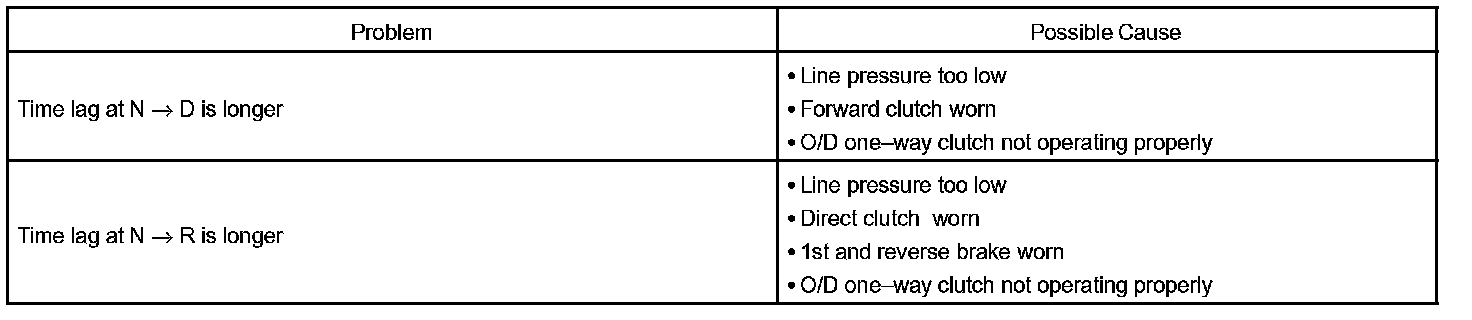
Evaluation (if the N to D or N to R is longer than that specified):