Brake Rotor/Disc: Testing and Inspection
GENERALIn manufacturing the brake rotor, tolerances of the braking surfaces for flatness, parallelism and lateral runout are held very close. The maintenance of close tolerance on the shape of the braking surfaces is necessary to prevent brake roughness. In addition to these tolerances, the surface finish must be held to a specified range. The control of the braking surface finish is necessary to avoid pulls and erratic performance and to extend lining life. Light scoring of the rotor surfaces not exceeding 0.38mm (0.015 in) in depth, which may result from normal use, is not detrimental to brake operation.
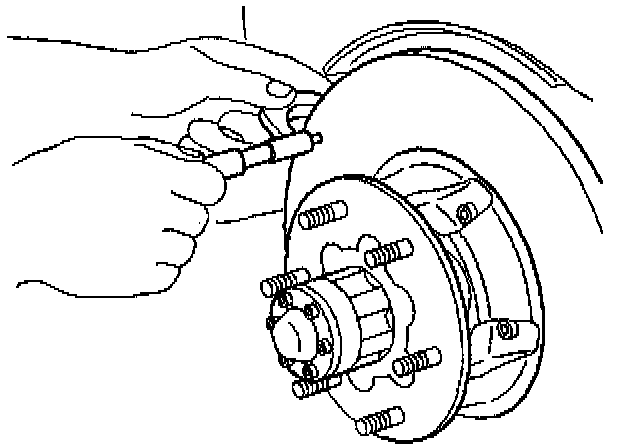
Thickness Variation/Parallelism Check
1. Thickness variation can be checked by measuring the thickness of the rotor at four or more points around the circumference of the rotor. All measurements must be made at 29 mm (1.14 in) -front/22 mm (0.87 in)- rear from the edge of the rotor.
Specs:
Front Rotor Thickness:
Standard 26.0 mm (1.024 in.)
Service Limit 24.6 mm (0.969 in.)
Rear Rotor Thickness:
Standard 18.0 mm (0.709 in.)
Service Limit 16.6 mm (0.654 in.)
2. A rotor that varies by more than 0.010 mm (0.0004 in) can cause pedal pulsation and/or front end vibration during brake applications. A rotor that does not meet these specifications should be refinished to specifications or replaced.
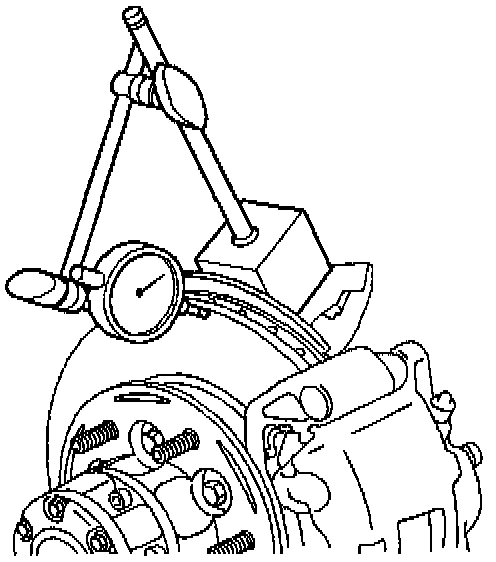
Lateral Runout Check
1. Adjust the wheel bearing correctly.(Refer to Transmission and Drivetrain)
2. Install 2 wheel nuts to retain rotor.
3. Fasten a dial indicator to the suspension so that the indicator stylus contacts the rotor about 29 mm (1.14 in)-front/22 mm (0.87 in)-rear from the rotor edge.
4. Zero the dial indicator.
5. Move the rotor one complete revolution and observe total indicated runout.
Specs:
Maximum rotor runout 0.13 mm (0.005 in.)
NOTE: In runout is greater than the limit, replace or refinish the rotor.
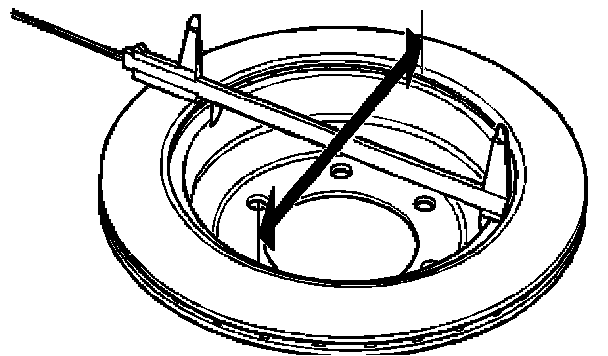
Rear Drum (in disc) Inside Diameter Check
Check the rear drum inside diameter by measuring at more than two positions. If the inside diameter is greater than the limit, replace the rear rotor.
Specs:
Rear Drum Inside Diameter:
Standard 210.0 mm (8.27 in.)
Service Limit 211.14 mm (8.32 in.)