Restraints and Safety Systems: Description and Operation
System DescriptionSRS Components
Airbags
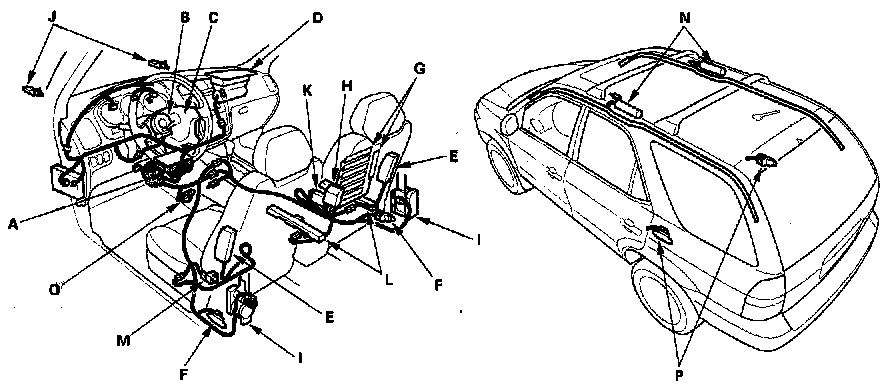
The SRS is a safety device which, when used with the seat belt, is designed to help protect the driver and front passenger in a frontal impact exceeding a certain set limit. The system consists of the SRS unit, including safing sensor and impact sensor (A), the cable reel (B), the driver's airbag (C), the front passenger's airbag (D), side airbags (E), side curtain airbags (N), seat belt tensioners (I), front impact sensors (J), side impact sensors (F, P), and roll rate sensor (O). Since the driver's and front passenger's airbags use the same sensors, both normally inflate at the same time. However, it is possible for only one airbag to inflate. This can occur when the severity of a collision is at the margin, or threshold, that the determines whether or not the airbags will deploy. In such cases, the seat belt will provide sufficient protection, and the supplemental protection offered by the airbag would be minimal.
Side Airbags
The side airbags (E) are in each front seat-back. They help protect the upper torso of the driver or front passenger during a moderate to severe side impact. Side impact sensors (first) (F) in each door sill, side impact sensors (second) (P) in each rear door sill, and the SRS unit safing sensor detect such an impact and instantly inflate the driver's or the front passenger's side airbag. Only one side airbag will deploy during a side impact. If the impact is on the passenger's side, the passenger's side airbag will deploy even if there is no passenger.
Side Curtain Airbags
The side curtain airbags (N) are in each side of the roof. They help protect the head of the driver, front passenger, and passenger's in the rear outer seats during a moderate to severe side impact. Side impact sensors (first) (F) in each front door sill, side impact sensors (second) (P) in each rear door sill, roll rate sensor (O) under the center console, and the SRS unit detect such an impact and instantly inflate the driver's or the passenger's side curtain airbag and the seat belt tensioners. A side impact causes the side curtain airbag and the side airbag on the impacted side to deploy at the same time.
Seat Belt Tensioners
The seat belt tensioners are linked with the SRS airbags to further increase the effectiveness of the seat belt. In a front-end collision, a side collision, or a rollover, the tensioners instantly retract the seat belt firmly to secure the driver and front passenger in their seats.
OPDS
The side airbag system also includes an occupant position detection system (OPDS). This system consists of a sensor (G) and an OPDS unit (H) in the front passenger's seat-back. The OPDS unit sends occupant height and position data to the SRS unit. If the OPDS unit determines that the front passenger is of small stature (for example, a child) or the front passenger is leaning into the side airbag deployment path, the SRS unit automatically disables the passenger's side airbag. The SRS unit also disables the airbag when the OPDS detects certain objects on the seat. When the passenger's side airbag is disabled, the side airbag cutoff indicator on the instrument panel alerts the driver that the passenger's side airbag will not deploy in a side impact. When the object is removed, or the passenger sits upright, the side airbag cutoff indicator goes off after a few seconds, alerting the driver that the passenger's side airbag will deploy in a side impact.
Front Passenger's Weight Sensors
The front passenger's weight sensor unit (K) is under the front passenger's seat along with the weight sensors (L). The weight sensors detect the weight on the seat, and send the information to the front passenger's weight sensor unit. If the total weight is about 65 lbs (30 kg) or less, the front passenger's weight sensor unit sends a signal to the SRS unit to prevent the passenger's airbag from deploying. When the passenger's airbag is disabled, the passenger airbag cutoff indicator on the center panel comes on to alter the driver that the front passenger's airbag will not deploy in a front-end collision.
Driver's Seat Position Sensor
The driver's seat position sensor (M) is under the driver's seat on the left side. When the driver's seat is moved to its full forward position, the deployment of the driver's airbag is moderated to decrease its force of impact during a front-end collision.
Roll Rate Sensor
The roll rate sensor is located under the center console. It detects the amount of roll of the vehicle and sends the information to the SRS unit. The SRS unit uses this information to determine if a vehicle rollover is imminent. If so, it deploys both side curtain airbags and the front seat belt tensioners.
Side Airbag Cutoff Indicator/OPDS Operation
The indicator comes on if the front passenger's seat is occupied by a small adult or child who is leaning into the deployment path, or an object (grocery bag, briefcase, purse, etc.) is in the seat. This indicates the passenger's side airbag is off and will not deploy; there is no problem with the side airbag. If the passenger sits upright or moves to another seat, or you remove the object from the seat, the indicator should go off.
Passenger Airbag Cutoff Indicator
The indicator comes on if the weight of the front passenger is about 65 lbs (30 kg) or less. This indicates the passenger's front airbag is off and will not deploy. The front airbag is shut off to reduce the chance of airbag-caused injuries.
SRS Operation
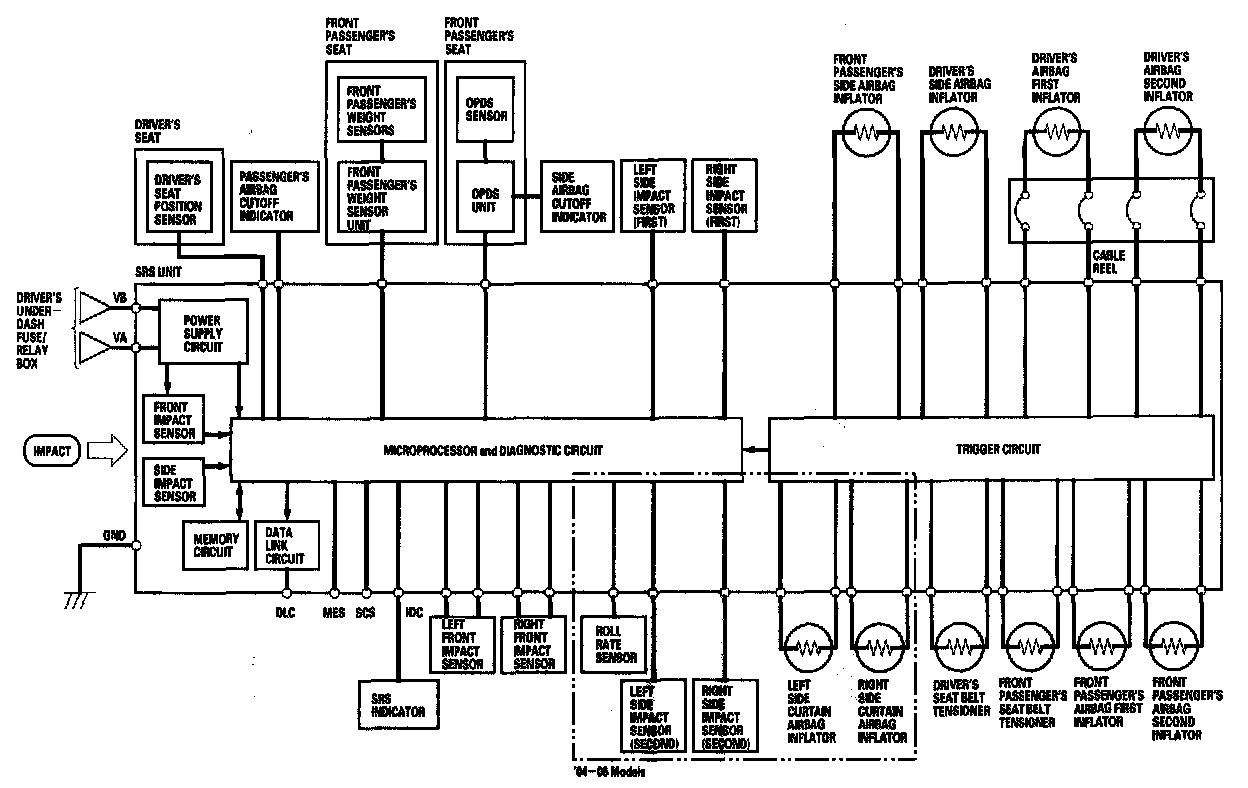
The main circuit in the SRS unit senses and judges the force of impact and, if necessary, ignites the inflator charges. If battery voltage is too low or power is disconnected due to the impact, the voltage regulator and the back-up power circuit will keep voltage at a constant level.
For the SRS to operate
Seat Belt Tensioners
1. A front impact sensor, side impact sensor, or the roll rate sensor must activate and send electric signals to the microprocessor.
2. The microprocessor must compute the signals and send them to the tensioners.
3. The charges must ignite and deploy the tensioners.
Driver's and Front Passenger's Airbag(s)
1. A front impact sensor must activate and send electric signals to the microprocessor.
2. The microprocessor must compute the signals and, depending on the severity of the collision and whether the seat belt buckle switch is ON or OFF, it sends the appropriate signals to the airbag inflator(s).
3. The microprocessor turns off the signals to the front passenger's airbag if the front passenger's weight sensor unit determines that the weight of the occupant in the front passenger's seat is about 65 lbs (30 kg) or less.
4. When the driver's seat is moved to its full forward position, the seat position sensor sends a signal to the microprocessor to moderate the deployment of the driver's airbag.
5. The inflators that received signals must ignite and deploy the airbags.
Side Airbag(s)
1. A side impact sensor must activate and send electric signals to the microprocessor.
2. The microprocessor must compute the signals and send them to the side airbag inflator(s). However, the microprocessor cuts off the signals to the front passenger's side airbag if the SRS unit determines that the front passenger's head is in the deployment path of the side airbag.
3. The inflator that received the signal must ignite and deploy the side airbag.
Side Curtain Airbag(s)
1. Side impact sensor and/or the roll rate sensor must activate and send electrical signals to the microprocessor.
2. The microprocessor must compute the signals and send them to the side curtain airbag and side airbag inflator(s).
3. The inflator that received the signals must ignite and deploy the side curtain airbag and side airbag at the same time.
Self-diagnosis System
A self-diagnosis circuit is built into the SRS unit; when the ignition switch is turned ON (II), the SRS indicator comes on and goes off after about 6 seconds if the system is operating normally. If the indicator does not come on, or does not go off after 6 seconds, or if it comes on while driving, it indicates an abnormality in the system. The system must be inspected and repaired as soon as possible. For better serviceability, the SRS unit memory stores a DTC that relates to the cause of the malfunction, and the unit is connected to the data link connector circuit. This information can be read with the HDS when it is connected to the DLC (16P).
NOTE: If the battery negative cable is disconnected during troubleshooting, do the following.
Before you disconnect the battery, make sure you have the anti-theft code for the radio and the navigation system, then write down the frequencies for the radio's preset buttons.
After you reconnect the battery:
- Do the engine idle learn procedure.
- Do the power window control unit reset procedure.
- Enter the radio and navigation system anti-theft code, enter the audio presets, and set the clock.