Manifold Pressure/Vacuum Sensor: Description and Operation
Manifold Absolute Pressure (MAP) Sensor
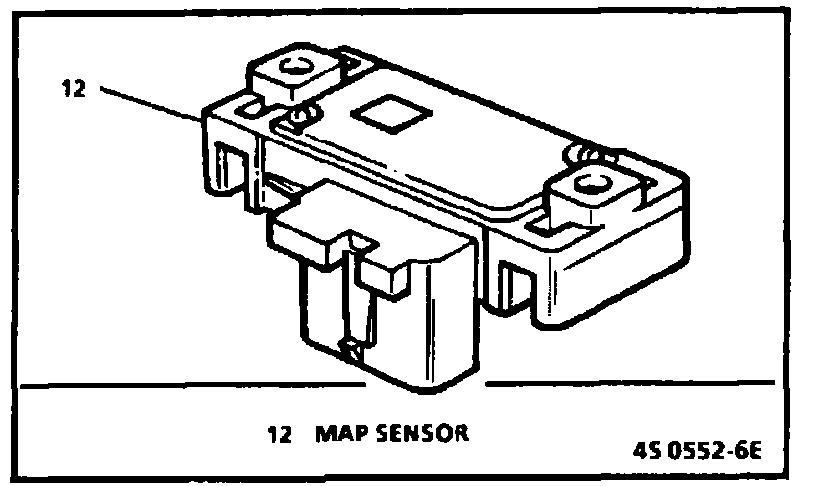
The Manifold Absolute Pressure (MAP) sensor measures the changes in the intake manifold pressure which result from engine load and speed changes, and converts this to a voltage output.
A closed throttle on engine coastdown would produce a relatively low MAP output, while a wide-open throttle would produce a high output. Manifold Absolute Pressure (MAP) is the OPPOSITE of what you would measure on a vacuum gage. When manifold pressure is high, vacuum is low. The MAP sensor is also used to measure barometric pressure under certain conditions, which allows the ECM to automatically adjust for different altitudes. The ECM sends a 5 volts reference signal to the MAP sensor. As the manifold pressure changes, the electrical resistance of the sensor also changes. By monitoring the sensor output voltage, the ECM knows the manifold pressure. A higher pressure, low vacuum (high voltage) requires more fuel, while a lower pressure, higher vacuum (low voltage) requires less fuel.
A failure in the MAP sensor circuit should set a Code 33 or Code 34.