Anti-Afterburn Valve
Fig. 14 - Anti-Afterburn Valve:
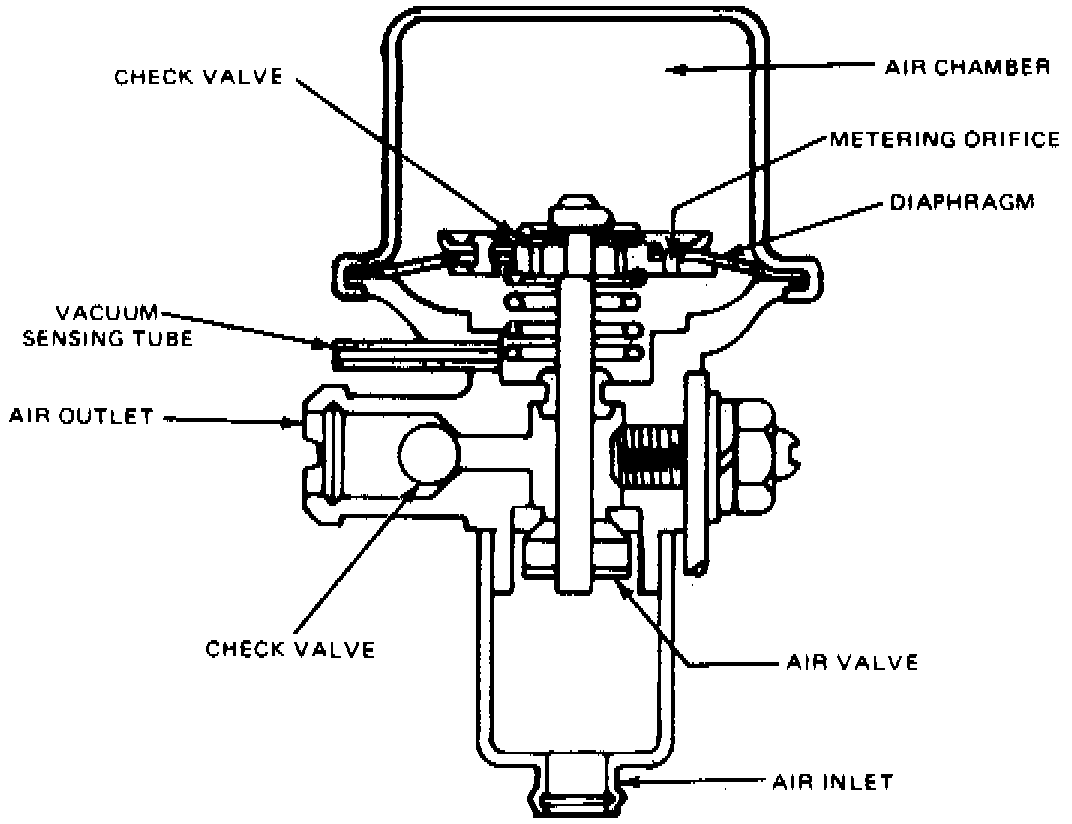
The anti-afterburn valve, Fig. 14, is controlled and operated by intake manifold vacuum. The valve is activated when intake manifold vacuum suddenly increases and is kept open in proportion to the amount of pressure change sensed by the diaphragm of the valve system. The diaphragm is installed with the check valve and the metering orifice. The check valve permits air flow only from the vacuum sensing chamber to the air chamber. Therefore, if the air in the vacuum sensing tube decreases, the check valve opens and allows air flow into the air chamber to equalize the vacuum of both chambers. If the vacuum increases, the check valve closes and the diaphragm moves downward until the air flow through the metering orifice equalizes the vacuum. When the diaphragm is pushed downward, the air valve opens to allow air flow to the intake manifold. However, as the pressure is equalized, the spring returns the diaphragm and air valve to the closed position. The time required to equalize the vacuum is in proportion to the amount of vacuum change applied to the diaphragm.
As the anti-afterburn valve completes its operation, the deceleration valve adds additional fuel to enrichen the lean mixture created in the intake manifold by the deceleration action. This additional fuel permits more complete combustion and reduced emission contaminants.
The deceleration valve operates when all its controlling switches are closed. The accelerator switch closes the circuit when the accelerator pedal is released. The speedometer switch closes the circuit at speeds above 17-23 mph. On 1972-74 models, the clutch switch closes the circuit when the clutch pedal is released.