49-State Models
EGR Valve, 2.0L Manual Trans (49 States):
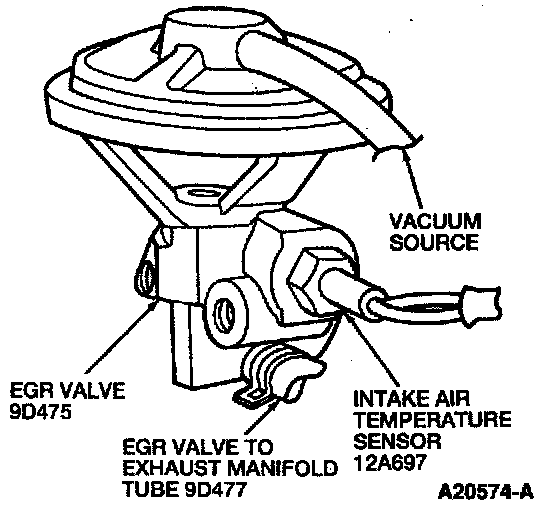
PURPOSE
The EGR valve recirculates portions of the exhaust gas back into the engine to reduce the amount of nitrogen released during combustion, and reduce combustion temperature. The amount of exhaust gases that are released into the engine is proportional to the load on the engine.
OPERATION
The system uses a control solenoid activated by the Powertrain Control Module (PCM) to operate the EGR system. The EGR system can be deactivated by the PCM and sensor inputs to the PCM. The Exhaust Gas Recirculation (EGR) valve operates under two conditions. If the sensors notify the PCM that the EGR valve needs to be activated, the PCM will activate the Exhaust Vacuum Regulator (EVR) solenoid. Vacuum is applied from the EVR solenoid to the Exhaust Gas Recirculation Vacuum Modulator (EGRM) valve. The EGRM valve opens the Number 3 port, in turn opening the EGR valve allowing exhaust gas to recirculate. The second condition occurs when sufficient engine speed and load are reached. Under these conditions, the EGRM valve closes due to moderate levels of exhaust back pressure and intake vacuum. This eliminates the venting of ported vacuum, which is high enough to open the EGR valve. An Exhaust Gas Recirculation Temperature (EGRT) sensor is threaded into the EGR valve body. The EGRT sensor detects the EGR flow and notifies the PCM with an input signal. The EGRT sensor causes the PCM to illuminate the Malfunction Indicator Lamp (MIL) in the case of an EGR malfunction.