Boost Pressure
PURPOSE
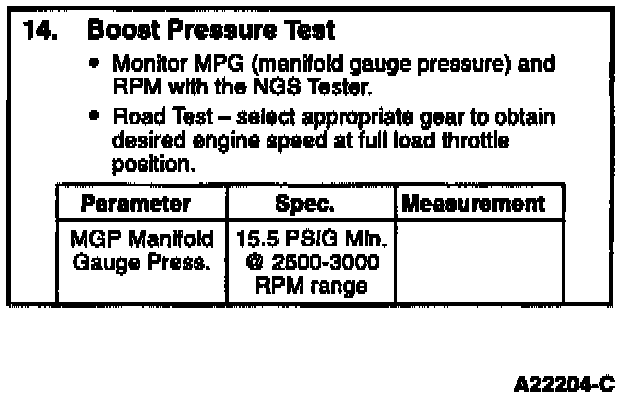
To determine if the engine can develop sufficient boost to obtain specific power.
If the engine can obtain specified boost there is no engine power problem. There may be chassis or applications concerns but the engine is performing as specified.
New Generation Star Hookup With Adapter Cable:

RECOMMENDED PROCEDURE
Monitor New Generation Star (NGS) Parameter Identification (PID) "MGP". After the engine is up to operating temperature, find an open section of road and select the best gear to achieve a 2500 through 3000 rpm acceleration. With the accelerator at WOT note the boost reading while accelerating through the 2500 to 3000 rpm range. Boost will level out after 3000 rpm. The highest boost reading will be noticed between 2500-3000 rpm.
ALTERNATE PROCEDURE
Install a "T" (manufactured locally out of common fittings) into the Manifold Absolute Pressure (MAP) sensor line that comes from the intake manifold. Make sure the MAP sensor is hooked up for this test.
Magnehelic(R) Gauge:

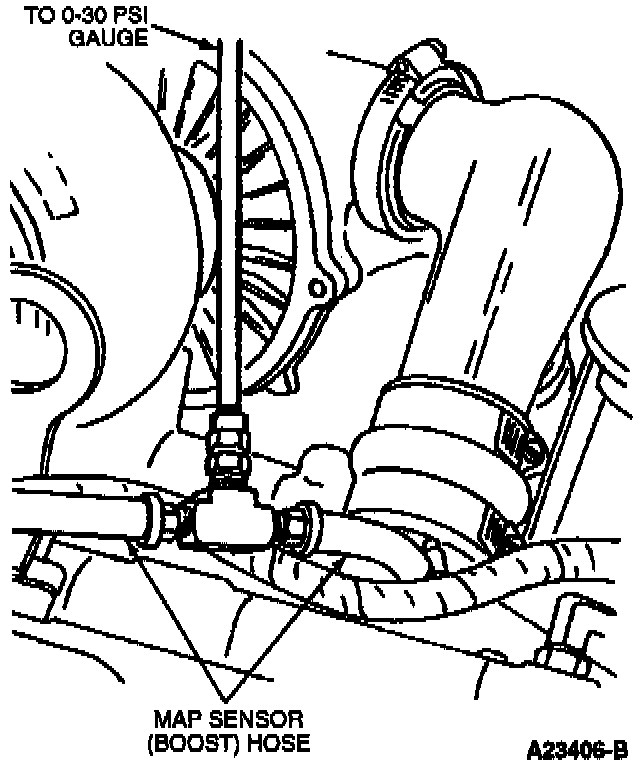
Connect a "T" to a 0 to 30 psi gauge that is temporarily installed in the cab. Route the hose so that it is not crimped and does not come in contact with any hot surface.
After the engine is up to operating temperature find an open section of road and select the best gear to achieve a 2500 through 3000 rpm acceleration. With the accelerator at WOT, note the boost reading while accelerating through the 2500 to 3000 rpm range. Boost will level out after 3000 rpm. The highest boost reading will be noticed between 2500-3000 rpm. This test is best accomplished either climbing a hill or with the truck fully loaded.
POSSIBLE CAUSES
- Restricted intake or exhaust.
- Low fuel pressure.
- Low injection control pressure.
- Control system faults.
- Defective injectors.
- Defective turbocharger.
- Base engine failure.
TOOLS REQUIRED
- A "T" manufactured locally out of common fittings
- 0 to 30 psi gauge
- Rotunda New Generation Star (NGS) Tester 007-00500 or equivalent