A/C Refrigerant System Operation
A/C REFRIGERANT SYSTEM OPERATIONRefrigerant Flow
During stabilized (A/C system shutdown) conditions, refrigerant system pressures are equalized on both the high and low sides of the refrigerant system.
When an A/C, mix or defrost function is selected and vehicle requires cooling, the system operates as follows:
- The A/C clutch field coil is energized and the A/C clutch is pulled into contact with the belt-driven A/C clutch pulley.
- The A/C clutch then rotates the compressor shaft.
- When the A/C compressor shaft is rotated, the refrigerant vapors from the suction side of the refrigerant system are compressed into a decreasingly smaller area, increasing the refrigerant vapor pressure and also raising the refrigerant vapor temperature.
- The high-pressure and high-temperature A/C compressor discharge refrigerant vapor is released into the A/C condenser core assembly, through the A/C manifold and tube.
- In the A/C condenser core, high pressure refrigerant vapor condenses into a high pressure liquid when heat is removed from the refrigerant vapor by outside air passing over A/C condenser core fins and tubing.
- High pressure liquid refrigerant from the A/C condenser core enters the inlet side of the A/C evaporator core orifice.
- Refrigerant pressure is reduced in the A/C evaporator core as a result of the flow restriction produced by the A/C evaporator core orifice and the A/C compressor suction.
- As passenger compartment or outside airflow passes over the plate/fin sections of the A/C evaporator core, the refrigerant inside absorbs the heat and changes into a vapor.
- A/C compressor suction draws the vaporized refrigerant and oil mixture into the suction accumulator/drier where the heavier oil-laden vapors fall to the bottom and the lighter vapors and oil mixture continue their path to the A/C compressor through the A/C manifold and tube.
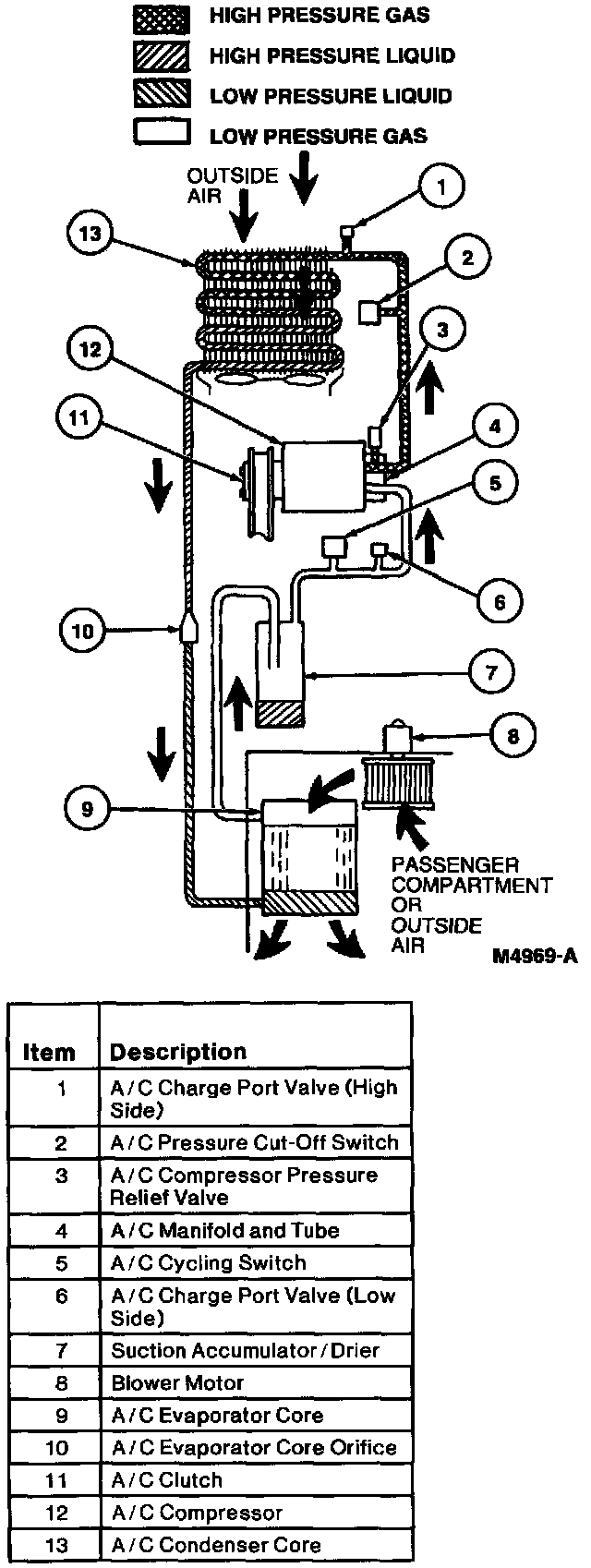
A/C Clutch Cycling Orifice Tube Type Refrigerant System
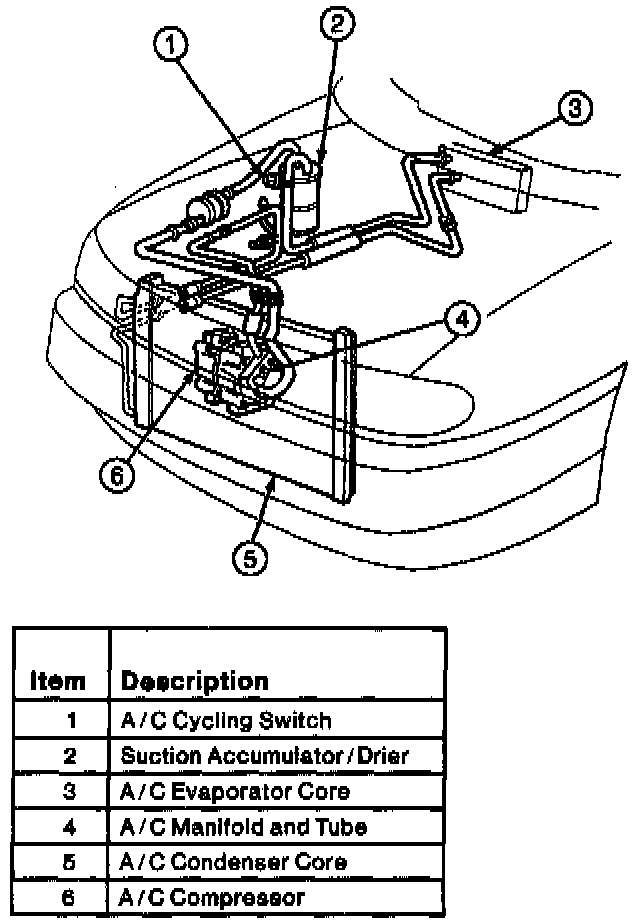
Refrigerant System - Without Auxiliary A/C
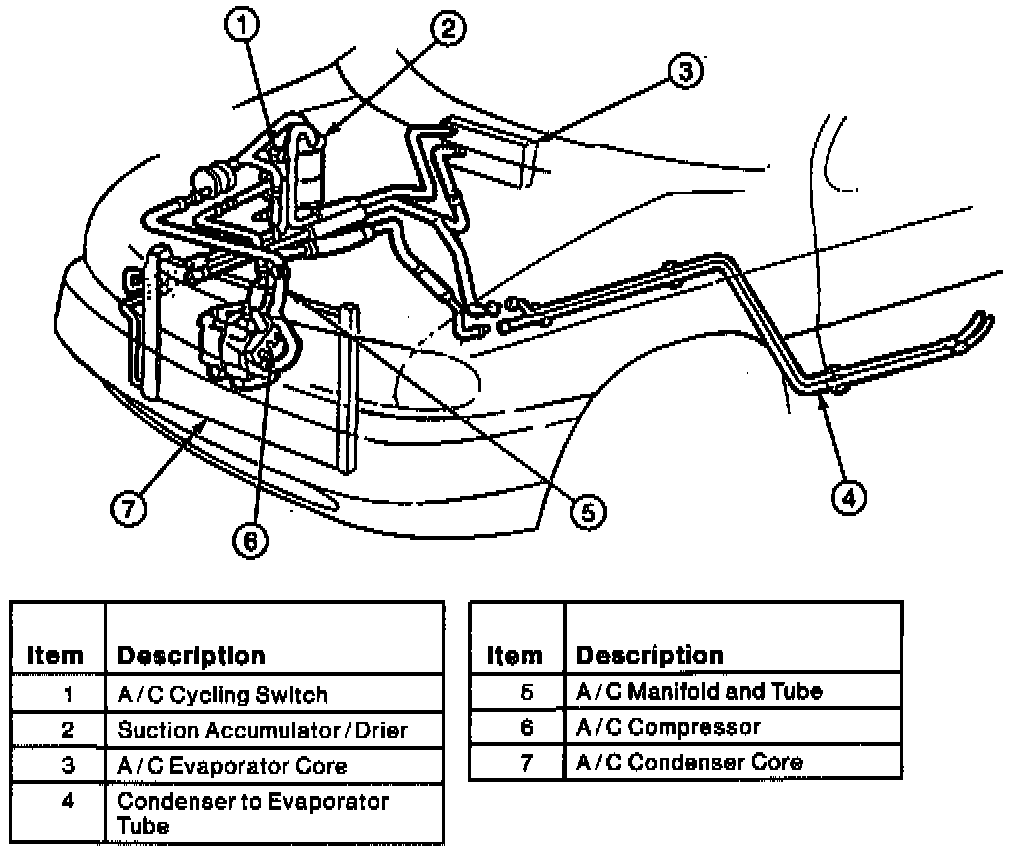
Refrigerant System - With Auxiliary A/C
REFRIGERANT SYSTEMS
This application uses the R-134a A/C system.
- The R-134a system uses a non-chlorofluorocarbon (non-CFC) based refrigerant R-134a.
- R-134a is a hydrofluorocarbon (HFC)-based refrigerant.
The A/C refrigerant system is an A/C clutch-cycling, orifice-tube type. The system components are:
- A/C compressor
- A/C clutch
- A/C condenser core
- A/C evaporator core
- suction accumulator/drier
- necessary refrigerant lines
System operation is controlled by the following:
- A/C evaporator core orifice
- A/C cycling switch
- A/C compressor pressure relief valve
- A/C pressure cut-off switch
The refrigerant system incorporates an A/C compressor, controlled by an A/C cycling switch. The A/C cycling switch:
- senses A/C evaporator core pressure to control A/C compressor operation.
- uses this method of compressor control to stop compressor operation during ambient temperatures below approximately 10°C (50°F) and to prevent A/C evaporator core from icing during normal system operation.
An A/C compressor pressure relief valve is installed in the A/C manifold and tube to protect the refrigerant system against excessive refrigerant pressures.
Operation of the A/C clutch is dependent on signals from the Powertrain Control Module (PCM). The system is programmed to interrupt compressor operation when certain conditions exist. The A/C clutch can be shut off (or kept off) for several seconds:
- at engine start-up
- at high engine speeds
- during acceleration
- when the engine coolant temperature exceeds a predetermined temperature.
- during low engine idle conditions (approximately 200 rpm below idle specifications)
An A/C evaporator core orifice is used to meter the liquid refrigerant into the A/C evaporator core for A/C evaporator core cooling.