Total Backlash Check
Total Backlash Check1. Raise and support the vehicle.
2. Remove the driveshaft.
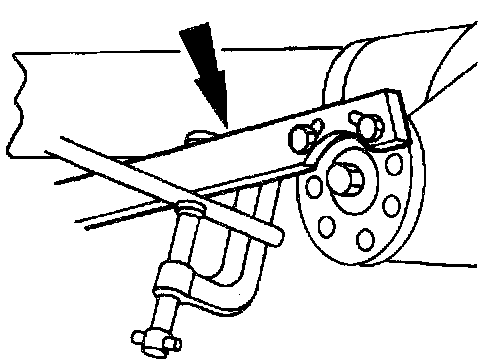
3. Install the Companion Flange Holder.
- Clamp a rigid bar or pipe to the tool. Clamp the other end of the bar or pipe to the frame or a body member in order to prevent movement of the rear axle pinion flange.
4. Lower the vehicle so that one rear wheel is resting on a wheel chock to prevent it from turning. The other rear wheel will be used to measure total rear axle backlash.
5. Rotate the free wheel slowly, by hand, until the feeling of driving the rear axle is encountered. Place a mark on the side of the tire, 305 mm (12 inches) from the center of the wheel, with a crayon or chalk.
6. While holding the crayon or chalk against the tire, rotate the wheel slowly in the opposite direction until the feeling of driving the rear axle is encountered again.
7. Measure the length of the crayon or chalk mark on the tire.
- If the length of the mark is 25.4 mm (1 inch) or less, the rear axle backlash is within allowable
- If the chalk mark is greater than 25.4 mm (1 inch), check for these conditions:
- Elongation of the differential pinion shaft and holes in the differential case.
- Missing differential pinion thrust washer or differential side gear thrust washer.
- Galling of the differential pinion shaft and bore.
- Excessive ring gear and pinion backlash. Follow the procedure for the type of rear axle to check backlash.
Able Shaft Bearing Noise
Axle shaft bearing noise is similar to gear noise and differential pinion bearing whine. Axle shaft bearing noise will usually distinguish itself from gear noise by occurring in all driving modes (drive, coast, and float), and will persist with the transmission in NEUTRAL while the vehicle is moving at the speed in which the concern is occurring. If the vehicle makes this noise, remove the suspect axle shaft, install a new bearing, and a new axle seal. Re-evaluate the vehicle for noise before removing any internal components.
Bearing Rumble
Bearing rumble sounds like marbles being tumbled. This condition is usually caused by a worn/damaged wheel bearing. The lower pitch is because the wheel bearing turns at only about one-third of the driveshaft speed. Wheel bearing noise also may be high-pitched, similar to gear noise, but will be evident in all four driving modes.