Evaporative Emission Control Canister: Service and Repair
EVAPORATIVE EMISSION CANISTERPart 1:
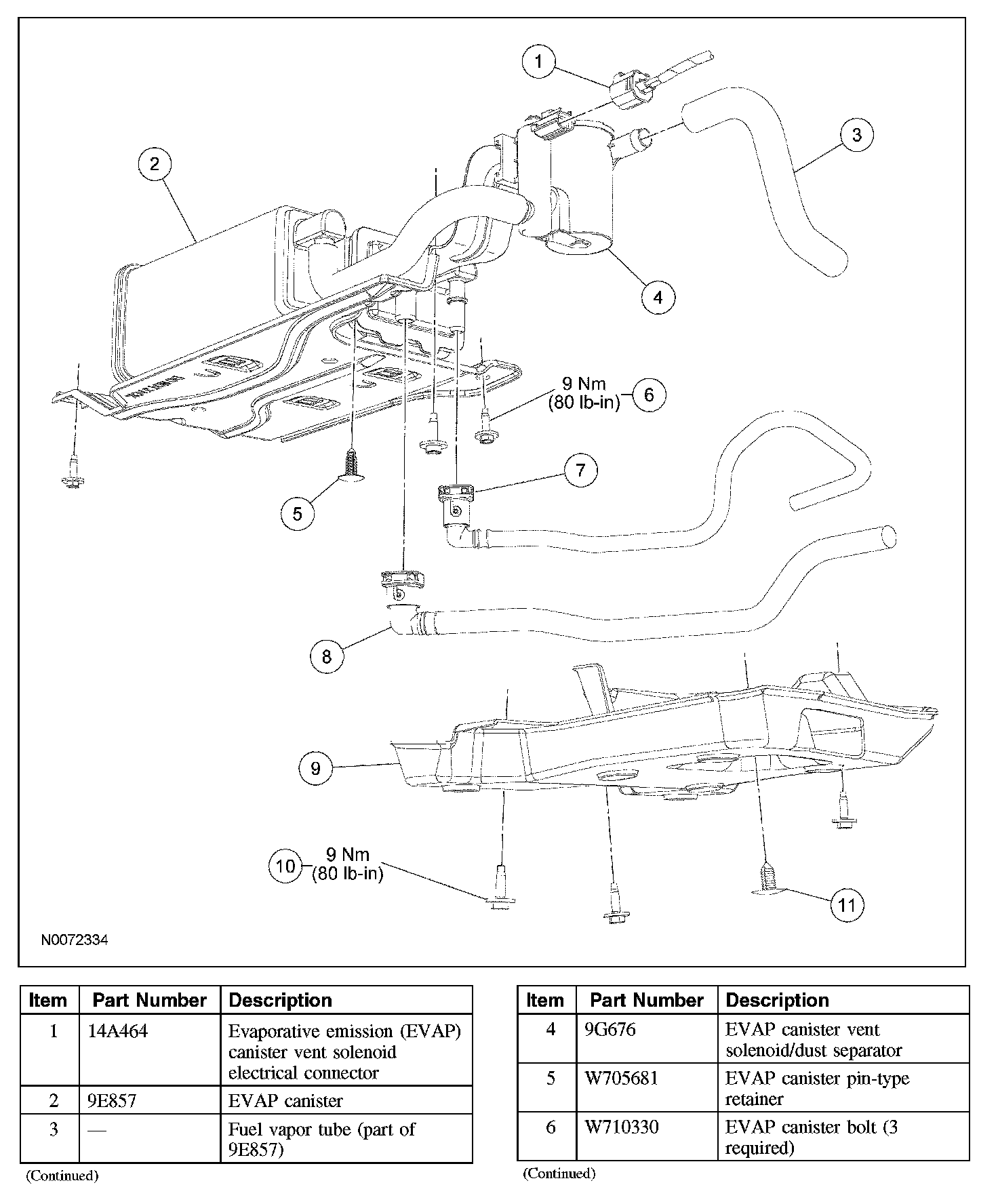
Part 2:
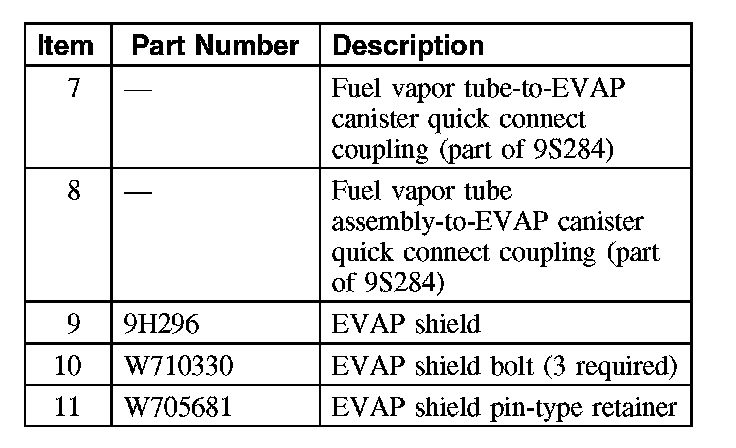
Removal and Installation
WARNING:
- Do not smoke, carry lighted tobacco or have an open flame of any type when working on or near any fuel-related component. Highly flammable mixtures are always present and may be ignited. Failure to follow these instructions may result in serious personal injury.
- Do not carry personal electronic devices such as cell phones, pagers or audio equipment of any type when working on or near any fuel-related component. Highly flammable mixtures are always present and may be ignited. Failure to follow these instructions may result in serious personal injury.
1. NOTE: Correct placement of the hoist arm to the frame lifting point is essential for the removal and installation of the evaporative emission (EVAP) canister.
With the vehicle in NEUTRAL, position it on a hoist.
2. Disconnect the battery ground cable.
3. Remove the 3 bolts, pin-type retainer and the EVAP shield.
- To install, tighten to 9 Nm (80 lb-in).
4. Disconnect the EVAP canister vent solenoid electrical connector.
5. Disconnect the fuel vapor tube-to-EVAP canister quick connect coupling.
6. Disconnect the fuel vapor tube assembly-to-EVAP canister quick connect coupling.
7. Disconnect the fuel vapor tube to the dust separator.
8. Remove the 3 EVAP canister bolts.
- To install, tighten to 9 Nm (80 lb-in).
9. Release the pin-type retainer and remove the EVAP canister.
10. NOTE: When installing the EVAP canister, insert the alignment tab into the body first, then install the pin-type retainer and 3 bolts.
To install, reverse the removal procedure.
- Carry out the Evaporative Emission System Leak Test. Testing and Inspection
- Carry out the EVAP repair verification drive cycle.