Pinpoint Test F: The Liftgate Glass Latch Release Is Inoperative/Does Not Operate Correctly
Locks, Latches and Entry Systems

Pinpoint Tests
Pinpoint Test F: The Liftgate Glass Latch Release Is Inoperative/Does Not Operate Correctly
Refer to Wiring Diagram Set 117, Remote Keyless Entry and Alarm for schematic and connector information. Diagrams By Number
Normal Operation
The Smart Junction Box (SJB) does not release the liftgate glass unless the doors have been unlocked electronically or the request is initiated from an Integrated Keyhead Transmitter (IKT).
The SJB sends a voltage signal to the liftgate glass release switch through circuit CPL60 (BN/YE). When the switch is pressed, the signal is routed to ground through circuit GD150 (BK/WH). When the SJB detects a request from the liftgate glass release switch, the SJB provides voltage to the liftgate glass latch release motor (integral to the liftgate glass latch) through circuit CPL59 (BN/BU). Ground for the liftgate glass latch is provided through circuit GD150 (BK/WH).
The liftgate glass release input circuit CPL60 (BN/YE) changes to circuit 1760 (WH/VT), and the ground circuit GD150 (BK/WH) changes to circuit 57 (BK) in the 13412 wiring harness.
- DTC B2667 (Liftglass Release Switch Circuit Failure) - a continuous and on-demand DTC that sets when the SJB detects a short to ground on the liftgate glass release switch input circuit. This DTC may also set if the liftgate glass release switch is pressed for longer than 2 minutes.
This pinpoint test is intended to diagnose the following:
- Wiring, terminals or connectors
- Liftgate glass release switch
- Liftgate glass release motor (integral to the liftgate glass latch)
- SJB
PINPOINT TEST F: THE LIFTGATE GLASS LATCH RELEASE IS INOPERATIVE/DOES NOT OPERATE CORRECTLY
NOTICE: Use the correct probe adapter(s) when making measurements. Failure to use the correct probe adapter(s) may damage the connector.
NOTE: Failure to disconnect the battery when instructed will result in false resistance readings. Refer to Battery.
-------------------------------------------------
F1 CHECK THE DOOR LOCK OPERATION
- Lock and unlock the doors using a door lock control switch.
- Do the door locks operate correctly?
Yes
GO to F2.
No
Go To Pinpoint Test A. Pinpoint Test A: All Door Locks Are Inoperative
-------------------------------------------------
F2 CHECK THE RECORDED SJB DTCs FROM THE SELF-TEST
- Check the recorded results from the SJB self-test.
- Is DTC B2667 present?
Yes
GO to F3.
No
GO to F5.
-------------------------------------------------
F3 CHECK THE LIFTGATE GLASS RELEASE SWITCH (SHORT TO GROUND)
- Disconnect: Liftgate Glass Release Switch C4039.
- Clear the DTC and carry out the SJB self-test.
- Is DTC B2667 still present?
Yes
GO to F4.
No
INSTALL a new liftgate glass release switch.
-------------------------------------------------
F4 CHECK THE LIFTGATE GLASS RELEASE SWITCH INPUT CIRCUIT FOR A SHORT TO GROUND
- Ignition OFF.
- Disconnect: SJB C2280c.
- Measure the resistance between the liftgate glass release switchC4039-2, circuit 1760 (WH/VT), harness side and ground.

- Is the resistance greater than 10,000 ohms?
Yes
GO to F14.
No
REPAIR the circuit. CLEAR the DTCs. REPEAT the self-test.
-------------------------------------------------
F5 MONITOR THE LIFTGATE GLASS RELEASE SWITCH PID
- Ignition ON.
- Enter the following diagnostic mode on the scan tool: SJB DataLogger.
- Monitor the SJB liftgate glass release switch PID (LIFTGLASS_SW) while pressing the liftgate glass release switch.
- Does the PID indicate the liftgate release switch is active?
Yes
GO to F9.
No
GO to F6.
-------------------------------------------------
F6 CHECK THE LIFTGATE GLASS RELEASE SWITCH
- Disconnect: Liftgate Glass Release Switch C4039.
- Unlock the doors with the door lock control switch.
- Connect a fused jumper wire between the liftgate glass release switch C4039-2, circuit 1760 (WH/VT), harness side and the liftgate glass release switch C4039-1, circuit 57 (BK), harness side.

- Does the liftgate glass latch release?
Yes
INSTALL a new liftgate glass release switch. TEST the system for normal operation.
No
REMOVE the jumper wire. GO to F7.
-------------------------------------------------
F7 CHECK THE GROUND CIRCUIT TO THE SWITCH FOR AN OPEN
- Ignition OFF.
- Disconnect: Negative Battery Cable.
- Measure the resistance between the liftgate glass release switchC4039-1, circuit 57 (BK), harness side and ground.

- Is the resistance less than 5 ohms?
Yes
GO to F8.
No
REPAIR the circuit. TEST the system for normal operation.
-------------------------------------------------
F8 CHECK LIFTGATE GLASS RELEASE SWITCH INPUT CIRCUIT CPL60 (BN/YE) FOR AN OPEN
- Connect a fused jumper wire between the liftgate glass release switch C4039-2, circuit 1760 (WH/VT), harness side and the liftgate glass release switch C4039-1, circuit 57 (BK), harness side.
- Disconnect: SJB C2280c.
- Measure the resistance between the SJB C2280c-20, circuit CPL60 (BN/YE), harness side and ground.

- Is the resistance less than 5 ohms?
Yes
GO to F14.
No
REPAIR the circuit. TEST the system for normal operation.
-------------------------------------------------
F9 CHECK FOR A SHORT TO VOLTAGE TO THE LIFTGATE GLASS LATCH
- Disconnect: Liftgate Glass Latch C4040.
- Measure the voltage between the liftgate glass latch C4040-4, circuit CPL59 (BN/BU), harness side and ground.
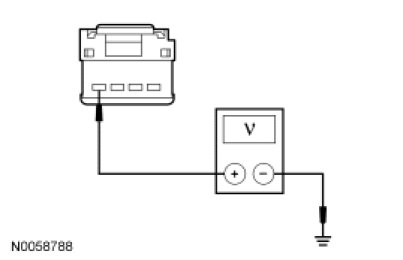
- Is any voltage present?
Yes
GO to F10.
No
GO to F11.
-------------------------------------------------
F10 CHECK CIRCUIT CPL59 (BN/BU) FOR A SHORT TO VOLTAGE
- Ignition OFF.
- Disconnect: SJB C2280d.
- Ignition ON.
- Measure the voltage between the liftgate glass latch C4040-4, circuit CPL59 (BN/BU), harness side and ground.
- Is any voltage present?
Yes
REPAIR the circuit. TEST the system for normal operation.
No
GO to F14.
-------------------------------------------------
F11 CHECK FOR VOLTAGE TO THE LIFTGATE GLASS LATCH
- Ignition OFF.
- Unlock the doors with the door lock control switch.
- NOTE: The SJB only supplies voltage to the liftgate glass latch momentarily. It is important to monitor the meter while pressing the liftgate glass release switch.
- While pressing the liftgate glass release switch, measure the voltage between the liftgate glass latch C4040-4, circuit CPL59 (BN/BU), harness side and ground.
- Is the voltage momentarily greater than 10 volts?
Yes
GO to F13.
No
GO to F12.
-------------------------------------------------
F12 CHECK CIRCUIT CPL59 (BN/BU) FOR AN OPEN
- Disconnect: SJB C2280e.
- Measure the resistance between the SJB C2280e-31, circuit CPL59 (BN/BU), harness side and the liftgate glass latch C4040-4, circuit CPL59 (BN/BU), harness side.
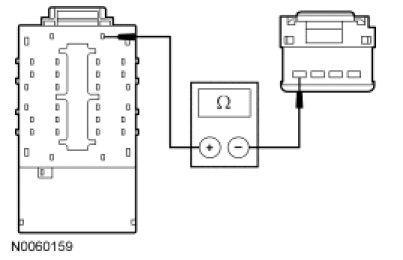
- Is the resistance less than 5 ohms?
Yes
GO to F14.
No
REPAIR the circuit. TEST the system for normal operation.
-------------------------------------------------
F13 CHECK THE GROUND CIRCUIT TO THE LATCH FOR AN OPEN
- Disconnect: Negative Battery Cable.
- Measure the resistance between the liftgate glass latch C4040-3, circuit GD150 (BK/WH), harness side and ground.
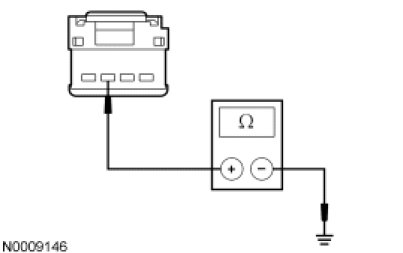
- Is the resistance less than 5 ohms?
Yes
INSTALL a new liftgate window latch. REFER to Liftgate Latch - Window Liftgate Latch - Window. TEST the system for normal operation.
No
REPAIR the circuit. TEST the system for normal operation.
-------------------------------------------------
F14 CHECK FOR CORRECT SJB OPERATION
- Disconnect all the SJB connectors.
- Check for:
- corrosion
- damaged pins
- pushed-out pins
- Connect all the SJB connectors and make sure they seat correctly.
- Operate the system and verify the concern is still present.
- Is the concern still present?
Yes
INSTALL a new SJB. TEST the system for normal operation.
No
The system is operating correctly at this time. The concern may have been caused by a loose or corroded connector.
-------------------------------------------------