Technician Safety Information
TECHNICIAN SAFETY INFORMATIONWARNING: ENGINES PRODUCE CARBON MONOXIDE THAT IS ODORLESS, CAUSES SLOWER REACTION TIME, AND CAN LEAD TO SERIOUS INJURY. WHEN THE ENGINE IS OPERATING, KEEP SERVICE AREAS WELL VENTILATED OR ATTACH THE VEHICLE EXHAUST SYSTEM TO THE SHOP EXHAUST REMOVAL SYSTEM.
Set the parking brake and block the wheels before testing or repairing the vehicle. It is especially important to block the wheels on front-wheel drive vehicles; the parking brake does not hold the drive wheels.
When servicing a vehicle always wear eye protection and remove any metal jewelry such as watchbands or bracelets that might make an inadvertent electrical contact.
When diagnosing an antilock brake or speed proportional steering system problem, it is important to follow approved procedures where applicable. Following these procedures is very important to the safety of individuals diagnostic tests.
Some components of the antilock brake or speed proportional steering system are intended to be serviced in assembly only. Attempting to remove or repair certain system sub-components may result in personal injury and/or improper system operation. Only those components with approved repair and installation procedures should be serviced.
DRBIII SAFETY INFORMATION
WARNING: EXCEEDING THE LIMITS OF THE DRB MULTIMETER IS DANGEROUS. IT CAN EXPOSE YOU TO SERIOUS OR POSSIBLY FATAL INJURY. CAREFULLY READ AND UNDERSTAND THE CAUTIONS AND THE SPECIFICATION LIMITS.
^ Follow the vehicle manufacturer's service specifications at all times.
^ Do not use the DRBIII(r) if it has been damaged.
^ Do not use the test leads if the insulation is damaged or if metal is exposed.
^ To avoid electrical shock, do not touch the test leads, tips or the circuit being tested.
^ Choose the proper range and function for the measurement. Do not try voltage or current measurements that may exceed the rated capacity.
^ Do not exceed the limits shown in the table below:
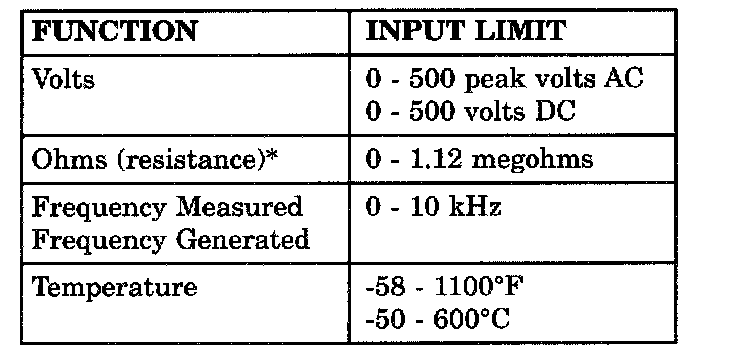
* Ohms cannot be measured if voltage is present. Ohms can be measured only in a non-powered circuit.
^ Voltage between any terminal and ground must not exceed 500v DC or 500v peak AC.
^ Use caution when measuring voltage above 25v DC or 25v AC.
^ Use the low current shunt to measure circuits up to 10A. Use the high current clamp to measure circuits exceeding 10A.
^ When testing for the presence of voltage or current, make sure the meter is functioning correctly. Take a reading of a known voltage or current before accepting a zero reading.
^ When measuring current, connect the meter in series with the load.
^ Disconnect the live test lead before disconnecting the common test lead.
^ When using the meter function, keep the DRBIII away from spark plug or coil wires to avoid measuring error from outside interference.