Fuel Tank: Testing and Inspection
FUEL TANK INSPECTION [L5]
CAUTION:
- Disconnecting/connecting the quick release connector without cleaning it may cause damage to the fuel pipe and quick release connector. Always clean the quick release connector joint area before disconnecting/connecting using a cloth or soft brush, and make sure that it is free of foreign material.
NOTE:
- This inspection is for fuel shut-off valve and rollover valve integrated in the fuel tank.
1. Complete the "BEFORE SERVICE PRECAUTION". Before Service Precaution
2. Disconnect the negative battery cable. Removal and Replacement
3. Remove the fuel tank. (See Service and Repair.)
4. Perform the following procedure to verify the fuel tank airtightness.
a. Plug the fuel pump unit pipe, ports A and C.
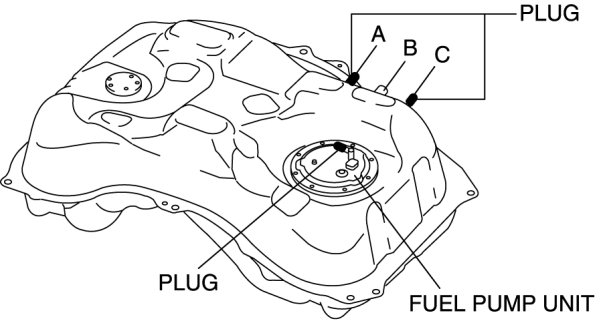
b. Apply a pressure of 3 kPa {22 mmHg, 0.8 inHg} to port B and wait for a while.
c. Verify that there is no air leakage from the fuel tank.
- If there is airflow, replace the fuel tank. (See Service and Repair.)
5. Plug the fuel pump unit pipe and port A.
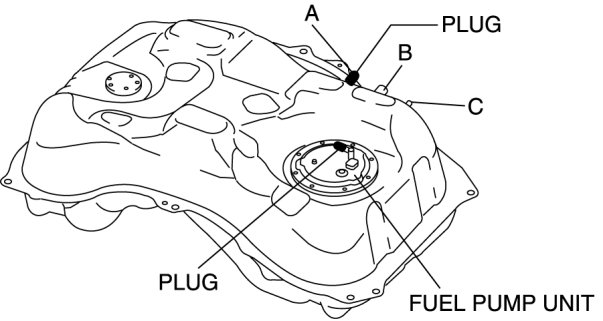
6. Level the fuel tank.
7. Apply a pressure of 3 kPa {22 mmHg, 0.8 inHg} to port B and wait for a while.
8. With the pressure still applied, verify that there is airflow from port C and the pressure is 0-3 kPa {0-22 mmHg, 0-0.8 inHg}.
- If there is no airflow, replace the fuel tank. (See Service and Repair.)
9. Apply a pressure of −0.5 kPa {−3.7 mmHg, −0.1 inHg} to port B and wait for a while.
10. With the pressure still applied, verify that there is airflow from port C and the pressure is −0.5-0 kPa {−3.7-0 mmHg, −0.1-0 inHg}.
- If there is no airflow, replace the fuel tank. (See Service and Repair.)
- If there is airflow, place the fuel tank upside down.
11. Plug the fuel pump unit pipe and port C.
12. Apply a pressure of 3 kPa {22 mmHg, 0.8 inHg} to port B and wait for a while.
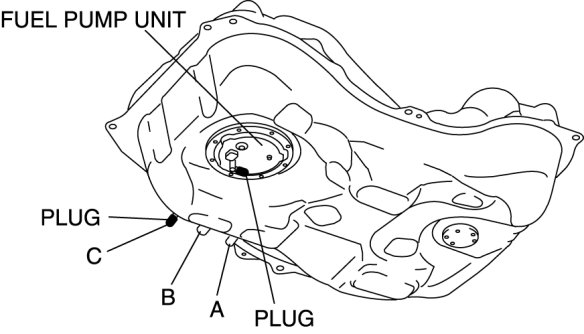
13. With the pressure still applied, verify that there is no airflow from port A.
- If there is airflow, replace the fuel tank. (See Service and Repair.)