Initial Inspection and Diagnostic Overview
EVAPORATIVE EMISSION SYSTEM
Inspection/Verification
1. Verify the customer concern is with the evaporative emission (EVAP) system.
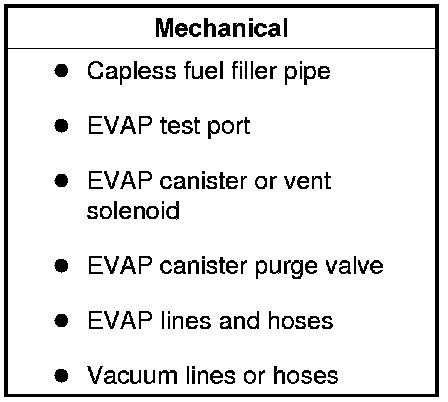
2. Visually inspect for the following obvious signs of mechanical damage.
Visual Inspection Chart
3. If the concern remains after the inspection, connect the IDS or equivalent tester to the data link connector (DLC) located beneath the instrument panel and select the vehicle to be tested from the IDS or equivalent tester menu. If the IDS or equivalent tester does not communicate with the vehicle:
a. check that the program card is correctly installed.
b. check the connections to the vehicle.
c. check the ignition switch position.
4. If the IDS or equivalent tester still does not communicate with the vehicle, see the IDS or equivalent tester manual.
5. Carry out the data link diagnostics test. If the IDS or equivalent tester responds with:
a. CKT914, CKT915 or CKT70 = ALL ECUS NO RESP/NOT EQUIP, see Communications Network - Control System.
b. NO RESP/NOT EQUIP for PCM. See Pinpoint Test 1: The PCM Does Not Respond To The Scan Tool.
c. SYSTEM PASSED, retrieve and record the continuous DTCs, erase the continuous DTCs and carry out the PCM KOEO self-test.
6. If the DTCs retrieved are related to the concern, see - PCM - DTC Index.
7. If the concern remains after the inspection carry out the leak test, see Component Tests and General Diagnostics and the repair verification drive cycle, see Evaporative Emission Repair Verification Drive Cycle.